
A website redesign south africa project is worth doing when your site is slow, dated, hard to edit, or not bringing in business — but the real skill is relaunching without losing the rankings you already have. A redesign that looks better but tanks your search visibility is a step backwards. For the wider build context, see our web design guide; this page covers when to redesign and how to do it safely.
That second part is where most redesigns go wrong. Teams focus on colours and layouts and forget that changing or dropping URLs without proper redirects can erase years of SEO progress overnight. Done well, a redesign refreshes the brand and improves results; done carelessly, it trades a tired site for a beautiful one that nobody finds.
Quick Answer
Redesign your website when it is slow, not mobile-friendly, hard to edit, off-brand, or failing to generate leads. The critical rule is to protect your existing rankings: audit your current URLs, map every old page to a new one with a 301 redirect, keep your best content and metadata, test on a staging site, and monitor closely after launch. Get that right and a redesign lifts both looks and traffic.
Thinking about a redesign but worried about losing your rankings? Let us de-risk it.
Get a Free Redesign AssessmentWhen to Redesign Your Website
You should consider a website redesign when the site is actively working against the business rather than for it. The clearest triggers are a slow or clunky experience, a design that no longer matches the brand, a site that does not work properly on phones, and pages that attract visitors but fail to turn them into enquiries or sales.
There are practical triggers too. If the site is painful to update, locking you into a developer for every small change, that alone justifies a rebuild on a more editable platform. A rebrand, a shift in what the business offers, or a site built years ago on outdated technology are all sound reasons to start fresh rather than patch endlessly.
What is not a good reason, on its own, is boredom. "I'm tired of how it looks" feels urgent but is the weakest case for spending money — especially if the current site ranks and converts. The strongest redesigns fix a real problem with speed, mobile, editability, or conversion, not just a cosmetic itch.
It also helps to weigh the cost of doing nothing. A site that loads slowly or fails on mobile is quietly losing enquiries every month, and that lost business often dwarfs the cost of fixing it.
If you can point to visitors arriving and leaving without converting, or to a site nobody can update without calling a developer, the redesign is usually paying for itself in recovered opportunities well before the rebuild is even finished. Framing it as recovered revenue, not just spend, makes the decision far clearer than agonising over colours and layouts.
The Real Triggers for a Redesign
Redesign when the site is slow, not mobile-friendly, off-brand, hard to edit, or failing to convert visitors into enquiries — these are real business problems. A rebrand or outdated technology also qualifies. Pure boredom with the look is the weakest reason, particularly if the current site already ranks and converts. Fix a problem, not just an appearance.
Website Redesign South Africa: How to Relaunch Without Losing Rankings
The single most important part of any website redesign south africa project is protecting the search rankings the current site already holds. According to Google's site move and redirect guidance, permanent 301 redirects from old URLs to their new equivalents preserve ranking signals and do not cause a loss in authority — which is exactly why a redirect map is non-negotiable.
The safe sequence is straightforward but must be followed. Audit and list every existing URL, identify your highest-traffic and highest-converting pages, and keep their URLs unchanged wherever possible. Where URLs must change, map each old page to its closest new page and set a 301 redirect — never a temporary 302, and never a redirect chain.
Just as important is keeping what already works. Preserve your best content, page titles, meta descriptions, and headings rather than "designing them away", because those carry the ranking signals Google has tracked for years. Update internal links to point at the new URLs, refresh the XML sitemap, and test the whole thing on a staging site before it ever goes live.
The Redirect Rule That Saves Your Traffic
Map every old URL to a new one and use permanent 301 redirects — this is the step that preserves rankings and link equity through a redesign. Keep high-performing URLs unchanged where you can, retain your best content and metadata, update internal links, and test on staging first. Skipping the redirect map is the single most common way a redesign destroys hard-won traffic.
Want your redesign handled so the rankings come with you, not get left behind?
Get a Free Migration-Safe PlanThe Website Redesign Process, Step by Step
A sound redesign follows a clear sequence rather than jumping straight to design. It starts with discovery — understanding the business goals, the current site's strengths and weaknesses, and what the redesign must achieve — followed by a content and URL audit that feeds the redirect map described above.
From there the work moves through design, build, and rigorous testing on a staging environment. Speed and mobile performance are built in, not bolted on, and every redirect and internal link is checked before launch. The improvement in load time alone often justifies the project, which is why we treat site speed as a core deliverable rather than an afterthought.
Launch is not the finish line. The first days and weeks after going live are when issues surface, so the new site is monitored in Google Search Console for crawl errors and 404s, with redirects and rankings watched closely. A careful launch-and-monitor phase is what separates a smooth relaunch from a slow-motion traffic loss.
It is worth saying plainly that a website redesign south africa project lives or dies on this discipline — discovery, audit, redirect map, staging, and monitoring — not on the visual design alone.
The look matters, but it is the least risky part of the job. The parts that actually protect the business are the unglamorous ones: knowing every URL, redirecting every old page to its right destination, and watching the data closely in the weeks after the new site goes live.
What a Website Redesign Costs in South Africa
The cost of a redesign depends on the size of the site and the depth of the work, from a straightforward refresh of a small brochure site to a full rebuild of a large, content-heavy or ecommerce site. The detailed ranges sit in our web design pricing guide, but the same principle applies as with any build: the cheapest quote usually skips the migration care that protects your traffic.
That migration care is precisely where the value sits. A quote that includes a proper URL audit, a redirect map, content preservation, and post-launch monitoring costs more than one that simply rebuilds the pages — but it is the difference between keeping your rankings and paying twice when the traffic disappears and has to be rebuilt. Put plainly, a website redesign south africa project is only a bargain if it keeps the traffic it inherits.
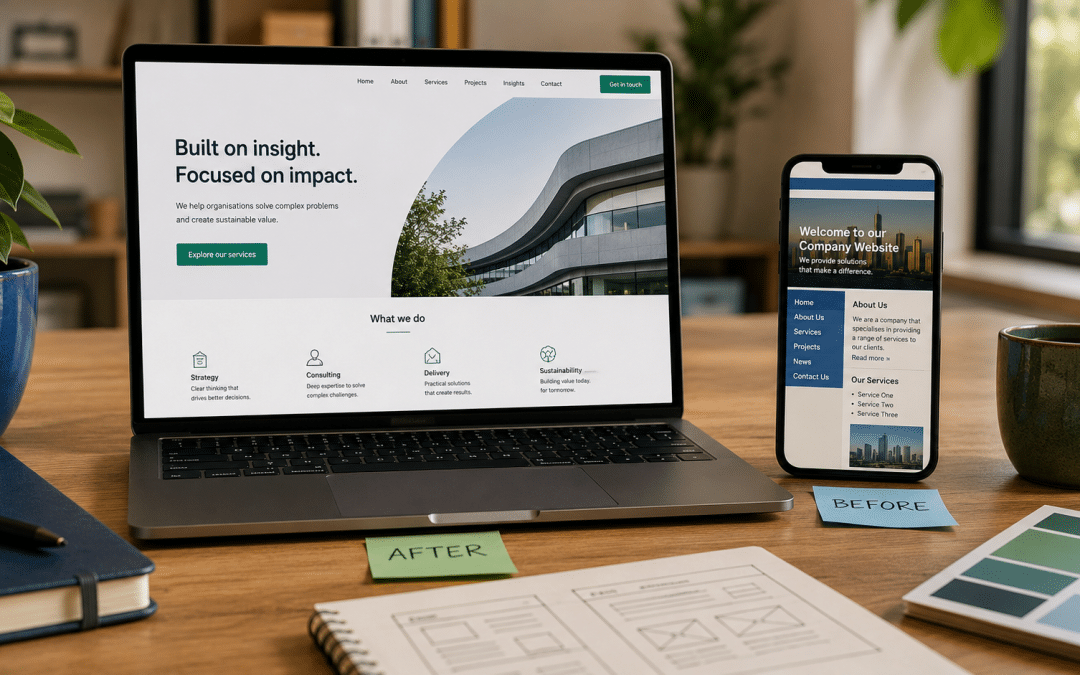
A Real-World Example: Before and After
The clearest illustration is a representative SA business that redesigned a slow, dated site the right way — with a full redirect map and content preserved. The new site was faster and far easier to convert on, and because every URL was mapped and redirected, rankings held through the move and then improved as speed and structure got better.
| Metric (monthly) | Before — dated, slow site | After — migration-safe redesign | Change |
|---|---|---|---|
| Mobile load time | 6.2s | 1.9s | −69% |
| Organic traffic retained | Baseline | 100% held at launch | No loss |
| Organic traffic (3 months on) | Baseline | +28% | +28% |
| Enquiries from the site | 18 | 47 | +161% |
| Bounce rate | Baseline | Markedly lower | Improved |
The line that matters is "organic traffic retained": the redesign held every bit of existing traffic at launch through the redirect map, then grew it as the faster, cleaner site did its work. Compare that to the common alternative — a redesign that drops URLs, loses a chunk of organic traffic overnight, and spends months clawing it back.
Held First, Grew Second
A migration-safe redesign retained 100% of organic traffic at launch, then grew it by nearly a third within three months as speed and structure improved — and enquiries more than doubled. The redirect map is what made the "no loss" possible. The alternative, a redesign without it, typically loses traffic on day one and spends months recovering ground it never needed to lose.
The GPM Differentiator
Most agencies treat a redesign as a design project and bolt SEO on at the end, if at all — which is exactly how rankings get lost. We come at it from an operator's seat, having scaled SA businesses where organic traffic was the pipeline, so our web design services build the URL audit, redirect map, and content preservation into the project from day one, not as an upsell after launch.
For redesign clients that means a faster, better-converting site that keeps the rankings it arrives with, with every old URL mapped and monitored through the move. You own the site, the domain, and the data, with no lock-in — and an honest answer when a targeted refresh of your current site would beat a full rebuild.
Who This Is NOT For
A migration-safe redesign suits most businesses with an established site, but not everyone. Being clear about that upfront saves wasted spend — so here is who should pause.
Anyone redesigning purely out of boredom. If the current site is fast, mobile-friendly, ranks, and converts, a full redesign may spend money to solve a problem you do not have. A targeted refresh of look and content is often the smarter, cheaper move than a rebuild that risks the rankings you already hold.
Businesses unwilling to budget for migration care. The redirect map, content preservation, and post-launch monitoring are what protect your traffic — and they cost more than a bare rebuild. If you want only the cheapest quote with none of that, this careful approach is not the fit, and the traffic loss usually costs more in the end.
Owners who cannot pause to plan the URL map. A safe relaunch needs a proper audit of existing pages before any design begins. If there is no time to map URLs and redirects and the site must go live immediately, the risk of losing rankings rises sharply — speed here is the enemy of a clean migration.
Brand-new businesses with no existing site. If you have no live site and no rankings to protect, this is not a redesign — it is a first build, and the migration-safety focus does not apply. A new build follows a different path, so the rankings-preservation emphasis here will not match your situation.
Want an honest read on whether to redesign or just refresh? Start free.
Get a Free Redesign ReviewFrequently Asked Questions
Will a website redesign hurt my Google rankings?
It can, if it is handled carelessly — but it does not have to. The danger comes from changing or dropping URLs without proper 301 redirects, which breaks the links Google has indexed. With a full URL audit, a redirect map, and preserved content and metadata, a redesign can hold your rankings through the move and then improve them as speed and structure get better.
How do I redesign a website without losing traffic?
Audit every existing URL, keep your highest-performing pages on the same URLs where possible, and map any changed URLs to their new equivalents with permanent 301 redirects. Preserve your best content, titles, and meta descriptions, update internal links, refresh the sitemap, test on a staging site, and monitor Search Console after launch. That sequence is what protects traffic through a redesign.
When should I redesign my website?
Redesign when the site is slow, not mobile-friendly, off-brand, hard to edit, or failing to convert visitors into enquiries, or when you have rebranded or outgrown outdated technology. These are real business problems worth solving. Being merely tired of the look, when the site still ranks and converts, is usually the weakest reason to spend on a full rebuild.
How much does a website redesign cost in South Africa?
It depends on the size of the site and the depth of the work, from a refresh of a small brochure site to a full rebuild of a large or ecommerce site. The detailed ranges are in our web design pricing guide. Be wary of the cheapest quote — it usually omits the URL audit, redirect map, and monitoring that protect your existing traffic.
Should I keep my old URLs when I redesign?
Wherever possible, yes. Search engines tie rankings to URLs, so keeping high-performing URLs unchanged is the safest path. Only change a URL structure when there is a clear reason, and when you do, map every old URL to its new destination with a 301 redirect. Unnecessary URL changes are one of the most common causes of lost rankings in a redesign.
How long does a website redesign take?
A small site refresh can take a few weeks, while a full rebuild of a larger or ecommerce site takes longer, through discovery, design, build, testing, and a careful launch. The timeline also depends on how quickly content and feedback come back from your side. A rushed launch that skips staging and redirect testing is where avoidable traffic loss happens.
If you are nervous that a redesign will undo the search visibility you have built, that caution is well placed — it is exactly the risk a careless rebuild creates. The answer is not to avoid redesigning but to do it migration-safe, so the new site keeps every ranking it arrives with and builds from there.
Get a Free Redesign Assessment
Tell us about your current site and we will map a migration-safe redesign — a URL audit, a redirect plan to protect your rankings, and the speed and conversion priorities that matter most — delivered as a one-page assessment you own outright. No obligation — we will get back to you within 24 hours.
Get My Free Redesign Assessment