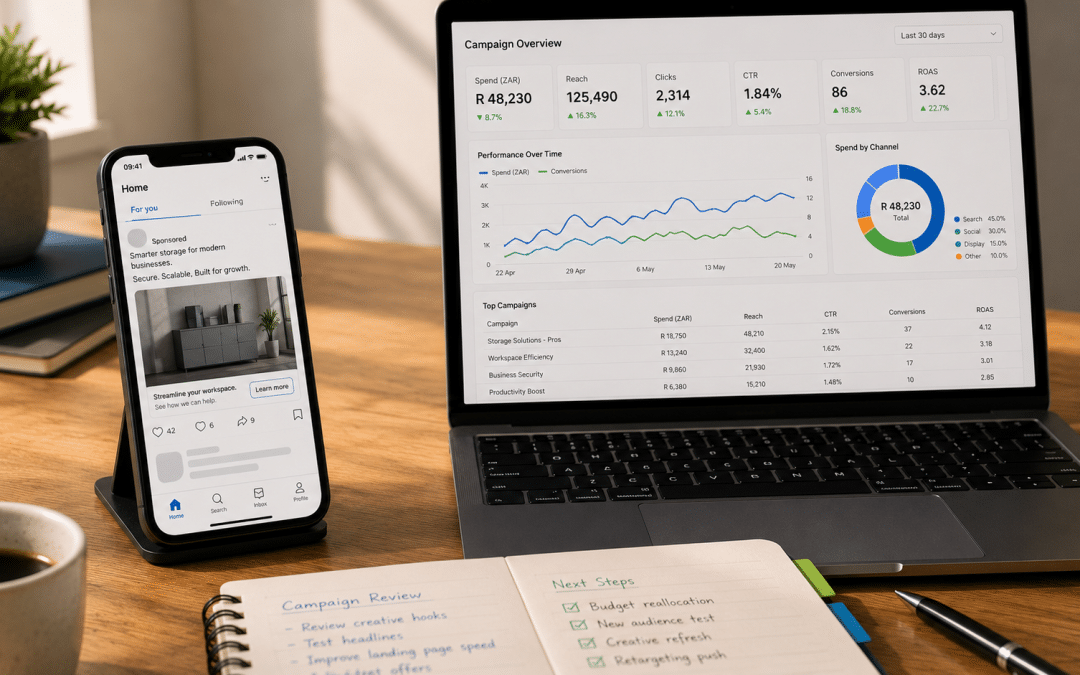
Meta ads south africa covers paid advertising across Facebook, Instagram, Messenger, and Threads — the channels that reach roughly 25 million-plus active SA users daily and remain the most cost-effective paid acquisition platform for most SA B2C and many B2B businesses in 2026.
Typical campaigns run on a cost-per-thousand-impressions (CPM) of R40 to R120 depending on industry and audience, with ecommerce return-on-ad-spend (ROAS) commonly landing between 3x and 5x once the account is structured. This guide is the complete operator reference for meta ads south africa in the local market.
It covers how the auction actually works, what campaigns cost in Rand, the targeting and creative that move the needle locally, how to measure ROAS honestly, and when paid social beats Google Ads for an SA business. For the paid-channel comparison, see our Google Ads South Africa guide; for the strategic foundation, our SA paid social strategy guide.
Quick Answer
Paid social on Meta's platforms works through a real-time auction: every time a user opens Facebook or Instagram, advertisers compete for that impression, and the winner is decided by bid, estimated action rate, and quality combined — not by bid alone.
For SA businesses, the practical levers are creative quality (the biggest lever), audience signal quality (pixel and Conversions API data), and offer strength. Costs run lower than US benchmarks: CPM R40-R120, CPC R2-R12 depending on objective and industry.
The decision rule for whether to invest: Meta's platforms suit visual products, impulse-friendly offers, broad consumer audiences, and lead-generation campaigns where the channel delivers 40-60% lower cost-per-lead than Google in many SA verticals. Per Meta's official ad auction documentation, the system pairs each advert with the people most likely to act — which means creative and audience signals matter more than raw budget.
Want a quick read on whether paid social is the right channel for your specific SA business — and what budget would actually move the needle?
Get a Free Channel Fit CallWhat Meta Ads South Africa Actually Covers
The term meta ads south africa refers to paid advertising run through Meta's platform — formerly Facebook Ads — which serves campaigns across Facebook, Instagram, Messenger, and Threads from a single Ads Manager account.
For local businesses, this is one platform reaching the largest combined social audience in the country, with granular control over who sees each advert and what action it drives. The platform is the dominant paid-social channel for local advertisers in 2026.
The strategic point most SA businesses miss: this isn't four separate channels to manage, it's one auction-driven system that places your advert wherever it will perform best across all four surfaces. You set the objective, audience, budget, and creative; the platform decides which placement — a Facebook feed, an Instagram Reel, a Stories slot — delivers your result most efficiently. Understanding that single-system logic is the foundation everything else builds on.
| Surface | Best For (SA Context) |
|---|---|
| Facebook Feed | Broad reach, older demographics, conversion campaigns, detailed offers |
| Instagram Feed + Reels | Visual products, younger SA audiences, brand building, impulse purchases |
| Stories (FB + IG) | Lower CPM awareness, full-screen creative, time-sensitive offers |
| Messenger | Conversational lead capture, re-engagement, click-to-message campaigns |
| Threads | Emerging placement, early-mover low-cost reach for SA brands testing it |
How the Meta Ads Auction Works in 2026
Every advert on the platform is placed through a real-time auction that runs billions of times daily — once for each opportunity to show someone an advert. The winner is not the highest bidder; it is the advert with the highest total value.
That value is calculated from three inputs combined: the bid, the estimated action rate (how likely this user is to take your desired action), and quality. This is the single most important meta ads south africa mechanic for any local advertiser to understand.
The practical implication is liberating for smaller SA budgets: a well-crafted advert with strong engagement signals can beat a bigger-spending competitor with a weak one. You are not simply buying your way to the top — you are competing on relevance. That is why creative quality and audience-signal quality matter more than raw spend, and why an SA business with a modest budget and excellent creative routinely outperforms a larger advertiser running lazy campaigns.
The Three Auction Inputs Explained
Your bid is what you are willing to pay for the outcome you have chosen — but it is only one of three factors. Estimated action rate is the platform's prediction of whether this specific user will do what you want, based on their past behaviour and how similar users responded.
Quality is the platform's assessment of your creative and landing experience, drawn from engagement signals and post-click behaviour. Strong performance on all three lowers your effective cost — the core economics of meta ads south africa.
The Auction Insight That Changes SA Budgets
Because the auction rewards relevance and engagement — not just bid size — the highest-leverage investment for most SA advertisers is creative, not budget. A business that improves its advert's estimated action rate and quality score will pay a lower CPM for the same audience, effectively stretching the same Rand budget further. Doubling creative quality often beats doubling spend.
This is why agencies that promise results purely through bigger budgets miss the point. The auction is designed so that better adverts cost less to deliver. The right move for a constrained SA budget is to invest in creative testing and audience-signal quality first, and scale spend only once the account is winning auctions efficiently. Spend amplifies a working system; it cannot rescue a weak one.
Meta Ads Cost in South Africa: Real Rand Benchmarks
Meta ads south africa costs run materially lower than US benchmarks, which is why SA businesses can achieve strong results on budgets that would barely register in North American markets. Where US CPMs commonly exceed the equivalent of R350-R400, SA CPMs typically land between R40 and R120 depending on industry, audience competition, and campaign objective. Understanding the real local figures prevents the budget misjudgement that comes from reading global pricing guides.
| Metric | Typical SA Range (2026) | What Drives It |
|---|---|---|
| CPM (cost per 1,000 impressions) | R40 - R120 | Industry competition, audience size, placement, season |
| CPC (cost per click) | R2 - R12 | Objective, creative quality, audience intent |
| Cost per lead (lead campaigns) | R35 - R250 | Vertical, offer strength, form length, follow-up speed |
| Ecommerce ROAS | 3x - 5x (8x+ top performers) | Product margin, creative, audience signal quality |
| Minimum viable monthly test budget | R6,000 - R12,000 | Needs enough volume for the algorithm to learn |
The seasonal pattern matters for SA planning: costs spike in November (Black Friday and festive-season competition) and reset lower in January, mirroring the global Q4 auction pressure. SA advertisers planning campaigns should budget for materially higher CPMs in the Black Friday window and treat January as the cheapest acquisition month of the year.
Trying to work out what a realistic monthly budget looks like for your SA business and target return?
Get a Free Budget ProjectionCampaign Objectives: Choosing the Right One
In meta ads south africa, the objective you select tells the platform what outcome to optimise for, and choosing the wrong one is the most common reason SA campaigns underperform. An advertiser who picks "traffic" when they want sales gets cheap clicks that never convert; one who picks "sales" with no conversion data starves the algorithm of signal. Matching the objective to your actual business goal is the foundation of a working account.
| Objective | When to Use It (SA Context) |
|---|---|
| Sales (conversions) | Ecommerce and direct-response — the default for revenue-driven SA campaigns once a pixel has data |
| Leads | Service businesses, B2B — instant forms or click-to-message; bridges to your sales pipeline |
| Engagement | Building audience and signal early; warming cold audiences before a conversion push |
| Awareness | Brand launches, broad reach at lowest CPM; rarely the right primary objective for SA SMEs |
| Traffic | Sending people off-platform; usually inferior to conversion objectives for revenue goals |
Targeting That Works for South African Audiences
Audience targeting within meta ads south africa has shifted significantly toward AI-driven broad targeting, where you give the algorithm strong conversion signals and let it find buyers rather than hand-picking narrow interests. For SA advertisers, the highest-performing setup in 2026 combines broad or Advantage+ audiences with high-quality pixel and Conversions API data — letting the platform's machine learning identify likely buyers across the local audience pool.
That said, SA-specific audience structure still matters. Custom audiences built from your own customer lists, website visitors, and engagement give the algorithm a seed of known-good buyers to model against. Lookalike audiences built from SA purchasers then expand reach to similar local users. The combination — strong first-party signal feeding broad AI targeting — consistently beats the old approach of stacking narrow interest filters.
The SA Targeting Shift Most Accounts Haven't Made
The biggest targeting mistake in SA accounts in 2026 is still running narrow, heavily-layered interest audiences as though it were 2021. The platform's AI now performs best with broad targeting fed by strong conversion signals — narrow manual targeting starves the algorithm of the room it needs to find buyers efficiently. Accounts that switch to broad-plus-signal routinely see CPMs fall and ROAS rise.
The prerequisite is signal quality: broad targeting only works if the pixel and Conversions API are sending clean conversion data. SA businesses with broken or partial tracking get the worst of both worlds — broad targeting with no signal to guide it. Fix the tracking first, then let broad targeting do its job. The order is non-negotiable.
Creative: The Biggest Lever in South African Paid Social
Creative is the single biggest performance lever in meta ads south africa, full stop — more than budget, more than targeting, more than bid strategy. Because the auction rewards engagement and estimated action rate, a stronger advert literally costs less to deliver. For SA businesses, this means the highest-ROI investment is usually a disciplined creative-testing process, not a bigger media budget.
The creative that performs in the SA market shares common traits: mobile-first vertical format (most SA users are on mobile), a hook in the first two seconds, locally relevant context (Rand pricing, SA settings, local pain points), and a clear single call to action. Generic global creative pasted into an SA campaign consistently underperforms locally-grounded creative that speaks to the actual South African buyer.
A Practical SA Creative Testing Cadence
The winning approach is systematic, not inspired: launch 3-5 creative variations per campaign, let the auction allocate spend to the strongest, kill the underperformers, and feed the learnings into the next batch. This continuous-improvement loop — not a single "perfect" advert — is how SA accounts compound performance over time. Most businesses that struggle with paid social simply never built a creative-testing rhythm.
Measuring ROAS Honestly in the SA Market
For meta ads south africa, return on ad spend is the metric that matters most, but it is also the one most often measured dishonestly in SA accounts. Platform-reported ROAS overstates true performance because it credits conversions to the platform that would have happened anyway and uses attribution windows that flatter the channel. The honest measure blends platform data with your actual revenue and a realistic view of incrementality.
For SA ecommerce, a platform-reported ROAS of 3x-5x is a reasonable target once the account is structured and the pixel has data — but the operator question is always "what is the incremental return?" — the revenue the campaign genuinely caused, not merely tracked. Businesses that scale on platform-reported ROAS alone often discover the real number is lower; businesses that measure incrementality scale with confidence.
| ROAS Reading | SA Interpretation |
|---|---|
| Below 1.5x | Usually unprofitable after product cost — fix creative, offer, or tracking before scaling |
| 2x - 3x | Workable for high-margin SA products; thin for low-margin — depends on unit economics |
| 3x - 5x | Healthy target range for most structured SA ecommerce accounts |
| 5x - 8x+ | Strong performance — usually strong creative plus clean signal plus good offer combined |
Meta Ads vs Google Ads for South African Businesses
The platform and Google Ads serve different intent, and the right answer for most SA businesses is "both, in sequence" rather than "one or the other." Google Ads captures existing demand — people actively searching for what you sell — while paid social creates demand by putting compelling offers in front of people who were not searching. For SA businesses with a defined budget, the sequencing question matters more than the either-or one.
As a rule of thumb for the SA market: if people are already searching for your product or service in volume, Google Ads captures that intent efficiently and should usually come first. If your product benefits from visual demonstration, impulse appeal, or audience-building, paid social creates demand that search cannot. Lead-generation campaigns in particular often deliver 40-60% lower cost-per-lead on Meta's platform than on Google in SA verticals — a meaningful gap for service businesses.
The Channel-Sequencing Logic for SA Budgets
For a constrained SA budget, the decision is not Meta versus Google — it is which channel matches your demand reality. Existing high-intent search demand favours Google first; demand that must be created, or visual or impulse products, favour paid social. Most growing SA businesses end up running both, with the split determined by where the marginal Rand earns the best return at their stage.
The practical sequence for many SA SMEs: start with whichever channel matches your strongest demand signal, prove return, then add the second channel to capture the demand the first cannot. Running both badly on a small budget usually beats running neither well — but running one well first beats splitting a thin budget across two underfunded accounts.
How Growth Pulse Media Approaches Meta Ads
Most SA meta ads south africa agencies sell on budget and reporting dashboards — bigger spend, more impressions, prettier charts — while the actual performance lever, creative quality fed into a clean signal system, goes underinvested.
The right approach treats the account as an auction-competition problem: win auctions efficiently through strong creative and clean conversion signal first, then scale spend into a system that is already working rather than throwing budget at one that is not.
Dirk built and ran a real SA ecommerce business that depended on paid social for customer acquisition — direct experience structuring accounts, testing creative, fixing tracking, and scaling spend only once the unit economics held.
That operator seat applied to your meta ads south africa campaigns produces decisions grounded in what drives profitable return in the local market, not vanity reach metrics. The work is run in-house, with the same discipline applied to a R10,000 budget as a R100,000 one.
SA businesses ready to run paid social as a profit channel rather than a cost centre can use our digital marketing service, which covers account structure, creative testing, pixel and Conversions API setup, audience strategy, and honest ROAS measurement. We pair campaign management with the strategic framework from SA paid social strategy and the channel-mix view from SA Google Ads.
Who Meta Ads Is NOT For
Paid social is a powerful channel for the right SA business, but it is genuinely the wrong first move for some. Here is who should look elsewhere or fix prerequisites before investing.
Businesses with no working conversion tracking: The platform's AI targeting and optimisation depend entirely on clean conversion signal from the pixel and Conversions API. SA businesses that launch campaigns before their tracking works are flying blind — the algorithm has no signal to optimise against, budget gets wasted on the wrong audiences, and the account never learns. Fix tracking first; campaigns second. There is no shortcut around this prerequisite.
Pure high-intent search businesses on a tiny budget: If your customers are actively searching for exactly what you sell and your budget only stretches to one channel, Google Ads usually captures that existing intent more efficiently than paid social creates new demand. Splitting a sub-R6,000 monthly budget across both channels typically underfunds both. Match the single channel to your demand reality first.
Businesses expecting profit from week one: Paid social accounts need a learning phase — the algorithm requires conversion volume to optimise, and creative testing takes iterations to find winners. SA businesses expecting positive ROAS in the first two weeks consistently pull campaigns before they stabilise. Budget for a 4-8 week ramp to reliable performance, not an instant return.
Operations unwilling to invest in creative: Because creative is the biggest performance lever, businesses that refuse to produce and test multiple creative variations cap their results regardless of budget or targeting. SA advertisers who run one tired creative for months and blame the platform have misdiagnosed the problem. If you will not invest in creative testing, paid social will underperform for you specifically.
Wondering whether your SA business meets the prerequisites for paid social to actually pay off — or whether something needs fixing first?
Get a Free Readiness CheckThe discipline carrying all of this is treating the platform as an auction-competition system rather than a budget-spending exercise. The advertisers who win in the SA market are the ones who feed the auction strong creative and clean signal, measure return honestly, and scale spend only into a system that is already proven to work. The budget is the amplifier, never the strategy.
The 2026 SA market rewards this discipline more than ever: AI-driven targeting and Advantage+ campaigns mean signal quality and creative now determine performance more than manual targeting ever did, and CPMs that rose globally still leave SA among the more cost-effective markets for paid social. The binding constraint remains operator discipline — clean tracking, systematic creative testing, honest measurement, and patient scaling rather than the spend-first, measure-loosely approach that wastes most SA paid-social budgets.
Frequently Asked Questions
How much do Meta ads cost in South Africa?
SA costs run lower than US benchmarks: CPM (cost per 1,000 impressions) typically R40-R120, CPC (cost per click) R2-R12, and cost per lead R35-R250 depending on industry, objective, and creative quality. A realistic minimum monthly test budget is R6,000-R12,000 — enough volume for the algorithm to learn. Costs spike in November for Black Friday and reset lowest in January.
Are Meta ads or Google Ads better for South African businesses?
They serve different intent. Google Ads captures existing search demand; paid social creates demand through compelling offers shown to people who were not searching. For SA businesses, the right answer is usually both in sequence — start with the channel matching your strongest demand signal, prove return, then add the second. Lead-generation campaigns often deliver 40-60% lower cost-per-lead on Meta's platform than Google in SA verticals.
What is a good ROAS for Meta ads in South Africa?
For most structured SA ecommerce accounts, a platform-reported return on ad spend of 3x-5x is a healthy target once the pixel has data, with top performers reaching 8x or more. Below 1.5x is usually unprofitable after product cost. The important caveat: platform-reported ROAS overstates true performance, so the operator question is always the incremental return — the revenue the campaign genuinely caused, not merely tracked.
How much budget do I need to start Meta ads in South Africa?
A realistic minimum viable test budget is R6,000-R12,000 per month — enough conversion volume for the platform's algorithm to exit the learning phase and optimise. Below that, the account rarely gathers enough signal to perform reliably. The budget should fund a 4-8 week ramp to stable performance, not an expectation of instant profit. Creative testing within that budget matters more than the raw figure.
Do Meta ads still work in South Africa in 2026?
Yes — Meta's platforms reach roughly 25 million-plus active SA users and remain the most cost-effective paid-social channel for most South African B2C and many B2B businesses. The 2026 shift is toward AI-driven targeting and Advantage+ campaigns, where creative quality and clean conversion signal drive performance more than manual targeting. Accounts that adapt to broad targeting fed by strong signal outperform those still running narrow 2021-era interest stacks.
What's the biggest mistake South African businesses make with Meta ads?
The biggest mistake is under-investing in creative while over-investing in budget. Because the auction rewards engagement and estimated action rate, a stronger advert costs less to deliver — so creative is the highest-leverage investment, not spend. The second most common error is launching campaigns before conversion tracking (pixel and Conversions API) works, which leaves the algorithm with no signal to optimise against.
Ready Running Meta Ads as a Profit Channel in South Africa?
Growth Pulse Media structures and runs paid-social campaigns for SA businesses across ecommerce, B2B, and local services — account structure, creative testing, pixel and Conversions API setup, audience strategy, and honest incremental-ROAS measurement. Real operator experience scaling paid social for an SA business through every algorithm shift. In-house execution, limited client load, no outsourcing. No obligation — we reply within 24 hours.
Get Your Free Meta Ads Strategy Call