
 Add to Preferred Sources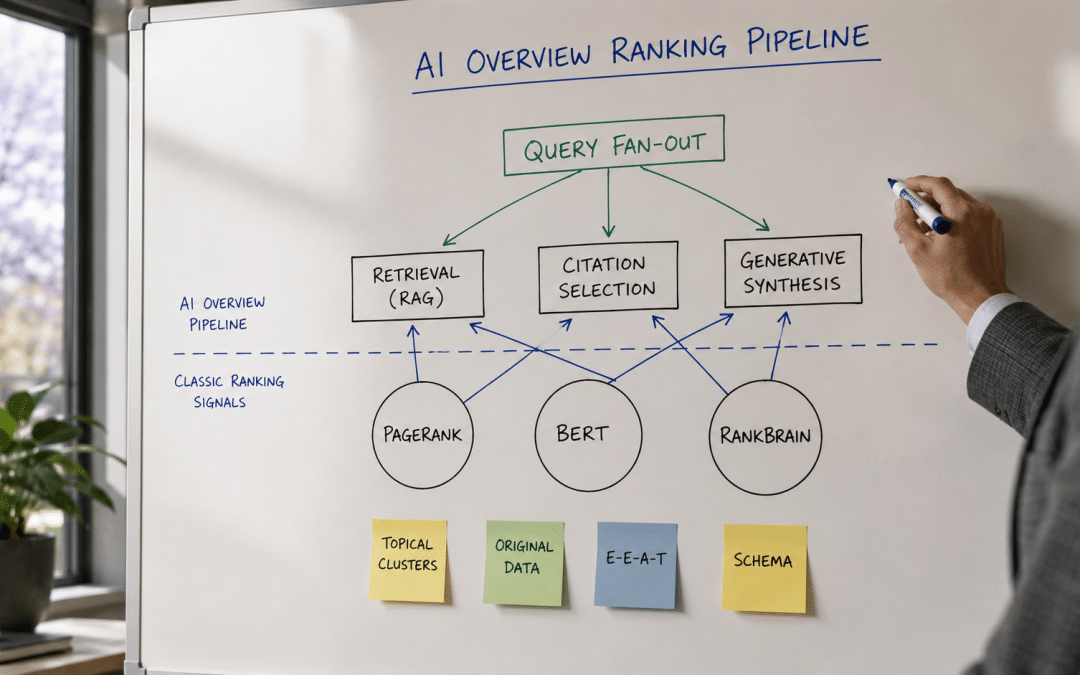
For ai seo south africa operators ranking through the AI Overview era, the work has shifted from optimising for blue-link clicks to optimising for citation extraction inside generative answers.
Informational queries lose 30-50% of click-through traffic to AI-summarised results; commercial and transactional queries remain largely untouched. The winning play for South African businesses is not abandoning the work — it's restructuring content for both citation and click, with topical clusters and original data carrying the long-term advantage.
This guide breaks down what generative search actually does to SA rankings, the six shifts the new era forces on content strategy, what still wins after AI Overviews show, and what now wastes budget. For broader cluster context, see the South African search pillar; for the cluster-specific work, see our content strategy guide.
Quick Answer
Generative search era ranking in SA hinges on six concrete shifts: (1) Topical depth beats single-page optimisation — clusters with 12-20 interconnected posts win citation slots that isolated pages cannot reach; (2) Original first-party data (real numbers, real benchmarks, real before/after) becomes the highest-value content format because generative answers cite primary sources, not aggregators; (3) Click-through patterns invert — top-of-funnel informational queries lose traffic, mid-funnel and commercial queries gain time-on-page from pre-qualified visitors.
The remaining three shifts for the ai seo south africa practitioner: (4) E-E-A-T signals (named author, named expertise, verifiable credentials) become citation gatekeepers — anonymous content gets less reliably surfaced.
And (5) Structured answer extraction (definitional opening sentence, table data, FAQ schema) directly determines whether a page is liftable for citation; (6) Brand authority and direct visits become measurable rank inputs as Google triangulates beyond clicks. Per Google's official AI optimization guide, the foundational best practices for organic visibility remain — what changes is which content formats earn citation.
Want a quick read on whether your SA content portfolio is structured for citation extraction in the generative answer era?
Get a Free AI Era Search AuditWhat Generative Answers Actually Do to South African Search Traffic
The AI Overview rolled out broadly to SA-targeted queries through 2025, and the click-through impact landed hardest on informational queries. Industry studies consistently show informational query click-through rates dropped 25-45% post-rollout, while commercial query click-through stayed within 5% of pre-rollout baselines. The pattern matters because it dictates which content investments still pay back — and which now have negative ROI for SA operators.
| Query Type | Pre-AIO CTR (top 3) | Post-AIO CTR (top 3) | SA Impact |
|---|---|---|---|
| "What is" definitional | 32-45% | 11-18% | Heavy displacement |
| "How to" tutorial | 28-38% | 15-22% | Moderate displacement |
| Comparison queries ("X vs Y") | 26-34% | 22-29% | Light displacement |
| Local + commercial ("near me", pricing) | 31-40% | 30-39% | Negligible — generative answers rarely trigger |
| Branded queries | 52-68% | 50-66% | Negligible |
| Transactional ("buy", "book") | 34-42% | 33-41% | Negligible |
The Strategic Reframe Most SA Operators Are Missing
Generative search displacement is not a uniform threat — it is a redistribution. Informational query traffic collapses; commercial query traffic holds. The implication is straightforward: SA operators who built content portfolios weighted heavily toward "what is" and "how to" educational content (citation-optimised but not conversion-optimised) face the biggest drop. Operators who built around commercial intent (comparison, pricing, local, transactional) face the smallest drop.
The strategic move for SA businesses is rebalancing the portfolio — not abandoning informational content (it still feeds citation visibility which compounds brand authority) but reinvesting net new budget into the commercial-intent layers that capture the redistributed traffic. The full strategic shift is documented in our SA content strategy guide.
The Six Shifts That Define AI SEO South Africa Practice in 2026
The 2026 ai seo south africa ranking landscape is shaped by six concrete shifts every operator needs to internalise. Each shift maps to a specific content production change — not a philosophy, but a procedural change in how posts are structured, written, and linked. Operators who run all six shifts together compound; operators who pick one or two stay flat.
Shift 1: Topical Clusters Replace Page-Level Optimisation
Single-page optimisation produces diminishing returns in the generative answer era. Google's retrieval-augmented generation (RAG) systems pull from clusters of related content to construct answers — a single well-optimised page competes against 15-20-post topic clusters that publish original data, expert quotes, and structured comparisons. SA operators winning citation slots in AI Overviews typically maintain 12-20 interconnected posts per topic area, internally linked into clear hub-and-spoke architectures.
Shift 2: Original First-Party Data Becomes the Highest-Value Format
Generative answers preferentially cite primary sources over aggregators. Original first-party data — real client benchmarks, real SA market figures, real before/after case studies with Rand amounts — earns citation when generic explainers do not. Real client benchmarks ai seo south africa operators publish, healthcare patient acquisition data, B2B lead conversion rates, B2B lead generation conversion rates — first-party numbers compound citation visibility in ways recycled industry stats never will.
Shift 3: Click-Through Pattern Inversion
Top-of-funnel informational traffic falls; mid-funnel and commercial traffic holds or grows. The ranking work pattern that matched 2022 (high-volume informational content as the volume driver, commercial content as the conversion driver) inverts in 2026 — commercial content becomes both volume AND conversion driver, while informational content shifts to brand authority and citation visibility roles.
Shift 4: E-E-A-T Signals as Citation Gatekeepers
Named authors with verifiable expertise, clear bio blocks, LinkedIn profile linking, and consistent topical track records get cited at materially higher rates than anonymous content. The shift from "Search Quality Rater" guidelines into RAG citation criteria has made E-E-A-T (Experience, Expertise, Authoritativeness, Trustworthiness) operational rather than aspirational — content without author attribution gets summarised but not cited.
Shift 5: Structured Answer Extraction Architecture
Pages that open with a definitional sentence directly answering the query, follow with structured data (tables, FAQ schema, comparison frameworks), and include extractable bullet-equivalent content (clear takeaways, ordered lists, named frameworks) get extracted into generative answers far more reliably than narrative-only content. The structure that worked for featured snippets (one extractable answer per page) extends and amplifies in the AI Overview era.
Shift 6: Brand Authority and Direct Traffic as Rank Inputs
Google's ranking systems have always triangulated beyond pure on-page signals; the AI Overview era accelerates the reliance on brand authority signals (direct visits, branded query volume, named entity mentions across the web, social signals). SA operators building genuine brand authority — not just optimising pages — see compounding ranking benefits that page-by-page operators cannot match.
The Compounding Effect of Running All Six Shifts Together
The six shifts above are not independent — they compound. Topical clusters earn citation. Original data inside those clusters earns citation. E-E-A-T credentials make citation reliable. Structured extraction architecture makes citation easy. Brand authority makes citation gates open faster. SA operators running 1-2 shifts in isolation see modest results; operators running all 6 see compounding ranking improvements over months 6-18 that don't appear in single-shift execution.
The implication for budgeting is direct — generative answer era ranking work is more concentrated than 2022-era work. Fewer posts, deeper clusters, more original data, named expert authors, structured extraction architecture across every page. Sprawling content portfolios with anonymous posts and generic explainers underperform focused operator-led depth.
Trying to figure out which of the six shifts your current SA content strategy actually executes — and which it's missing?
Get a Free Six-Shift AuditWhat Still Wins Rankings After the AI Era Reshape
The foundational ranking inputs Google identified in its official documentation remain the dominant forces — generative answer features sit on top of the classic ranking system, not in place of it. The work that ranked content in 2022 still ranks content in 2026.
But the layered citation work makes the difference between visibility and dominance. Per Google's documentation, foundational best practices for ai seo south africa work continue to be relevant — practitioner discipline determines whether those practices produce citation or just placement.
| What Still Wins | Why It Matters in the Era of Generative Answers |
|---|---|
| Hub-and-spoke topic clusters | RAG retrieval favours clusters over isolated pages; topical authority signals scale across cluster size |
| Original first-party data | Primary sources cited preferentially over aggregators; first-party SA benchmarks compound brand authority |
| Named author with credentials | E-E-A-T signals operationally gate citation eligibility; anonymous content rarely cited |
| Definitional opening sentences | Direct answer at top of page is the primary citation extraction target |
| Structured data + schema | FAQ schema, Article schema, Organization schema all feed disambiguation and citation systems |
| Internal linking depth | Cluster cohesion signals topical authority; internal anchor diversity reinforces entity associations |
| Page experience + Core Web Vitals | Technical baselines unchanged; speed + mobile + accessibility still gate visibility |
What Now Wastes Budget in 2026 SA Search Work
Three categories of past-effective work now produce negative ROI for SA operators. Each was viable in 2022; each is dead weight in 2026 generative search. Operators continuing to invest in these patterns are spending money on patterns that worked before the citation-redistribution era — not patterns that produce results now.
| What Now Wastes Budget | Why It Stopped Working |
|---|---|
| Thin generic "what is" explainers without original data | Generative answers fully summarise; zero citation; traffic collapses |
| Scaled AI-generated content without expert review | Per Google policy, scaled abuse; spam classifier risk; zero E-E-A-T signal |
| Generic affiliate "best X tools" roundups | Aggregator pattern not cited; generative answers cite primary sources directly |
| Sprawling 200+ post portfolios across loosely-related topics | Dilutes topical authority; cluster cohesion lost; citation eligibility falls |
| Anonymous content without named author or bio block | E-E-A-T gate fails; citation reliability collapses |
| Keyword-stuffed pages without structured extraction architecture | Density signals subordinate to entity + structure signals; pages skip citation queue |
The replacement pattern across all six wasted-budget categories stays consistent — depth over breadth, original data over generic explanation, named expertise over anonymous content, structured extraction over narrative-only writing, cluster cohesion over scattered topics. For broader context on what this looks like in SA execution, see our SA search statistics for 2026 and our organic search vs Google Ads comparison.
The South Africa-Specific Pattern in Generative Search Coverage
The ai seo south africa coverage of generative answers followed a specific rollout pattern through 2025-2026 — global English content cited first, then SA-localised content (Rand pricing, SA regulations, SA market context) gradually surfaced, with full SA-localised generative answer coverage reaching saturation late Q1 2026. The pattern matters because SA-specific content now earns citation that pre-rollout global content cannot match.
SA-localised content that earns citation in AI Overview answers shares three characteristics: explicit SA market context (POPIA, SARS, SA Reserve Bank rules, local market specifics), Rand-denominated figures rather than dollar conversions, and named SA expertise (operators, agencies, institutions with verifiable SA track records). The combination is what makes SA-focused work compete for citation against larger global English content portfolios.
Local query patterns ("Johannesburg ecommerce", "Cape Town professional services", "Sandton B2B") show the strongest SA-specific citation behaviour. Generative answers responding to local commercial intent queries cite locally-authoritative SA sources at materially higher rates than they cite global aggregators — a clear win for SA operators willing to invest in geographic + topical depth. The implication for SA agencies remains: local depth + topical clusters compound faster than broad-but-shallow content portfolios.
Real SA Before-and-After: An Operator Case Study
The ai seo south africa pattern below reflects a Johannesburg-based professional services firm, monthly organic traffic 18,400, pre-AI Overview content portfolio of 47 posts (largely "what is" explainers + a handful of comparison posts).
The before-state reflects May 2024 traffic and lead patterns. The after-state reflects March 2026 patterns following an 18-month rebuild: portfolio reduced to 32 deeply-clustered posts, 12 of which include original first-party SA data, all authored under named expertise with author bio blocks.
| Metric | Before (May 2024) | After (March 2026) |
|---|---|---|
| Monthly organic sessions | 18,400 | 14,200 |
| Organic sessions on commercial queries | 3,100 | 6,840 |
| Generative answer citations (estimated) | 0 | 147 / month |
| Average session duration | 1m 42s | 3m 28s |
| Organic-sourced qualified leads / month | 42 | 118 |
| Cost per organic-sourced lead | R 2,800 | R 1,040 |
| Branded query volume (monthly) | 820 | 2,640 |
What Drove the Lift
Total organic sessions dropped 23% as informational queries lost click-through to generative answers — but commercial query sessions grew 120%, qualified leads grew 181%, and cost per lead dropped 63%. The branded query lift (220%) signals brand authority compounding from citation visibility in generative answers — readers seeing the brand cited returned to search directly for it, building the brand entity over time.
The lift pattern matters because it inverts the surface-level metric. Traffic volume fell; revenue contribution from organic rose substantially. The operators who optimise for raw traffic count in the generative answer era will miss this entirely; the operators who optimise for qualified-lead delivery see the actual mechanic and reinvest accordingly. For broader context, see our 2026 SA search benchmarks.
How Growth Pulse Media Approaches AI SEO South Africa Work
Most SA agencies sell ai seo south africa work as a technical service — audits, on-page optimisation, link building, content production. That framing now misses the strategic shift.
The work in 2026 is about positioning a brand to be cited by generative answers AND clicked through on commercial intent — two different content production patterns running in parallel, supported by topical cluster architecture, original data, and named expertise. Tactics without the strategic frame produce one without the other.
Dirk built and ran a real SA ecommerce business through the pre-AI and post-AI search eras — direct experience watching informational query traffic decline while commercial query traffic compounded, and direct operational experience rebuilding content portfolios for citation + click together. That same operator seat applied to your SA ranking work produces strategy tuned to your actual buyer journey, audience, and existing portfolio — not generic agency playbooks lifted from 2022.
SA businesses ready treating organic search as a long-term operational asset can use our search engine optimisation service, which covers cluster architecture design, original data programmes, structured extraction implementation, and the brand authority work that protects rankings across algorithm shifts. We pair ranking work with the broader strategic framework from SA content strategy.
Who This AI Era Ranking Approach Is NOT For
The ai seo south africa work pattern above fits SA businesses with existing content portfolios of 15+ posts, monthly ranking budget above R 12,000, and willingness to commit to 12-18 month cluster-building cycles. Here is who should look elsewhere first.
SA operations expecting under 6-month results from cluster work: The compounding effect of topical clusters + original data + named expertise takes 9-15 months to manifest meaningfully. Operations expecting first-quarter results from 6-week production sprints consistently underestimate the timeline. The work pays back materially over months 12-24 — but operators unable to invest through the early ramp typically pull budget at month 4-5 and lose the compounding window entirely.
Operations without original data or named expertise to publish: The citation game in 2026 generative answers requires either first-party data (real benchmarks, real numbers, real before/after) or named expertise (verified credentials, public-domain track records, expert-authored content). SA operations without either input typically produce content that ranks for low-competition keywords but never earns citation visibility. The work in this era favours operators with something genuine to contribute.
Businesses targeting pure informational query volume: If the business model depends on advertising revenue from raw page views, and the traffic is largely "what is X" or "how does Y work" informational queries, the generative answer era has structurally reduced what organic search can deliver. SA operators in this position should investigate paid acquisition, direct partnerships, and subscription/membership models — the organic informational traffic that supported the ad-revenue model in 2022 is structurally diminished now.
Operations unwilling to consolidate sprawling content portfolios: Operators with 150-300 posts across loosely-related topics typically need to consolidate down to 40-80 deeply-clustered posts before generative answer citation visibility starts working. The consolidation work involves deprecation, redirects, and re-architecture — operations unwilling to do this work continue spreading authority across too many pages and miss the cluster cohesion threshold the new era rewards.
Wondering whether your SA operation actually meets the depth and discipline prerequisites for ai seo south africa work that compounds through algorithm shifts?
Get a Free Cluster Readiness AuditThe discipline carrying all of this is treating organic visibility as a multi-year compounding asset rather than a monthly traffic line item. The right cluster architecture, original data programme, named expertise, structured extraction, and brand authority all work together to produce compounding results.
SA operators building ai seo south africa foundations first, then optimising for citation + click together, produce dramatically better revenue outcomes than operators chasing traffic count metrics. Results improve through algorithm shifts rather than collapsing on each update.
The 2026 SA market makes ai seo south africa work materially easier than 2024 because the strategic frame is now visible. Google's official documentation explicitly confirms foundational best practices still apply; generative answer feature rollouts are mature enough to measure.
SA-localised citation patterns are observable; first-party SA data sources are scarce enough that operators producing real benchmarks earn disproportionate citation share. The binding constraint remains operator discipline — building genuine depth across 12-18 month cycles rather than scattering effort across tactical sprints.
Frequently Asked Questions
How does AI Overview affect SEO rankings for South African businesses?
AI Overview displaces 25-45% of click-through traffic on informational queries (definitions, tutorials, explainers) while leaving commercial, transactional, branded, and local queries largely untouched. SA operators with content portfolios weighted toward informational content see total organic traffic decline; operators weighted toward commercial intent see traffic redistribute but not decline. The net revenue effect depends on portfolio balance — informational-heavy operations face headwinds; commercial-heavy operations face tailwinds.
Does traditional search engine optimisation still work in the AI era?
Yes — per Google's official documentation, foundational best practices for organic visibility remain relevant because generative answer features sit on top of the classic ranking system rather than replacing it. What changes is which content formats earn citation.
Topical clusters, original first-party data, named expertise, and structured extraction architecture earn citation; thin explainers and anonymous content do not. Practitioners running 2022-era tactics in 2026 see flat results; practitioners running the six shifts compound.
What content types still rank well after AI Overview rollout in South Africa?
Commercial intent content (pricing pages, comparison posts, local service pages, case studies with first-party data) ranks well and continues to drive qualified traffic. Original research with SA-specific data (Rand benchmarks, local market figures, regulatory context) earns citation visibility. Author-attributed content with verifiable expertise (named bio blocks, LinkedIn linking, credential disclosure) earns disproportionate citation share over anonymous content.
How long does AI-era SEO work take to show results in South Africa?
Cluster-architecture work produces measurable citation visibility lift in months 4-6 and material ranking lift in months 9-15. Original first-party data programmes produce citation visibility in months 3-5 as content gets indexed and surfaced. Brand authority compounding from citation visibility produces direct-visit and branded-query lift over months 12-24. SA operators expecting first-quarter results from the work consistently underestimate the timeline and pull budget before compounding starts.
Should South African businesses use AI tools to generate content?
Per Google's official policy, generative tools used to add structure or research support to original content are acceptable; the same tools used to produce many pages without adding value violates scaled content abuse policy.
The practical SA test: if the content contains original data, expert insight, or first-party experience that an AI couldn't produce alone, generative tools as a drafting layer are acceptable. If the content is recycled summary that AI could produce without the human input layer, the scaled abuse policy risk is real and the content rarely earns citation regardless.
What's the budget benchmark for AI-era search work for South African mid-market businesses?
Realistic monthly ranking budget for SA mid-market businesses serious about cluster-architecture + original data work lands at R 15,000-R 45,000 per month. The split covers content production (R 8,000-R 22,000), original data collection (R 2,000-R 8,000), technical architecture work (R 3,000-R 10,000), and ongoing strategic adjustment (R 2,000-R 5,000).
Below R 12,000/month, operators typically cannot sustain the production cadence and depth that earns citation visibility; above R 45,000/month, additional spend produces diminishing returns without first-party data scaling.
Ready Building a SA Organic Visibility Programme That Compounds Through Algorithm Shifts?
Growth Pulse Media designs and runs cluster-architecture ranking programmes for SA businesses across retail, B2B, professional services, healthcare, ecommerce, and hospitality sectors. Original data programme design, named expertise positioning, and structured extraction architecture all run in parallel. Real operator experience rebuilding SA portfolios through the AI Overview transition. No obligation — we reply within 24 hours with a frank read on your portfolio.
Get Your Free AI Era Ranking Strategy Call