
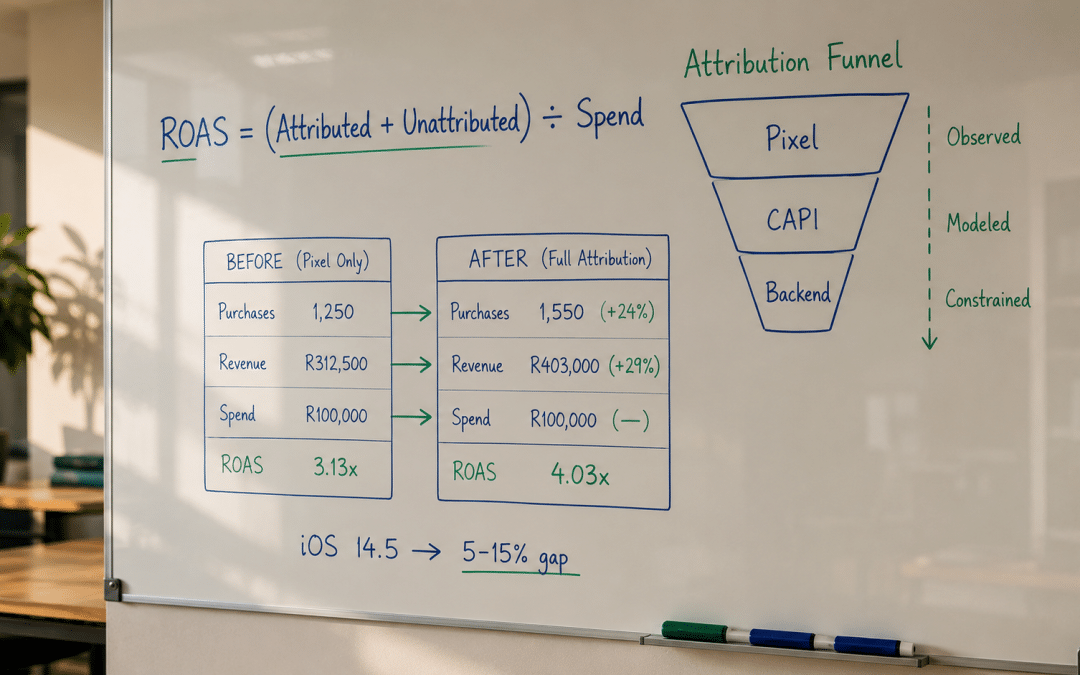
Measuring facebook ads roi south africa properly in 2026 requires reconciling three different conversion data sets — Meta Ads Manager (which now underreports by 5-15% in SA), your backend ecommerce or CRM data, and a server-side Conversions API (CAPI) feed.
The platform's reported ROAS figure on its own is a structurally incomplete number that leads SA advertisers to kill profitable campaigns and scale unprofitable ones. For broader paid-social context, start with our social media marketing Johannesburg guide.
This guide covers the real measurement framework, why January 2026 Meta API changes made facebook ads roi south africa harder to track, the Conversions API SA implementation reality, how to read backend versus platform data, and a real SA before-and-after attribution rebuild. For a sibling comparison view, see Facebook ads vs Instagram ads in SA.
Quick Answer
The real facebook ads roi south africa formula is: ROAS = (Total Attributed Revenue + Unattributed Incremental Revenue) ÷ Total Spend.
Most SA advertisers calculate only the first term — Meta-attributed revenue — and miss the second, which represents conversions that genuinely came from campaigns but were lost to iOS opt-outs, ad blockers, and cross-device journeys. The result: reported ROAS sits 5-15% lower than reality in SA, and 20-30% lower in markets with higher iOS share.
Three SA-specific factors reshape global Facebook ROAS benchmarks: (1) SA iOS share is roughly 22-25% versus 55%+ in the US, so the attribution gap is smaller but real; (2) most SA Shopify stores have not implemented the Conversions API despite the 2-click setup; (3) Meta's January 2026 removal of 7-day and 28-day view attribution windows dropped reported conversions by 15-30% globally — without any actual change in campaign performance.
Want a quick read on whether your current measurement is leaving 10-20% of real returns invisible in your reporting?
Get a Free Attribution AuditWhy the Reported ROAS Lies — and How Much
The gap between what Meta reports and what actually happened in your business is the single biggest measurement problem in 2026 paid media. Reported ROAS on the platform comes from three increasingly imperfect data sources: the browser Pixel (degraded by iOS 14.5 ATT opt-outs and tracker blockers), modeled conversions (statistical estimates filling gaps from opt-outs), and Conversions API server events (if implemented, which most SA advertisers have not done).
When advertisers trust only the Ads Manager dashboard, they underinvest in campaigns actually working. A campaign showing 2.0x reported ROAS in SA might really be doing 2.3-2.5x once you reconcile against backend sales data. Conversely, attribution-stuffed campaigns sometimes claim credit for conversions that branded search or direct traffic actually drove — so the reverse problem exists too. The honest measurement approach reconciles both directions.
The SA Attribution Gap by the Numbers
SA businesses measuring facebook ads roi south africa on Pixel-only tracking systematically underreport by 5-15% of true conversions, with the gap widening to 18-25% for businesses with significant iOS audiences (premium brands, fintech, B2B SaaS). The fix is implementing the Conversions API (CAPI) — server-side tracking that bypasses browser restrictions. Industry data shows CAPI implementation typically lifts reported ROAS by 10-25% versus Pixel-only setups.
Critically, this is not "better performance" — it is the same performance, finally being measured. SA advertisers should expect a sudden reported ROAS jump in the first 2-3 weeks after CAPI activation, not because campaigns improved but because previously invisible conversions are now visible.
The Real ROI on Facebook Ads in South Africa Framework — Three Data Layers
Building a defensible facebook ads roi south africa figure requires three layers that must agree (or have their disagreements understood). SA brands routinely run on only one layer and treat it as ground truth — which is the root cause of most ROAS measurement disputes between agencies, marketing teams, and finance.
| Layer | What It Captures | SA Implementation Status |
|---|---|---|
| Meta Pixel (browser) | Click + view conversions from non-opted-out users | ~95% of SA advertisers have it |
| Conversions API (server) | Server-side events bypassing browser blocks | ~25-30% of SA advertisers have it |
| Backend reconciliation | Actual sales from Shopify, WooCommerce, CRM | ~15% do this systematically |
The honest ROI on facebook ads in south africa figure compares Meta-attributed revenue against backend numbers for the same period, applies a directional incrementality test (run a small geo-holdout for 2-3 weeks), and reports both numbers with the gap explained rather than hidden. Single-source attribution measurement — only Meta, or only Shopify — produces numbers that fall apart on either side under cross-examination.
The Conversions API — SA Implementation Reality
The Meta Conversions API is the single highest-impact measurement fix available to SA advertisers in 2026. Per Meta's official Conversions API documentation, CAPI creates a server-to-server connection that sends conversion events directly to Meta, bypassing browser limitations entirely. The setup is genuinely simple for SA stores on Shopify, WooCommerce, or major hosted platforms — typically 2-click integration through the Facebook channel/plugin.
SA implementation realities: Shopify stores can enable CAPI in roughly 15 minutes through the Meta sales channel. WooCommerce stores using the relevant plugin get it almost as easily. Custom-built SA ecommerce or B2B SaaS sites need developer time — typically 4-12 hours of setup.
The ROAS visibility gain justifies the cost on any account spending more than R 30,000/month. The Event Match Quality (EMQ) score Meta provides afterwards needs to sit above 6.0 for reliable attribution; below 6.0 means insufficient customer parameters are being sent.
Facebook Ads ROI in South Africa Attribution Windows — What January 2026 Changed
On January 12, 2026, Meta permanently removed the 7-day view and 28-day view attribution windows from its Insights API. The default attribution window is now 7-day click + 1-day view. SA advertisers who were running B2B campaigns with longer consideration cycles, or remarketing campaigns relying on view-through credit, saw reported conversions drop 15-30% overnight — with no actual performance change.
For SA ecommerce with same-day purchase cycles (under R 1,500 average order value), the change has minimal real-world impact — most conversions happen within 24-48 hours anyway.
SA Attribution Window Choice Cheat Sheet
SA ecommerce stores with sub-R 1,500 AOV: default 7-day click + 1-day view is correct — no change needed post-January 2026. SA B2B service businesses or luxury brands above R 5,000 AOV: maximise the 7-day click window and accept the view-window loss; supplement with backend reconciliation to recover the missing attributed revenue.
SA brands running pure remarketing campaigns lost the most from the January 2026 changes — these campaigns relied heavily on view-through credit that no longer counts. The mitigation is treating remarketing as a downstream support layer rather than a primary ROAS-attributed channel, and measuring its contribution through incrementality testing rather than view-through clicks.
For SA B2B service businesses with 30-90 day consideration windows, or SA luxury/high-AOV brands where browsing extends across weeks, the change materially understates true facebook ads roi south africa. The mitigation is the same as for the iOS attribution gap: backend reconciliation against actual revenue, not platform-reported revenue alone.
Sitting on a Facebook spend that the dashboard reports as breakeven, while finance keeps asking why customer growth has continued anyway?
Get a Free ROAS ReconciliationReal SA Before-and-After Facebook Ads ROI in South Africa Rebuild
The pattern below reflects a JHB-based SA ecommerce store — beauty and skincare, ~R 680 AOV, monthly Meta spend R 42,000. The before-state was: Pixel-only tracking, Meta-reported ROAS treated as ground truth, no backend reconciliation, no CAPI. The after-state reflects 90 days post-rebuild with CAPI installed, weekly backend reconciliation, and corrected attribution windows.
| Metric | Before (Pixel-only) | After (CAPI + reconciled) |
|---|---|---|
| Monthly Meta spend | R 42,000 | R 42,000 (unchanged) |
| Reported Meta ROAS | 2.1x | 2.7x |
| Backend-verified ROAS | Not measured | 2.9x |
| Attributed revenue/month | R 88,200 | R 121,800 |
| Customer acquisition cost | R 290 | R 215 |
| EMQ score | Not tracked | 7.2 |
| Internal decision quality | "Should we cut spend?" | "Increase by 30%" |
What Drove the Result
Three changes produced most of the lift. First, CAPI installation through the Shopify Meta channel surfaced approximately 18% of conversions the Pixel had been missing — primarily iOS users on Safari and Chrome users with privacy extensions.
Second, weekly backend reconciliation against Shopify orders showed a further 7% of conversions that even CAPI did not catch — usually cross-device journeys where the click happened on mobile and the purchase on desktop the following day.
Third, attribution window discipline (extending from default 1-day click to 7-day click + 1-day view where data supported it) captured longer-cycle browsers. The combined effect: the same R 42,000 spend that looked breakeven on Pixel-only data revealed itself as a 2.9x backend-verified ROAS — enough confidence to scale spend by 30% the following month.
How Growth Pulse Media Approaches Facebook Ads ROI in South Africa Measurement
Most SA agencies report monthly facebook ads roi south africa numbers straight from the dashboard and call it a measurement system. The number is between 5% and 30% wrong depending on the audience composition, attribution setup, and time of measurement — and that wrongness compounds into wrong budget decisions. We build the three-layer measurement infrastructure first (CAPI, backend reconciliation, attribution-window discipline), then run campaigns into it.
Dirk built and ran a real SA ecommerce business through the full iOS 14.5 attribution collapse and the subsequent rebuild — including the painful experience of seeing previously profitable campaigns suddenly look unprofitable for measurement reasons, then losing six months working out how to reconnect the data. The lever sequence we apply reflects what real SA paid social actually needs in 2026, not generic agency reports built on pre-iOS-14 playbooks.
For SA businesses ready to take Meta ROI measurement seriously, our digital marketing service covers the CAPI installation, attribution-window planning, backend reconciliation cadence, and ongoing optimisation against verified return data. We pair it with the broader paid-social context from Facebook ads strategy in SA and the cross-platform view from Google ads vs Facebook ads.
Who This Guide Is NOT For
The measurement framework above suits SA businesses with monthly Facebook spend above R 20,000 and ecommerce or B2B SaaS structure where backend revenue is trackable. Here is who should look elsewhere first.
Brand-awareness campaigns with no conversion goal: The CAPI and backend reconciliation approach assumes you are running campaigns with a measurable revenue or lead outcome. SA brands running pure top-of-funnel reach activity (event activations, brand launches) measure success on reach, video completion, and engagement — not ROAS. Reading reach campaigns through a ROAS lens generates misleading numbers regardless of measurement infrastructure quality.
SA businesses spending under R 15,000/month on the platform: Meta's algorithm needs roughly 50 conversions per week per group to optimise reliably. Below R 15,000/month, most SA advertisers will not produce enough conversion volume to make CAPI's measurement improvements statistically meaningful. The advice is to either lift spend to the threshold or rely on Pixel-only data and accept the wider error margin — implementing CAPI on sub-threshold spend is over-engineering.
Service businesses with phone-call conversions and no CRM tracking: If your primary conversion event is a phone call that gets logged in a shared inbox or scribbled on a whiteboard, no attribution infrastructure can rescue the measurement. SA service businesses need to install proper CRM call tracking (CallRail, WhatConverts, HubSpot) before Facebook ROI measurement becomes possible. Without backend event capture, even perfectly configured CAPI cannot tell you which calls came from the platform.
Operators expecting attribution to "feel right": Properly measured facebook ads roi south africa frequently looks different from what intuition expects. Some efforts operators assumed were vanity end up being meaningful pipeline contributors; some they loved end up showing weak backend ROAS. Operators unwilling to let the data overrule their intuition will resist measurement findings — at which point even perfect infrastructure produces no decision improvement.
Trying to figure out whether your facebook ads roi in south africa is genuinely weak or just measurement-blind to the real returns?
Get a Free Performance DiagnosisThe discipline carrying all of this is treating measurement as infrastructure, not a monthly report. SA brands that install CAPI, set up backend reconciliation, document attribution-window choices, and reconcile platform data against actual revenue weekly produce facebook ads roi south africa numbers that hold up to finance scrutiny and drive correct budget decisions. SA brands that report Pixel-only Meta data and accept it as truth consistently make wrong scale-or-cut decisions on individual campaigns.
The reported number from the dashboard is the start of the measurement conversation, not the end of it. Backend reconciliation, CAPI implementation, and attribution-window discipline together turn a noisy ROAS figure into a defensible business metric. For SA businesses spending more than R 30,000/month on the platform, the measurement infrastructure typically pays back within 60-90 days through better budget allocation alone.
Frequently Asked Questions
What is a good Facebook Ads ROI in South Africa?
For SA ecommerce, healthy backend-verified ROAS sits at 3.0x-5.0x for established stores, 2.0x-3.0x for new stores still building creative libraries and audience signals. SA service businesses target 5:1 return on ad spend as the equivalent baseline.
The headline Meta-reported ROAS will typically sit 10-25% below backend-verified numbers once attribution gaps are accounted for — so reported ROAS of 1.8x might be genuine ROAS of 2.2x once CAPI and backend reconciliation are in place.
How does iOS 14.5 affect Facebook Ads ROI tracking in SA?
iOS 14.5 ATT (App Tracking Transparency) lets users opt out of cross-app tracking. Roughly 75-85% of iOS users opt out, breaking Pixel-based conversion attribution for those users. SA iOS share is roughly 22-25%, which means the SA-specific attribution gap is smaller than markets like the US (55%+ iOS share) but still meaningful at 5-15% conversion underreporting. The Conversions API solves most of this gap by tracking conversions server-side rather than browser-side.
Do I need the Conversions API to measure Facebook ROI properly in SA?
For any SA business spending more than R 20,000/month on the platform, yes — CAPI is the difference between a measurement system that produces defensible numbers and one that systematically underreports by 5-15%. SA Shopify stores can install CAPI in roughly 15 minutes through the Meta sales channel. WooCommerce stores using the Facebook for WooCommerce plugin get it almost as easily. Custom sites need 4-12 hours of developer time.
How did the January 2026 Meta attribution changes affect SA advertisers?
On January 12, 2026, Meta removed the 7-day view and 28-day view attribution windows from the Ads Insights API. SA advertisers running long-consideration B2B or remarketing campaigns saw conversions drop 15-30% overnight with no actual performance change. The mitigation is backend reconciliation against real revenue rather than relying on platform-reported numbers, and ensuring CAPI is installed to maximise click-attribution coverage.
What is the Event Match Quality (EMQ) score and what should mine be?
EMQ measures how well Meta can match conversion events to specific users, scored 0-10. Meta recommends maintaining scores above 6.0 for reliable attribution. Below 6.0 typically means insufficient customer parameters are being sent through CAPI — common fixes are enabling automatic advanced matching and ensuring email, phone, city, and state are sent with each event. EMQ above 7.5 is excellent; SA stores routinely reach 8.0+ with proper CAPI setup.
How long does it take to see improved ROI measurement after implementing CAPI in SA?
Most SA businesses see CAPI measurement improvements within 2-3 weeks of activation. Reported ROAS typically jumps 10-25% in that window — this represents conversions that were happening but previously invisible, not actual performance improvement. Backend reconciliation should be implemented in parallel and reviewed weekly to validate the new CAPI numbers against actual sales data. Full measurement confidence usually arrives at 6-8 weeks post-implementation.
Ready to Build a Facebook Ads ROI in South Africa System That Holds Up Under Finance Scrutiny?
Growth Pulse Media builds the three-layer measurement infrastructure SA paid-social campaigns actually need — CAPI installation, backend reconciliation, attribution-window planning, and ongoing ROAS verification against real revenue. Real operator experience surviving iOS 14.5 collapse and rebuilding measurement that finance can defend. In-house execution, limited client load. No obligation — we will get back to you within 24 hours with a frank read on whether your current measurement is producing defensible numbers.
Get Your Free ROI Measurement Audit