
 Add to Preferred Sources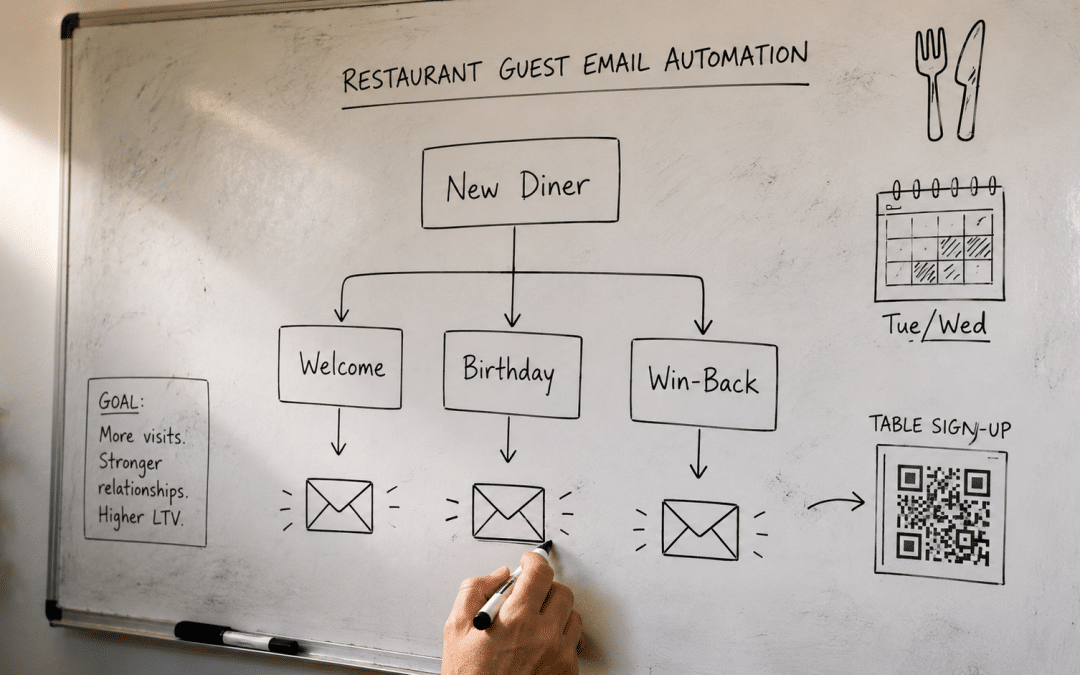
Email marketing for restaurants is the highest-ROI channel a South African eatery can run — driving repeat visits, filling quiet midweek tables, and turning one-time diners into regulars at a fraction of the cost of paid ads. SA venues that run it properly see open rates above 40%, far higher than most other industries, because diners actively want to hear about new menus, specials, and bookings.
For the broader strategy behind it, start with our complete email marketing guide for South Africa.
This guide covers exactly which campaigns work for SA venues, the local tools and POPIA rules, realistic Rand costs, and the flows that fill tables on slow nights. It is written for independent operators, small groups, cafés, and dark kitchens across Johannesburg, Cape Town, and Durban.
Quick Answer
Email marketing for restaurants in South Africa works best when it combines three things: a guest list captured at the table or online booking, a small set of automated flows (welcome, birthday, win-back), and regular broadcasts for menu changes and specials. SA venues typically see 40%+ open rates and R 30-R 42 in return for every R 1 spent.
The biggest mistake SA venues make is blasting the same promo to everyone. The diners who visit weekly and the ones who came once a year ago need different messages — and segmenting by visit frequency is what separates venues that fill tables from those that get unsubscribes.
Want a quick assessment of whether your venue's guest list is set up to actually drive bookings?
Get a Free Restaurant List AuditWhy Email Marketing for Restaurants Works So Well in SA
Email marketing for restaurants outperforms almost every other channel because diner intent is unusually high — people who join a venue's list already like the place and want reasons to return. According to the Travel and Hospitality benchmark, this category sees open rates around 40%, well above the cross-industry average in the low 30s. For SA venues specifically, three factors push performance even higher.
| Factor | Why It Helps SA Venues | Impact |
|---|---|---|
| High diner intent | List members already like the venue and want to return | 40%+ open rates vs ~30% average |
| Low cost per send | Sends cost cents per recipient vs Rand-per-click on ads | R 30-R 42 return per R 1 spent |
| Owned audience | Your list is not rented from Meta or Google — no algorithm risk | Direct reach, no reach throttling |
| Local timing control | Send a lunch special at 10am or a Friday booking nudge at 3pm | Drives same-day foot traffic |
That last point matters most for SA venues. A well-timed message — "two tables left for tonight's wine pairing" sent at 3pm — can fill a quiet Tuesday in a way no social post reliably can, because it lands directly in the inbox rather than waiting to be discovered in a feed.
The Owned-Audience Advantage Most SA Venues Ignore
Social media followers are rented — Meta decides how many of your followers actually see a post, and that number keeps shrinking. A subscriber list is owned. Every diner on it can be reached directly, every time, with no algorithm deciding whether your message gets through. For a venue living on repeat visits, that direct line to past guests is the single most valuable asset you can build.
The practical implication: every guest who walks out without joining your list is a guest you may never reach again. Capturing the list is the foundation everything else is built on.
Building the Guest List: Where SA Venues Actually Capture Diners
The guest list is the foundation of email marketing for restaurants, and SA venues have more capture points than most realise. The goal is to collect a contact (with consent) at every natural touchpoint without making it feel like a transaction.
At the Table
A QR code on the table or the bill that offers something specific — "Join for a free dessert on your next visit" — converts far better than a generic "sign up for our newsletter". The incentive has to be worth a sign-up. SA diners respond well to a tangible first-visit reward.
Through Online Bookings
If your venue takes reservations through Dineplan, Quicket, or your own site, the booking flow is the richest capture point — you get the address plus visit data. Make the opt-in a clear, separate tick (POPIA requires this) rather than a pre-ticked box.
Via WiFi Login
Many SA venues offer free WiFi. A captive-portal sign-in that asks for a contact in exchange for access is a low-friction capture point, provided the consent is explicit and separate from the WiFi terms.
At Point of Sale
If you run Yoco, SnapScan, or a POS with a CRM layer, the checkout is a natural moment to capture the address — especially for takeaway and delivery orders where you already need contact details.
Not sure which capture points fit your specific venue setup? Tell us how your venue operates and we will map the best ones.
Get a Free Capture StrategyEmail Marketing for Restaurants: The Flows That Fill Tables
The campaigns that drive bookings for SA venues fall into two types: automated flows that run in the background, and broadcasts you send manually. The flows do the heavy lifting — they trigger on diner behaviour and run without ongoing effort once set up.
| Flow / Campaign | Trigger | What It Does for the Venue |
|---|---|---|
| Welcome series | New list signup | Delivers the promised incentive, introduces the venue, drives first/next visit |
| Birthday offer | Diner's birthday month | Free dessert or drink — high-margin, high-emotion booking driver |
| Win-back | No visit in 60-90 days | Re-engages lapsed diners before they are gone for good |
| Post-visit thank-you | After a booking/visit | Requests a Google review, builds the relationship |
| Midweek filler | Manual, weekly | Promotes quiet-night specials to fill Tuesday/Wednesday tables |
| New menu / event broadcast | Manual, as needed | Announces seasonal menus, wine dinners, live music |
The Two Flows That Drive Most Venue Revenue
For SA venues just starting, the welcome series and the win-back flow drive most of automated bookings. The welcome series captures diners at peak enthusiasm — right after they join — and the win-back catches them before they drift away permanently. Birthday offers are a close third because they carry genuine emotion and a built-in reason to book.
Everything else can wait. A venue running just these three flows plus a weekly midweek-special broadcast already outperforms most SA venues doing any of this at all.
Timing is the other half of email marketing for restaurants. SA diners check inboxes most on weekday mornings and again around 4pm as they plan the evening, so a send scheduled for 10am Tuesday or 3pm Friday tends to land when booking intent is highest.
Weekend mornings work well for brunch-led venues, while late-afternoon midweek sends catch the after-work crowd. Avoid Sunday evenings and Monday mornings, when inboxes are crowded and open rates dip.
Segmentation by visit frequency multiplies the effect. A guest who books every fortnight should never receive the same "we miss you" message as someone who last visited eight months ago. Split the list into regulars, occasional guests, and lapsed diners, then tailor the offer to each.
Regulars get early access to events, occasional guests get a reason to come back sooner, and lapsed diners get a stronger incentive to return. This single discipline lifts booking rates more than any subject-line tweak.
SA Tools and What They Actually Cost
The platform choice for email marketing for restaurants depends entirely on whether your venue needs POS-integrated guest data or just a clean broadcast tool. According to Mailchimp's restaurant marketing tools, general-purpose platforms cover the fundamentals well, but they do not pull reservation data automatically — that gap matters for SA venues with booking systems.
| Platform | SA Monthly Cost | Best For |
|---|---|---|
| Mailchimp | R 0 (free 500 contacts) → R 3,800+/month | Independent SA venues wanting easy templates and food photography design |
| Klaviyo | R 0 (free 250) → R 12,000+/month | SA groups wanting deep segmentation by visit frequency and spend |
| Omnisend | R 0 (free 250) → R 6,500/month | SA venues wanting messaging + SMS combined at lower cost |
| Flodesk | Flat ~R 650/month unlimited | Brand-forward SA eateries prioritising design over automation |
| Mailerlite | R 0 (free 1,000) → R 2,800/month | Budget-conscious SA cafés and small eateries |
For most independent SA venues, Mailchimp or Mailerlite on the free or entry tier covers everything needed to start. The jump to Klaviyo makes sense once a venue has thousands of diners and wants to segment campaigns by how often someone visits or what they typically spend.
POPIA: The Compliance Rules SA Venues Must Follow
Email marketing for restaurants in South Africa falls under POPIA (the Protection of Personal Information Act), and the rules are stricter than many venue owners assume. Getting consent right is not optional — it protects the venue and keeps deliverability high.
Compliant capture: A diner ticks a clear, separate, un-pre-ticked box that says "Yes, send me specials and menu updates" when joining via your booking system or QR code. Consent is explicit, specific, and recorded with a timestamp.
Non-compliant capture: Adding every diner who ever booked a table to your mailing list without explicit consent, or using a pre-ticked opt-in box. Both breach POPIA and risk complaints plus spam-folder placement that kills your open rates.
Beyond consent, every message must include a working unsubscribe link and your venue's physical address. SA venues must also honour unsubscribes promptly. These are not just legal requirements — they directly protect your sender reputation, which determines whether your emails reach the inbox or the spam folder.
Email Marketing for Restaurants: A Real SA Example
A Cape Town bistro running R 480,000/month in revenue started structured email marketing for restaurants in September 2025. Before: a dormant Mailchimp account with 600 contacts and no automated flows. After 5 months of welcome, birthday, win-back flows and weekly midweek broadcasts:
| Metric | Before (Sep 2025) | After (Feb 2026) | Change |
|---|---|---|---|
| Active list size | 600 | 2,400 | +300% |
| List open rate | 22% | 44% | +22 pp |
| Midweek covers (Tue-Wed) | 35/week | 78/week | +123% |
| Repeat-visit rate | 18% | 37% | +19 pp |
| List-attributed revenue | R 0 tracked | R 62,000/month | new channel |
| Cost of tooling | R 0 (unused) | R 1,400/month | 44× return |
The biggest single driver was the midweek filler broadcast — a Tuesday-morning send promoting that evening's special more than doubled quiet-night covers. The win-back flow recovered roughly 40 lapsed diners a month who had not visited in 90+ days. Total tooling cost of R 1,400/month produced a 44× return in attributed revenue.
How Growth Pulse Media Approaches Restaurant Outreach
Most agencies treat restaurant outreach like any other programme — generic templates, generic flows, generic results. We approach it from operator reality: Dirk scaled an SA business using the same platforms (Klaviyo, Omnisend, Mailchimp) and the same payment and booking integrations SA venues rely on, so we know what actually moves covers versus what just looks busy in a dashboard.
Our engagements focus on the flows that fill tables — welcome, win-back, birthday, midweek filler — and on capturing the guest list properly at every touchpoint, all POPIA-compliant from day one. We work with a deliberately limited client load so the senior team stays involved. For SA venues ready to build this properly, our email marketing service covers strategy, setup, automation, and ongoing campaigns.
Who This Guide Is NOT For
Email marketing for restaurants delivers for most established SA eateries, but it is not the right first move for everyone. Here is who should look elsewhere first.
Brand-new venues with no guest base yet: The channel needs a list, and a list needs diners. A venue in its first two months has nobody to reach. Focus first on getting people through the door via local SEO, Google Business Profile, and social, then build the list as diners arrive.
Venues unwilling to capture emails at the table: If front-of-house staff will not consistently prompt diners to join, the list never grows and the channel never works. The channel rewards venues that build the capture habit into service. Without that operational commitment, the tooling sits unused.
Pure delivery-only dark kitchens on aggregator platforms: If all your orders come through Uber Eats or Mr D and you never get the customer's direct contact, you do not own the relationship — the aggregator does. This channel is harder here; your effort is better spent on the channels where you can actually capture contact details.
Venues looking for instant results this weekend: Email compounds over months as the list grows and flows mature. It will not fill tables this Saturday from a standing start. For immediate covers, paid local ads or a WhatsApp blast to existing contacts work faster; this is the long-game asset that pays off steadily.
Not sure whether your venue is ready to invest in this channel yet? We will give you a straight answer based on your actual setup.
Get a Free Readiness CheckOne final principle ties all of this together: consistency beats intensity. A venue that sends one well-crafted message every week, reliably, will always outperform one that blasts five in a busy month and then goes silent for two.
Diners come to expect the rhythm — the Tuesday special, the Friday booking nudge — and that predictability is what keeps a list warm and engaged. Build the habit into your weekly routine and measure what each send drives in covers.
The venues that win treat their guest database as a long-term asset rather than a quick promotional lever. They protect it with clean opt-ins, respect how often they reach out, and always lead with something genuinely useful to the diner.
Get that balance right and the list becomes the most dependable source of repeat bookings a venue owns, weathering the algorithm changes and ad-cost spikes that disrupt every other channel.
Frequently Asked Questions
How much does email marketing for restaurants cost in South Africa?
Most SA venues start free — Mailchimp covers 500 contacts and Mailerlite covers 1,000 at no cost. As your list grows, expect R 1,400-R 3,800/month on entry tiers, scaling to R 6,500-R 12,000/month for larger groups wanting deep segmentation on Klaviyo or Omnisend. For most independent venues, tooling stays under R 2,000/month while producing 30-44× returns in attributed bookings.
What open rate should an SA restaurant expect?
SA restaurants typically see open rates around 40%, well above the cross-industry average in the low 30s, because diners genuinely want menu and booking updates from venues they like. Bear in mind that Apple Mail Privacy Protection inflates reported open rates by 15-20 points, so click-to-open rate is a more honest measure. A well-run venue list should see clicks of 2-4% per campaign.
Is email marketing for restaurants POPIA compliant?
It can be, and must be. POPIA requires explicit, specific, separate consent — a clear un-pre-ticked opt-in box, not auto-adding every diner who booked a table. Every send needs a working unsubscribe link and the venue's physical address, and unsubscribes must be honoured promptly. Done right, compliance also protects your sender reputation and keeps emails out of the spam folder.
What are the best campaigns for a restaurant to send?
The highest-performing campaigns are a welcome series for new signups, a birthday offer, a win-back flow for diners who have not visited in 60-90 days, and a weekly midweek-special broadcast to fill quiet nights. Post-visit review requests and seasonal menu or event announcements round out the set. For most SA venues, the welcome and win-back flows drive most automated bookings.
How do SA venues build a guest list without annoying diners?
Offer something specific in exchange for a sign-up — a free dessert on the next visit converts far better than a generic ask. Capture at natural touchpoints: a QR code on the bill, the online booking opt-in, WiFi login, or point of sale. Keep the consent clear and separate per POPIA. The key is making the incentive worth a sign-up rather than treating signup as a transaction.
Should a restaurant use email or WhatsApp to reach diners in South Africa?
Both, for different jobs. Email marketing for restaurants is the owned long-game asset — it builds repeat-visit relationships and compounds over months. WhatsApp is faster for immediate, time-sensitive nudges like "two tables left tonight" because SA diners check it constantly. The strongest SA venues use it for the relationship and a WhatsApp list for urgent same-day capacity. See our WhatsApp marketing guide for that layer.
Ready to Turn Your Venue's Guest List Into Booked Tables?
Growth Pulse Media builds guest programmes for South African operators that actually fill tables — POPIA-compliant capture at every touchpoint, the welcome, win-back, birthday and midweek flows that drive covers, and real operator experience with the platforms SA venues use. No obligation — we will get back to you within 24 hours with a frank assessment of your guest list and the fastest path to more bookings.
Get Your Free Restaurant Booking Plan