
 Add to Preferred Sources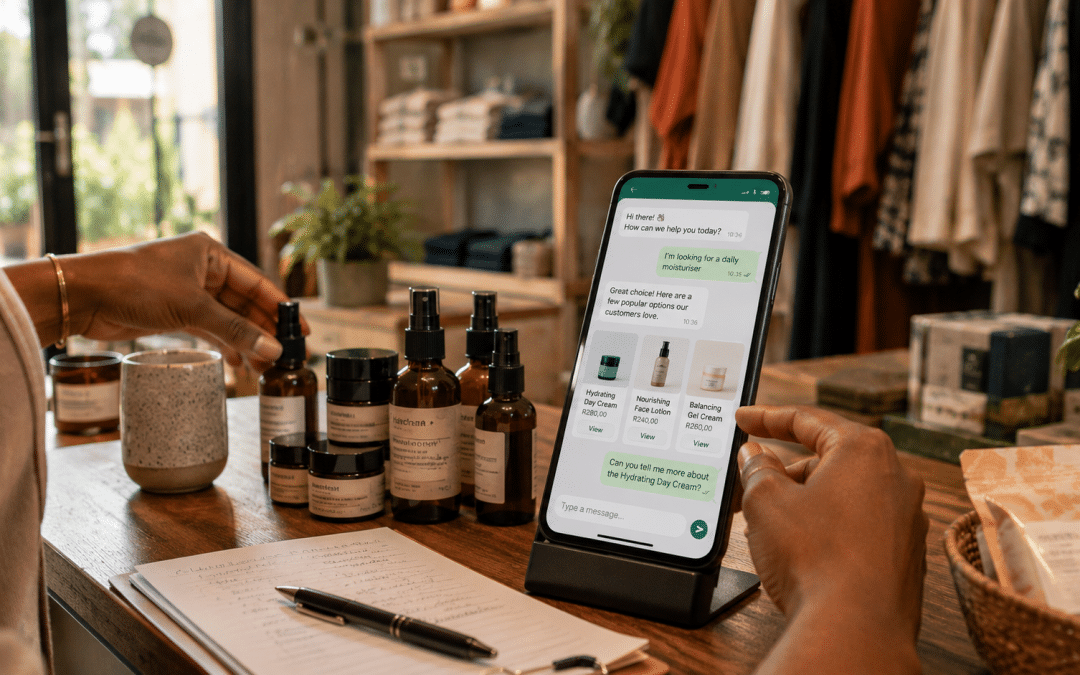
What is WhatsApp commerce in South Africa? It is the practice of selling products and services directly inside WhatsApp chats — using product catalogs, in-chat checkout flows, payment links, and automated order management — instead of pushing buyers to a separate website. For SA businesses, this matters because WhatsApp has 28+ million local users who already buy through the channel daily, often skipping ecommerce sites entirely.
This explainer answers what is WhatsApp commerce in SA in practical terms — the mechanics, the SA-specific opportunity, the toolchain, and how WhatsApp commerce connects to your existing Shopify or ecommerce stack. The two playbooks behind it: our complete WhatsApp marketing guide for SA covers the broader messaging strategy, and our Shopify South Africa guide covers the storefront layer this connects to.
Quick Answer
It is selling directly inside chat using built-in features: product catalogs (your inventory inside the app), product messages (rich cards with images, prices, "add to cart" buttons), in-chat carts, order management, and payment links.
SA merchants use it for three primary use cases: order placement (replacing the checkout page), abandoned cart recovery (rescuing failed website checkouts), and post-purchase service (delivery updates, returns, repeat orders). It works alongside an existing Shopify store or as a standalone storefront for businesses without a website.
Want a free assessment of whether WhatsApp commerce would lift revenue for your specific SA business?
Get a Free WhatsApp Commerce AuditWhat Is WhatsApp Commerce — The Core Mechanics
So what is WhatsApp commerce at the technical level? So what is WhatsApp commerce at the technical level? It uses four distinct components built into the Business Platform. Understanding what each does — and how they connect — explains why the channel performs so well for SA retail and ecommerce.
| Component | What It Does | SA Use Case Example |
|---|---|---|
| Product Catalog | Stores your full inventory inside the Business app — images, prices, descriptions, SKUs | Salon shows their treatment menu and pricing without a website |
| Product Messages | Rich cards sent in chat showing 1-30 products with "add to cart" buttons | Boutique sends new arrivals to opted-in customer list every Friday |
| In-Chat Cart | Customers add items, adjust quantities, and submit orders inside the chat thread | Restaurant takes weekday lunch orders without a delivery app |
| Order + Payment Flow | Order confirmation, payment link (PayFast/Peach/Yoco), delivery updates — all in-chat | Ecommerce store recovers abandoned carts with a payment link in WhatsApp |
The four components work together as a single chat-based storefront. According to Meta's official guide to publishing a shop on WhatsApp, businesses can connect their existing product catalog to Business Accounts and surface it inside chats directly.
What Is WhatsApp Commerce vs WhatsApp Marketing?
One of the first sources of confusion when SA businesses research what is WhatsApp commerce is the overlap with marketing. The terms get used interchangeably but they are not the same thing. Marketing is about broadcasting promotional messages to an opted-in list (announcements, sale alerts, new arrivals, abandoned cart nudges). The commerce layer is about completing the actual transaction inside the chat — catalog browsing, cart management, payment, and order tracking.
| Dimension | WhatsApp Marketing | WhatsApp Commerce |
|---|---|---|
| Primary purpose | Drive awareness, traffic, engagement | Complete the sale |
| Key features | Broadcasts, segmentation, automation flows | Catalogs, product messages, cart, checkout |
| Tools required | BSP (Wati, respond.io, etc.) + message templates | BSP + product catalog + payment gateway integration |
| Metric to watch | Open rate, reply rate, CTR | Conversion rate, AOV, cart abandonment |
| Where it fits | Top + middle funnel | Bottom funnel + post-purchase |
Both layers work together. SA businesses running broadcasts without checkout capture interest but then push customers back to a website where 60-70% drop off. SA businesses running the checkout layer without broadcasts have it ready but no audience to send through it. The full stack is both layers running in parallel.
Where Most SA Businesses Get the Marketing-Commerce Split Wrong
SA SMEs typically deploy WhatsApp for promotions first and never set up the commerce layer — they treat the channel like a glorified SMS broadcast tool. The result is a 25-40% engagement rate on broadcasts that drives traffic to a website which then bleeds 60-70% at checkout.
The fix is sequencing: build the catalog and payment flow first (the commerce layer), then add the marketing broadcasts on top. That way every promotional message lands in a chat where the buyer can complete the purchase without leaving WhatsApp.
Why WhatsApp Commerce Matters Specifically for SA Businesses
To understand what is WhatsApp commerce worth for SA businesses, look at the underlying market. SA has structural conditions that make in-chat selling disproportionately powerful compared to other markets. Three factors compound: high mobile-data costs make app switching expensive, low desktop usage means most ecommerce already happens on mobile, and WhatsApp penetration is functionally universal across LSM bands.
The SA-Specific Numbers Behind In-Chat Selling
WhatsApp has roughly 28 million SA users — more than Facebook, Instagram, and TikTok combined in active monthly usage. The average local user opens the app 23 times per day. By comparison, the average SA ecommerce site sees a visitor return roughly once every 11 days.
For SA businesses, this means meeting buyers where they already are — inside their most-used app — rather than asking them to context-switch to a browser. The cost-per-acquisition difference often runs 40-60% lower for in-chat checkout vs traditional cart redirects.
The SA Business Models Where WhatsApp Commerce Wins
Asking what is WhatsApp commerce worth pays back differently across business types. This channel is not equally valuable for every SA business. Five categories see the strongest results when answering what is WhatsApp commerce for their SA business as a primary or secondary sales layer.
| SA Business Type | Why It Wins via In-Chat Selling | Typical Revenue Lift |
|---|---|---|
| Service businesses without a website | Catalog replaces the website entirely — bookings via chat | R 18,000-R 65,000/month new revenue |
| Shopify stores with cart abandonment | Chat-based recovery converts 18-28% of abandoned carts | +12-22% topline lift |
| Restaurants + takeaways | Order-by-chat skips Mr D / Uber Eats commission (12-30%) | +8-15% margin recovery |
| Fashion + beauty boutiques | Visual product cards work natively for visual categories | +25-40% repeat purchase rate |
| B2B services with consultative sales | Catalog as service menu + payment link for deposits | +15-25% close rate on warm leads |
Wondering which of these models fits your SA business — or whether your category warrants a different approach?
Get a Free Fit DiagnosisHow WhatsApp Commerce Connects to Shopify (and Why That Matters)
The most common question SA merchants ask after "what is WhatsApp commerce" is how it connects to existing stores. For SA Shopify merchants, the Business Platform connects natively via official integration apps (Wati, respond.io, 360dialog all offer Shopify connectors). Once connected, the Shopify product catalog syncs into the chat channel automatically, abandoned-cart webhooks fire recovery messages, and order updates push from Shopify into the customer's chat thread.
This matters because Shopify is the dominant SA ecommerce platform — more than 8,000 active SA stores, with PayFast and Peach Payments as the dominant gateways. A Shopify+WhatsApp stack means the merchant runs one store, one inventory, and one customer record — but reaches customers across both surfaces from the same source of truth. For broader Shopify context, see our Shopify explainer.
The Shopify-Plus-WhatsApp Stack Pattern That Wins in SA
SA Shopify merchants getting the strongest results treat Shopify as the source of truth and the chat channel as the conversion surface for repeat customers. New-customer acquisition still happens via Google Ads, Meta Ads, and Instagram driving to the website; the chat layer handles abandoned cart recovery, repeat purchases, and post-purchase support.
This split typically lifts repeat-purchase rate by 30-50% and recovers 18-28% of carts that email-only recovery misses entirely.
The Real Cost of Running WhatsApp Commerce in SA
The honest answer to "what is WhatsApp commerce going to cost" is more than the catalog itself. SA businesses considering this channel often underestimate the operational layer beneath the catalog. The catalog itself is free; the costs sit in the BSP subscription, the per-conversation pricing Meta charges, the integration work, and the ongoing content updates.
| Cost Component | Typical SA Range (Monthly) | Notes |
|---|---|---|
| BSP subscription (Wati / respond.io / 360dialog) | R 1,100-R 4,200 | See WhatsApp Business app vs API options for vendor comparison |
| Meta per-conversation charges | R 0.18-R 1.10 per conversation | Marketing rate higher than utility rate |
| Shopify integration (if applicable) | R 0-R 900 | Free with most BSPs; premium connectors charge extra |
| Catalog setup + product photography | R 4,500-R 18,000 (one-off) | Image quality is the #1 conversion factor |
| Ongoing content + response management | R 6,500-R 22,000 | In-house staff time or agency retainer |
| Total monthly run-rate | R 8,000-R 28,000 | Excluding one-off setup |
For a typical SA SME doing R 200,000-R 500,000/month, the channel pays for itself within 60-90 days if the use case fits one of the five categories above. For deeper cost breakdown, see our WhatsApp marketing costs guide.
Real-World SA Example: Boutique Adding WhatsApp Commerce to Shopify
Here is a real example showing what is WhatsApp commerce capable of for an SA boutique. An SA fashion boutique running a Shopify store with R 285,000/month in revenue added in-chat selling in November 2025. Before: website-only ecommerce with 68% cart abandonment, 23% return-customer rate, average order value R 720. After 5 months of running it alongside Shopify:
| Metric | Before (Shopify only) | After (Shopify + WhatsApp) | Change |
|---|---|---|---|
| Monthly revenue | R 285,000 | R 412,000 | +45% |
| Cart abandonment rate | 68% | 52% | -16 pp |
| Recovered carts / month | 22 (email only) | 87 (email + chat) | +295% |
| Average order value | R 720 | R 815 | +13% |
| Return-customer rate | 23% | 34% | +11 pp |
| Monthly channel cost | R 4,200 (email tools) | R 14,800 (email + chat) | +R 10,600 |
| Net new revenue | — | +R 127,000/month | 12× return on incremental spend |
The boutique kept Shopify as the source of truth — products, inventory, and orders flowed through Shopify — but the conversion layer shifted toward the chat channel for repeat customers and abandoned cart recovery. New customers still discovered the brand on Instagram and bought through the website; existing customers gravitated to the chat channel within 3-4 purchase cycles.
Common Mistakes SA Businesses Make Launching This Channel
SA businesses launching what is WhatsApp commerce often skip past four common mistakes that wreck the rollout before it has a chance to perform.
Treating it as a marketing-only channel without commerce features: SA businesses often deploy the channel for broadcasts only, never setting up the catalog, payment links, or cart features. The result: a marketing tool without the conversion layer that produces 80% of the ROI. Set up the catalog and payment integration from day one.
Manual order management at any meaningful volume: Some SA businesses try to run orders through the free Business app without BSP integration. This works up to roughly 200 messages/month, then breaks: missed orders, lost replies, no order tracking. Above that volume, BSP infrastructure is non-negotiable.
Ignoring the response-time expectation: Customers on this channel expect replies within 30-60 minutes during business hours — far faster than email. SA businesses launching this channel without staffing the response queue produce worse conversion than they did before they started. Build response capacity before launching.
Skipping the catalog photography investment: Product images in chat display smaller than on a website, but conversion correlates 3-4× more strongly with image quality. Cheap stock photos or phone-camera snapshots tank conversion rates regardless of pricing or copy. Budget R 4,500-R 18,000 for proper catalog photography.
How Growth Pulse Media Helps SA Businesses Launch WhatsApp Commerce
Most SA agencies asked what is WhatsApp commerce treat it as a single marketing channel. We treat it as a stack — broadcasts + checkout + integration with the existing Shopify or ecommerce store — because Dirk built and scaled his own SA ecommerce business using exactly this approach before starting Growth Pulse Media.
That means our engagement covers the full picture: BSP selection, catalog setup, Shopify integration, payment flow design, response-team training, and ongoing optimisation.
We work with a deliberately limited number of clients per quarter so the senior team stays involved in setup and optimisation rather than handing off to junior staff. For SA businesses ready to deploy this channel properly, our WhatsApp marketing service covers strategy through execution.
Who This Guide Is NOT For
The what is WhatsApp commerce playbook applies to most SA retail and service businesses, but four categories should look elsewhere first.
B2B enterprise sales with R 100,000+ deal sizes: The commerce features are calibrated for transactional purchases (R 200-R 5,000 typical ticket). Enterprise B2B sales cycles involve procurement, contracts, and stakeholder committees that no chat-based flow handles cleanly. WhatsApp still has a role for B2B (lead nurturing, scheduling) but not as a commerce layer. See our WhatsApp for lead generation guide.
Businesses without consented contact lists: The commerce features still require buyers to initiate contact or opt in. SA businesses that try to mass-message non-consented numbers get accounts suspended within days, regardless of setup quality. Build the opt-in list first, then layer commerce on top.
Categories where buyers want to compare extensively: Insurance, mortgages, large appliances, vehicles — categories where buyers actively want to research multiple vendors side-by-side — work poorly in a chat-first checkout because the comparison happens in browser tabs. WhatsApp still helps as a follow-up channel, but the actual purchase decision happens elsewhere.
SA businesses without basic ecommerce infrastructure: The chat channel layers onto existing inventory, payment, and fulfilment systems. Businesses without payment gateways, basic stock control, or delivery capability cannot bolt a chat storefront on top and expect it to work. Build the underlying infrastructure first via our ecommerce explainer for SA, then add this layer.
Not sure whether your SA business is ready to add WhatsApp commerce to its stack? Let us run the diagnostic.
Get a Free Readiness CheckFrequently Asked Questions
Do I need a Shopify store to use WhatsApp commerce in SA?
No — what is WhatsApp commerce really requires is a catalog and a payment gateway, not a Shopify store. It works as a standalone storefront for SA businesses without any website — service businesses, salons, takeaways, small retailers.
The catalog lives inside WhatsApp Business, customers browse and order in chat, and payment happens via shared PayFast or Peach Payments links. A Shopify store amplifies the channel by adding inventory sync and abandoned cart recovery, but it is not required to start.
How does WhatsApp commerce handle payments in South Africa?
The honest answer to what is WhatsApp commerce doing on payments: the channel does not process payments natively. Instead, the merchant sends a payment link in chat — typically PayFast, Peach Payments, Yoco, or Ozow — and the buyer pays through that gateway. The merchant then confirms the order in chat and triggers fulfilment. Newer BSPs offer in-chat payment widgets that embed the link more seamlessly, but the underlying gateways remain the standard SA options.
Is WhatsApp commerce compliant with POPIA in South Africa?
When SA businesses ask what is WhatsApp commerce risk on POPIA, the answer is: yes, compliant when implemented properly. The two requirements: explicit consent before sending marketing or order messages to a customer (POPIA Section 11), and a documented opt-out mechanism. The chat channel itself is POPIA-compliant; the merchant's process around list-building and consent determines actual compliance. Always use double opt-in for marketing lists and honour opt-out requests within 24 hours.
What conversion rates should SA businesses expect from this channel?
On the conversion-rate side of what is WhatsApp commerce delivering: realistic SA benchmarks for opted-in customers: 18-28% conversion on abandoned cart recovery messages, 4-8% conversion on broadcast product announcements, 12-18% conversion on personalised product recommendations. These outperform email by 3-5× on most metrics. New unopened-list outreach performs far worse (under 2%) because the relationship has not been established.
How long does it take to set up the channel for an SA business?
Timing depends on scope. For a basic standalone deployment (catalog, payment links, response templates): 3-10 days including Meta verification, BSP onboarding, and catalog upload. For a Shopify-integrated deployment (sync, abandoned cart automation, order webhooks): 7-21 days depending on the complexity of the existing store. Custom workflows or developer-built integrations stretch to 4-8 weeks. See our WhatsApp automation guide for the automation layer.
Does WhatsApp commerce work for small SA businesses with under 200 customers?
Asking what is WhatsApp commerce worth for tiny operations? Yes — small SA businesses often see the strongest results because the channel scales down well. A salon with 150 regulars, a takeaway with 80 weekly customers, or a small boutique with 200 buyers can run the entire channel manually through the free Business app, then upgrade to a BSP only when volume justifies it.
The catalog feature is free; the chat is free; only paid messaging requires BSP infrastructure.
Ready to Launch WhatsApp Commerce for Your SA Business?
Growth Pulse Media runs end-to-end in-chat selling launches for South African businesses — from BSP selection and catalog setup through Shopify integration, payment flow design, and team training. Real operator experience scaling an SA ecommerce business through this exact channel, in-house execution, limited client load. No obligation — we will get back to you within 24 hours with a frank assessment of whether this channel fits your business.
Get Your Free WhatsApp Commerce Launch Plan