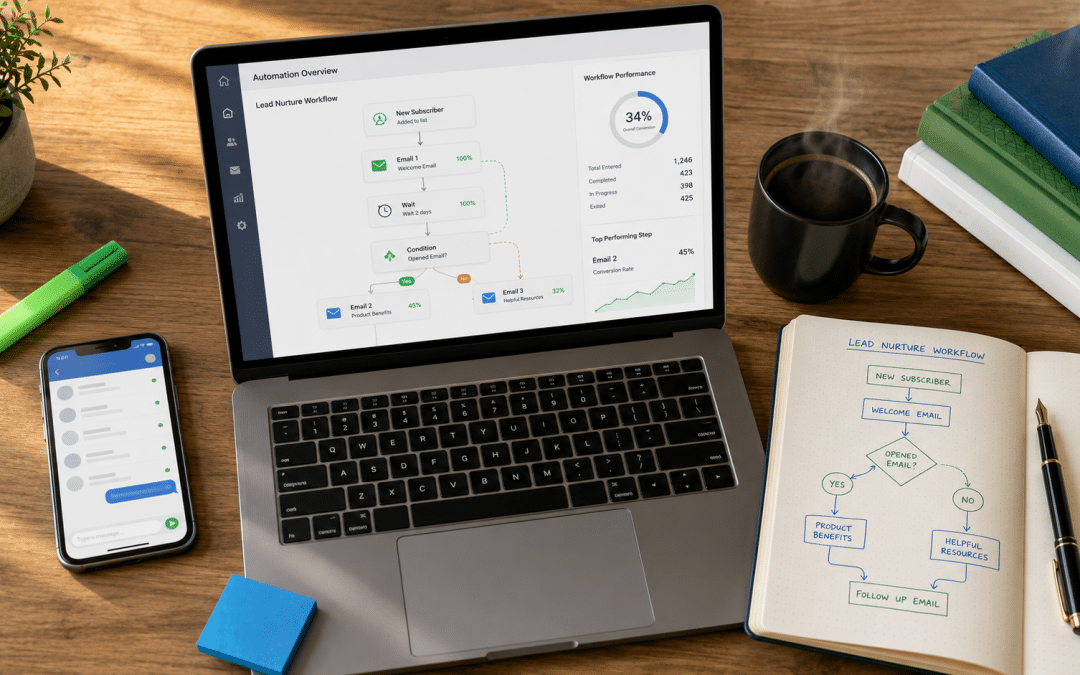
Marketing automation South Africa is the practice of orchestrating customer touchpoints — email, WhatsApp, retargeting ads, CRM-triggered tasks, SMS — through a connected system that fires the right message at the right moment without anyone clicking send. It is not email automation. It is not a Klaviyo flow.
It is the umbrella layer that connects all of those into one continuous customer journey. This guide explains what marketing automation South Africa actually looks like for SA businesses in 2026, which platforms work in the local market, and the implementation sequence that separates accounts that compound from accounts that abandon the tool 6 months in.
It builds on the broader digital marketing services for Johannesburg businesses and pairs with our email marketing strategy guide for South Africa, which covers the email layer specifically.
Quick Answer
Marketing automation in South Africa is a cross-channel orchestration system that triggers personalised messages and tasks across email, WhatsApp, retargeting ads, SMS, and CRM workflows based on customer behaviour. The leading platforms for SA businesses in 2026 are HubSpot (B2B and mid-market), Klaviyo (SA ecommerce), ActiveCampaign (small business CRM-first), Brevo (cost-conscious local-friendly), and the WhatsApp Business API for the channel SA buyers actually use.
The biggest mistake SA businesses make is conflating marketing automation with email automation. Email is one channel inside the system. SA buyers expect WhatsApp first, email second, retargeting third — and marketing automation done right orchestrates all three from one customer record.
Running marketing automation but only on one channel?
Most SA accounts we audit have email automation working in isolation while WhatsApp, retargeting, and CRM triggers run as separate systems. Tell us your current stack and we will show you where the orchestration gaps are leaking revenue.
Get a Free Automation Stack AuditWhat Marketing Automation South Africa Actually Is
Marketing automation South Africa is best understood as a single nervous system connecting every customer touchpoint. A buyer abandons a cart on a Wednesday afternoon — the system sends a recovery email at 7pm, fires a WhatsApp reminder Thursday morning if the email goes unread, launches a retargeting ad on Facebook by Friday, and creates a sales follow-up task in the CRM if the cart value is over R5,000.
None of that is one tool. It is multiple tools coordinated through shared customer data — typically a CRM at the centre with email, WhatsApp, ads, and analytics integrated around it. The orchestration is what makes it automation; the individual emails and messages are just outputs.
Per HubSpot’s marketing automation overview, the goal is delivering personalised experiences at scale while saving operational time. The keyword is “at scale” — manual personalisation works at 50 customers, breaks at 500, becomes impossible at 5,000. Automation is what lets SA businesses with one marketing hire compete with companies running 8-person marketing teams.
Why Email Automation is NOT Marketing Automation
This is the most common misconception in SA. Email automation — Klaviyo flows, Mailchimp sequences, Omnisend journeys — is one channel inside marketing automation, not the same thing as marketing automation. A Klaviyo welcome series fires 4 emails over 7 days. That is email automation.
Marketing automation is what happens when the same welcome series also: tags a contact as “Engaged” in HubSpot when they open email 3, fires a WhatsApp Business message offering a free consultation if they click the CTA in email 4, adds them to a Meta retargeting audience if they reach the end without purchasing, and creates a sales task in the CRM if their LinkedIn profile data suggests they fit your ICP.
The difference is the connective tissue between channels. Email automation works one channel; marketing automation works the system.
Key Takeaway
If your “marketing automation” is just email flows, you have email automation — not marketing automation. The orchestration layer that connects email, WhatsApp, ads, SMS, and CRM is where the compounding ROI lives. Most SA businesses are missing 60% to 80% of marketing automation’s value because they have only deployed the email piece.
The Cross-Channel Stack: What Marketing Automation South Africa Looks Like
A working marketing automation South Africa system typically has 5 layers, each handling a specific channel or function. The skill is choosing tools that integrate cleanly into a unified customer record, not stacking 12 best-in-class tools that cannot talk to each other.
| Stack Layer | Purpose | Top SA Platforms 2026 | Typical Monthly Cost |
|---|---|---|---|
| 1. CRM / customer database | Central record of every contact and interaction | HubSpot, Pipedrive, Zoho CRM | R600 – R8,000 |
| 2. Email automation | Drip campaigns, transactional flows, broadcasts | Klaviyo, Omnisend, ActiveCampaign, Brevo | R400 – R6,000 |
| 3. WhatsApp Business API | SA’s preferred consumer channel — order confirmations, reminders, broadcasts | 360dialog, Wati, Zoko, Twilio | R800 – R4,500 |
| 4. Retargeting / paid integration | Audience syncs from CRM into Meta and Google Ads | Native CRM integrations, Zapier, Make | R300 – R2,000 |
| 5. Workflow orchestration | The glue — fires actions across the stack based on triggers | HubSpot Workflows, ActiveCampaign Automations, Make, Zapier | Often included in CRM |
Most SA businesses are running 1 or 2 of these layers in isolation — typically email plus maybe a basic CRM. The compounding revenue lives in layers 3, 4, and 5 connecting them. WhatsApp without CRM sync is just bulk messaging; CRM without retargeting sync is just a contact list; retargeting without trigger automation is just a static audience.
Why WhatsApp Belongs in the Stack for SA
South Africa is a WhatsApp-first country. According to local market research, over 23 million South Africans use WhatsApp daily — significantly more than use Facebook or Instagram for purchasing communication. Marketing automation that ignores WhatsApp is automation that ignores the channel SA buyers actually open.
The WhatsApp Business API plugs into CRM workflows the same way email does. A trigger fires in HubSpot or ActiveCampaign; the WhatsApp Business API sends a templated message via 360dialog or Wati; the response gets logged back to the contact record. Done right, this is the highest-engagement channel in the SA stack — open rates above 90%, response rates above 30%.
Retargeting as Automation, Not Just Ads
Most SA businesses run retargeting as standalone Meta or Google Ads campaigns with manual audience uploads. That is not automation. True retargeting automation is when the CRM dynamically pushes audience segments into Meta and Google based on lifecycle stage — abandoned carts go into one audience, post-purchase upsells into another, dormant 90-day customers into a third — with the audiences updating automatically every 24 hours.
This single integration shift typically lifts retargeting ROAS by 40% to 80% on SA accounts because the ads serve to people in the right stage, not to a static list that mixes a week-old hot lead with a 6-month-old churned customer.
Want to see what a connected SA marketing automation stack looks like for your business?
Tell us your current tools and your monthly revenue. We will map the gaps — where your channels are running disconnected, where the trigger logic is missing, and where the cheapest wins are sitting.
Get a Free Stack MappingThe Five Workflows Every SA Business Needs
The five workflows below are the foundation. Implement these before exploring more advanced orchestration; they typically account for 70% to 80% of marketing automation revenue impact on SA accounts.
1. Abandoned Cart Recovery (Ecommerce) or Form Abandonment (B2B)
For ecommerce, an abandoned cart sequence: 1 hour after abandon, fire email reminder with cart contents; 4 hours later, send WhatsApp message with same content; 24 hours later, retargeting ad on Meta. This sequence recovers 10% to 25% of abandoned carts on SA stores running Shopify or WooCommerce with proper PayFast or Peach Payments integration.
For B2B, the equivalent is form abandonment — someone opens your contact form, fills 3 fields, then leaves. Fire an email within 30 minutes referencing what they were enquiring about, drop a sales task in the CRM if their company size is above a threshold, and start a 5-email nurture sequence for the lower-value leads.
2. Welcome Series with CRM Tagging
A 5-email welcome series over 10 days is table stakes. The automation version adds CRM tagging based on which emails get opened and clicked — contacts who click pricing pages get tagged “High Intent” and routed to sales; contacts who click educational content get tagged “Top Funnel” and kept in nurture; contacts who don’t open get retired after email 5 to protect deliverability.
This is where most SA email automation stops. Marketing automation extends it by also adding “High Intent” contacts to a Meta retargeting audience automatically and triggering a WhatsApp message offering a call.
3. Post-Purchase Sequence (Ecommerce) or Post-Demo Sequence (B2B)
The hour after a customer pays or books a demo is the highest-engagement window in the entire customer journey. Most SA businesses send one transactional email and stop. Marketing automation extends it: confirmation email immediately, WhatsApp delivery tracking 24 hours later, review request email 7 days post-delivery, upsell email 21 days post-purchase, win-back sequence 90 days later if no second purchase.
For B2B post-demo: thank-you email within 1 hour with meeting recap, follow-up nurture if no decision after 5 days, sales-task escalation if no engagement after 14 days.
4. Lead Scoring with Sales Handoff Triggers
Lead scoring is automation logic that assigns numerical points to contacts based on behaviour and demographic fit. Hit 75 points = “Marketing Qualified Lead” — sales gets the alert in their CRM, contact gets routed to a different nurture, and the system stops sending educational content because they are past education.
SA B2B businesses without lead scoring typically waste 60% of sales time on under-qualified leads. With scoring, sales talks only to the top 20% of contacts and conversion rates rise by 30% to 60%.
5. Dormant Customer Re-Engagement
The customer you already have is 5 to 25x cheaper to convert than a new customer, depending on industry. A dormant re-engagement workflow fires 30, 60, and 90 days after last purchase or last meaningful engagement — email first, WhatsApp second, retargeting ad third — with progressively stronger incentives (discount, free consultation, exclusive offer).
Most SA businesses have a steady leak of 15% to 25% of customers slipping into dormancy each year. A working re-engagement workflow recovers 20% to 40% of them — a six-figure recovery for most SA SMEs over a 12-month window.
Key Takeaway
Five workflows account for 70% to 80% of marketing automation revenue impact on SA accounts: abandoned cart, welcome series with tagging, post-purchase sequence, lead scoring with sales handoff, and dormant re-engagement. Build these five before exploring anything more advanced. Most SA businesses are missing 2 to 3 of the five, which is where the recoverable revenue sits.
Marketing Automation South Africa: Platform Comparison
The platform you choose affects what is possible in the workflows above. Some platforms own the email layer well but have weak CRM; others have great CRM but expensive email; only a few orchestrate across email, WhatsApp, and ads with integrated reporting. The table below shows realistic fits for SA business sizes in 2026.
| Platform | Best For (SA) | Cross-Channel Fit | Typical SA Monthly Cost |
|---|---|---|---|
| HubSpot | B2B mid-market, sales-led businesses, R10M+ revenue | Excellent — native CRM, email, workflows; integrates with WhatsApp via partners | R4,500 – R45,000 |
| Klaviyo | SA ecommerce, Shopify and WooCommerce stores | Strong email and SMS, weaker on broader CRM workflow logic | R900 – R12,000 |
| ActiveCampaign | Small business with CRM-first needs, mixed B2B and B2C | Strong email plus CRM workflows; SMS native; WhatsApp via integration | R500 – R6,000 |
| Brevo (formerly Sendinblue) | Cost-conscious SA SMEs, transactional + marketing mix | Good email and SMS, basic CRM, WhatsApp via API addon | R350 – R3,500 |
| Omnisend | SA ecommerce with strong WhatsApp focus | Email, SMS, web push, basic WhatsApp; tighter ecom focus | R450 – R5,000 |
| Mailchimp + Zapier stack | Smallest SA businesses prioritising cost over depth | Limited — works for basics, breaks at higher complexity | R250 – R2,500 |
The honest framing: there is no universally “best” platform. HubSpot is overpowered and overpriced for a R200K-revenue SA B2B; Mailchimp is underpowered for an R8M-revenue SA ecommerce store. Match the platform to your stage, your volume, and your tolerance for in-house technical work.
Real SA Example: Before and After Marketing Automation
An SA professional services firm came to us in late 2025 with a R32,000/month digital marketing budget and what they called “marketing automation” — a Mailchimp welcome series and nothing else. Email was running; WhatsApp was running (manually, one team member); ads were running; CRM was running. They were all running, but none of them were talking to each other. Over 4 months we connected them into one system. The table below shows what changed.
| Metric | Before (Email Only) | After (Cross-Channel System) |
|---|---|---|
| Tools running | Mailchimp, manual WhatsApp, Meta Ads, Pipedrive (disconnected) | ActiveCampaign + 360dialog WhatsApp + Meta + Pipedrive (connected) |
| Automation workflows live | 1 (welcome series) | 5 (all foundation workflows) |
| Channels in trigger logic | Email only | Email + WhatsApp + retargeting + CRM tasks |
| Lead-to-MQL conversion rate | 9% | 24% |
| Sales time per closed deal | 14 hours | 6 hours |
| Monthly recovered cart / form revenue | R8,400 | R41,200 |
| Email open rate (post-deliverability cleanup) | 14% | 31% |
| WhatsApp engagement rate | n/a (manual) | 62% open, 28% reply |
| Revenue per lead (90-day window) | R1,180 | R3,640 |
Total tool cost rose from R1,200/month to R4,800/month for the new stack. Revenue per lead tripled. Sales time per deal more than halved. The change was not better email — the existing emails were fine. The change was orchestration: making the five workflows fire automatically across channels instead of one channel doing all the work alone.
The GPM Difference: Orchestration Before Optimisation
Most SA agencies sell marketing automation as “we will set up your email flows.” We treat it as a stack architecture question first. Every digital marketing engagement at GPM starts with mapping the current tool stack, identifying the integration gaps, and sequencing implementation across all five foundation workflows — not just the email piece.
This comes from operator experience. Before GPM, Dirk built and scaled an SA ecommerce business across Klaviyo, Omnisend, PayFast, Peach Payments, The Courier Guy, and Aramex — running automated abandoned cart recovery, post-purchase sequences, and WhatsApp re-engagement at scale years before “marketing automation” became a buzzword in SA. The lesson was that orchestration compounds; isolated tools do not.
Who This Is NOT For
SA businesses under R50,000 monthly revenue
Marketing automation requires meaningful customer volume to compound. Below R50,000 monthly revenue, you typically have under 500 customer records — too few to justify the platform cost and integration time. Focus on lead generation basics first (paid search, basic email), reach scale, and revisit marketing automation once you have enough volume for the workflows to fire frequently.
Businesses with no CRM or clean customer data
Marketing automation runs on customer data. If your contact records are scattered across spreadsheets, Gmail, and a sales team’s heads, no automation tool will fix that — it will amplify the chaos. Clean the CRM data first, centralise the customer record, then introduce automation on top of a working data foundation. Reverse order guarantees expensive failure.
Companies expecting a 4-week ROI
Marketing automation compounds. The first 90 days are setup and learning; meaningful revenue impact typically shows in months 4 to 6. SA businesses looking for a 30-day return are better served by paid search or direct sales outreach. Automation is a 12-month investment that pays back 5x to 15x — but not in week 4.
Single-channel businesses with no need for orchestration
If 100% of your customer communication runs on a single channel — pure email-only B2C, pure WhatsApp-only local service — you do not need cross-channel marketing automation. You need that channel done well. Marketing automation’s value is in orchestration across channels. With only one channel, the orchestration layer is wasted spend.
What to Do This Week
Three actions in order will tell you whether marketing automation is the right investment for your SA business right now.
First, list every tool you currently use to communicate with customers — email platform, WhatsApp, SMS, CRM, ads, helpdesk, anything. Then draw a line between any two tools that share customer data automatically. If you end up with fewer than 3 connecting lines, your “marketing automation” is currently a collection of isolated tools.
Second, count how many of the five foundation workflows are running automatically end-to-end: abandoned cart, welcome series with tagging, post-purchase sequence, lead scoring with sales handoff, dormant re-engagement. Most SA businesses have 1 or 2 running; the gap to 5 is the revenue opportunity.
Third, calculate your customer record volume — how many contacts are in your database. Under 500 contacts, automation is premature. 500 to 5,000, automation starts paying back. Above 5,000, every month you delay automation is leaving meaningful revenue on the table.
Key Takeaway
The right time to invest in marketing automation for an SA business is when you cross 500+ contacts in your CRM, have at least 2 active customer-facing channels, and can commit to 90 days of setup before expecting compounding returns. Hit those three thresholds and automation pays back 5x to 15x. Miss them and the platform becomes another monthly expense generating noise.
Ready to move from email automation to true marketing automation?
Send us your current tool list, your customer record volume, and the workflows you have running today. We will map your gap to the five foundation workflows and quote on implementing the ones you are missing. Takes 30 minutes, free, no obligation.
Get a Free Workflow Gap AnalysisFrequently Asked Questions
What is the difference between email automation and marketing automation in South Africa?
Email automation is one channel — a sequence of emails fired by a trigger. Marketing automation is the orchestration system that connects email, WhatsApp, retargeting ads, SMS, and CRM workflows into one continuous customer journey. SA businesses running only email automation are missing 60% to 80% of marketing automation’s value because the WhatsApp, retargeting, and CRM-task layers are not connected to the email trigger logic.
How much does marketing automation cost for an SA business?
Typical monthly costs in 2026: R350 to R3,500 for Brevo or Mailchimp (small SME), R900 to R12,000 for Klaviyo or ActiveCampaign (growing business), R4,500 to R45,000 for HubSpot (mid-market). Add R800 to R4,500 for WhatsApp Business API access via 360dialog or Wati. Total stack cost typically ranges from R2,500/month at the small end to R50,000+/month at the enterprise end. Most SA SMEs find their fit in the R3,000 to R8,000/month range.
Which marketing automation platform is best for SA ecommerce?
Klaviyo for most SA Shopify and WooCommerce stores under R20M annual revenue — it has native ecommerce triggers, deep PayFast and Peach Payments integration, and the strongest SA market presence. Omnisend is the cost-conscious alternative with stronger WhatsApp focus. HubSpot becomes the fit once you cross R20M revenue and need full CRM-driven cross-channel orchestration that touches sales handoffs as well as marketing flows.
Can I use WhatsApp in marketing automation in South Africa?
Yes — and you should, because SA is a WhatsApp-first country. The WhatsApp Business API integrates with HubSpot, ActiveCampaign, Klaviyo, and most major platforms through partners like 360dialog, Wati, or Twilio. Trigger logic fires from your CRM the same way email triggers do; the WhatsApp message goes via the API. WhatsApp typically sees 90%+ open rates and 25%+ reply rates on SA accounts — significantly higher than email or SMS.
How long does it take to implement marketing automation for an SA business?
Realistic timeline: 4 to 6 weeks for setup of the foundation 5 workflows, 90 days for the first meaningful ROI signals, 6 to 12 months for the compounding revenue impact.
SA businesses expecting results in 30 days are better served by direct paid acquisition. Marketing automation pays back 5x to 15x — but the investment window is months, not weeks. Cutting the setup phase short to “see results faster” is the single most common reason SA implementations fail.
Do I need a CRM for marketing automation in South Africa?
Yes, in practice. Marketing automation works on customer data, and without a CRM acting as the centralised customer record, the trigger logic has no foundation to fire from. The CRM does not need to be HubSpot or Salesforce — Pipedrive, Zoho, ActiveCampaign’s built-in CRM, or even a structured Airtable can serve as the customer record layer for smaller SA businesses. What matters is one unified record per contact, not one tool per channel.
Get a Free SA Marketing Automation Audit
If your marketing tools are running but not talking to each other, or if “marketing automation” in your business is just an email welcome series, you are leaving meaningful revenue on the table. We will audit your current stack, map it against the five foundation workflows, and give you a prioritised implementation plan. No platform pitch — the recommendations are based on what fits your business, not what we sell.
If your setup is sound, we will tell you that and leave you with the audit document. If it is not, we will quote on the work if you want us to fix it.
No obligation — we will get back to you within 24 hours.
Request Your Free Automation Audit
Dirk van Greuning Founder of Growth Pulse Media and a specialist in South African search dominance. Dirk translates his experience in scaling South African businesses into high-velocity digital strategies for B2B and retail leaders. He writes about SEO, lead generation, and paid media from an operator’s perspective — prioritising pipeline value over impressions.
Connect with Dirk on LinkedIn