
 Add to Preferred Sources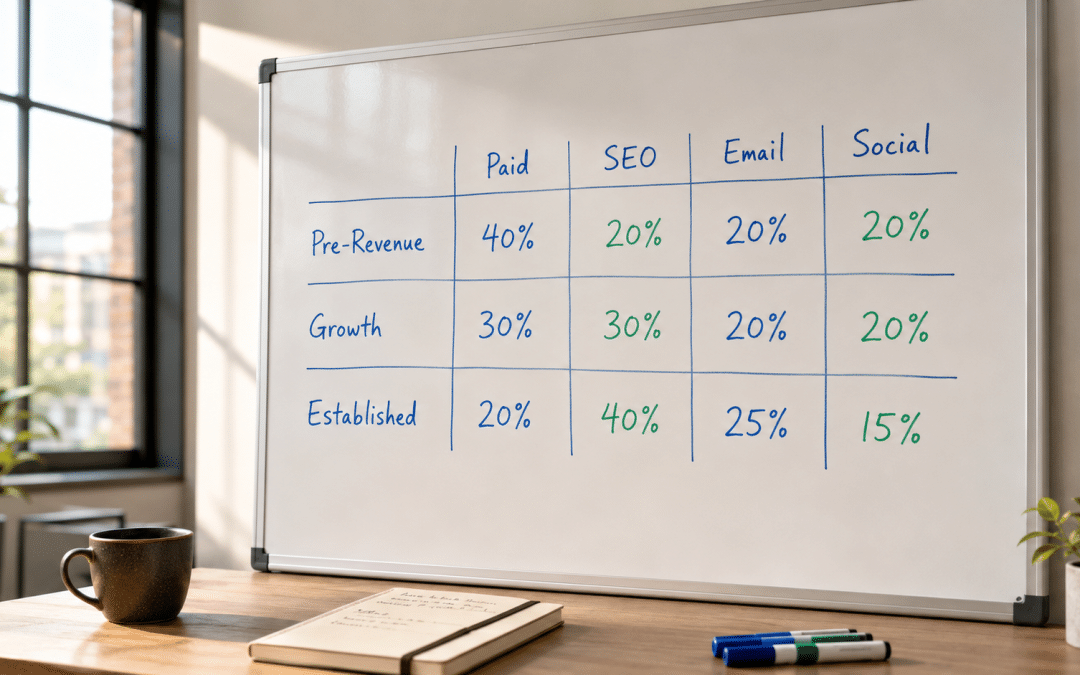
The honest answer to where to invest digital marketing budget for an SA business in 2026 is: it depends on three variables — your business stage, your buyer audience, and the goal you need this spend to hit in the next 90 days. Most SA businesses pick the channel first, then try to retrofit it to the goal, which is why so many R20,000-per-month marketing budgets generate zero traceable revenue.
This guide gives you the Growth Pulse Matrix — a decision framework that maps the three variables to a channel mix you can actually execute against. It sits downstream of our digital strategy guide for South Africa, which covers the strategic frame, and our digital marketing budget guide, which covers how much SA businesses should be spending in the first place.
Quick Answer
Where to invest digital marketing budget in SA depends on three things: business stage (pre-revenue, growth, established), audience type (B2C consumer, B2B enterprise, local service), and primary goal (awareness, lead generation, revenue, retention). A pre-revenue B2C business chasing first sales should put 70% of spend into paid ads with the rest in email; an established B2B business chasing pipeline should invert that — 60% into SEO and content with paid as the support layer.
The Gartner 2026 CMO Spend Survey found that 56% of CMOs say their organisation lacks the budget to deliver their 2026 strategy. The fix is not more budget — it is sharper allocation. Below is the matrix that decides which channel earns your next Rand.
Spending on digital marketing but unsure if it's the right mix?
Tell us your monthly budget, your business stage, and your single biggest pipeline goal. We will give you a channel allocation recommendation specific to your numbers — not a generic best-practice list.
Get a Free Channel Allocation ReviewWhere to Invest Digital Marketing: The Three Variables That Decide
The three variables that decide where to invest digital marketing spend are stage, audience, and goal. Pick the wrong channel for any one of them and you waste 50% to 80% of the budget without ever knowing what went wrong.
Stage determines the channel time-to-revenue you can tolerate. SEO compounds over 6 to 12 months; paid ads return revenue in the same week you launch. If you are 90 days from running out of runway, SEO is not where you invest — even if it is technically the highest-ROI long-term channel for your category.
Audience determines which platforms your buyers actually use to make decisions. B2B SaaS buyers research on Google and LinkedIn; B2C fashion buyers research on Instagram and TikTok; local service buyers search for "plumber near me" and click whatever appears in the Google Local Pack.
Investing in the wrong audience surface is the most common SA mistake we see — beautiful Instagram content for a B2B accounting firm whose buyers do not open Instagram for purchasing decisions.
Goal determines which metric the channel needs to move. Awareness goals need reach-priced channels (display, social organic, YouTube). Lead generation goals need intent-priced channels (search, retargeting, LinkedIn for B2B). Revenue goals need bottom-funnel channels (paid search on commercial keywords, retargeting, email automation). Retention goals need owned channels (email, WhatsApp, SMS).
Key Takeaway
The single biggest cause of wasted SA digital marketing spend is mismatched channel-to-goal selection. Spending R15,000 a month on Instagram for a B2B SaaS business is not "trying social" — it is funding a channel your buyers do not use to make purchase decisions. The matrix below maps the right channel to the right combination of stage, audience, and goal.
The Growth Pulse Matrix: Stage × Audience × Goal → Channel Mix
The Growth Pulse Matrix is the framework we use internally at GPM when scoping new client work in South Africa. It collapses the three variables into a channel allocation recommendation rather than a generic best-practice list. Below is the matrix for the most common SA business combinations.
| Stage | Audience | Primary Goal | Recommended Channel Mix |
|---|---|---|---|
| Pre-revenue / first 12 months | B2C consumer | First sales / proof of concept | Paid social 50%, paid search 30%, email 20% |
| Pre-revenue / first 12 months | B2B enterprise | First qualified meetings | LinkedIn outreach 40%, paid search 30%, content 30% |
| Pre-revenue / first 12 months | Local service | First local leads | Google Local + paid search 60%, GBP optimisation 25%, WhatsApp 15% |
| Growth stage / 1–3 years | B2C consumer | Predictable revenue scaling | Paid 40%, SEO 25%, email 20%, social organic 15% |
| Growth stage / 1–3 years | B2B enterprise | Pipeline at scale | SEO 35%, paid search 25%, LinkedIn 20%, email 20% |
| Growth stage / 1–3 years | Local service | Multi-suburb expansion | Local SEO 45%, paid search 25%, GBP 15%, WhatsApp 15% |
| Established / 3+ years | B2C consumer | Margin protection + retention | Email 35%, SEO 30%, paid 20%, social organic 15% |
| Established / 3+ years | B2B enterprise | Account expansion + thought leadership | SEO + content 50%, LinkedIn 25%, paid search 15%, email 10% |
| Established / 3+ years | Local service | Defending position + reviews | Local SEO 50%, GBP + reviews 25%, retargeting 15%, WhatsApp 10% |
The matrix is not absolute — businesses with strong existing brand awareness can compress paid spend faster than a cold-start brand can. Use it as the starting allocation, then adjust based on what your data shows over the first 90 days.
Why Stage Matters More Than Most SA Businesses Realise
A pre-revenue business and an established business can be in the same industry, target the same audience, chase the same goal, and still need entirely different channel mixes. The difference is time-to-revenue tolerance. Pre-revenue businesses cannot wait 6 to 12 months for organic search to compound — they need paid traffic generating leads in week one or the business does not exist long enough to see SEO pay off.
Established businesses can afford the long game. They have cash flow from existing customers funding the patient investments. SEO and content marketing at 50% of budget makes sense for an established B2B SA firm; it makes no sense for a 3-month-old startup that needs revenue before month 6.
Why Audience Determines the Platform, Not Your Preference
SA business owners often invest in the channels they personally use. A founder who lives on Instagram puts marketing budget into Instagram. A founder who reads LinkedIn puts it into LinkedIn. The founder's media diet is almost never the same as the target buyer's media diet.
Audit your own buyer behaviour, not yours. Where do your existing customers say they first heard of you? Which platform do they engage with most? What do they search to solve the problem you solve? These three questions answer the audience-to-platform mapping more accurately than any global best-practice list.
SA Channel Performance Benchmarks: What Returns Look Like
The table below shows realistic 90-day return windows for each major SA digital marketing channel, based on accounts we have worked with across B2B and B2C verticals over the past 24 months. These are not best-case scenarios — they are what most SA businesses should expect with competent execution.
| Channel | Time to First Leads | Time to Predictable ROI | Typical SA CPL Range |
|---|---|---|---|
| Paid search (Google Ads) | Week 1 | Month 2–3 | R150 – R1,200 |
| Paid social (Meta, TikTok) | Week 1 | Month 2–4 | R80 – R600 |
| LinkedIn paid (B2B) | Week 2–3 | Month 3–6 | R600 – R3,500 |
| SEO (organic search) | Month 4–6 | Month 9–12 | R40 – R350 (post-ranking) |
| Email marketing (to existing list) | Week 1 | Month 1–2 | R20 – R150 |
| WhatsApp marketing | Same day | Month 2–3 | R30 – R200 |
| Content marketing (long-form) | Month 6–9 | Month 12+ | R30 – R250 (compounding) |
| Google Business Profile / Local Pack | Week 4–8 | Month 3–6 | R0 – R80 (organic + minimal paid) |
Notice the spread on SEO and content. They have the worst time-to-leads ranking on the list but the best long-term CPL once they compound. The Gartner 2026 CMO Spend Survey reflects this tension — CMOs are being forced to make sharper allocation decisions precisely because budgets are flat while expectations rise. The answer is not more spend; it is more discipline in choosing channels by stage.
Key Takeaway
SEO is the highest long-term ROI channel for most SA businesses, but it is also the slowest. If you cannot afford to wait 9 to 12 months for it to compound, do not invest in SEO as the primary channel — invest in paid until cash flow can fund the patient investment. Pre-revenue businesses choosing SEO as the lead channel is the second-most common SA mistake we see, after the platform-preference error above.
Want to know which row of the matrix is yours?
Send us your stage, audience, current monthly budget, and the one number you most need to move in the next 90 days. We will tell you which channel mix matches your situation and where your current allocation is likely leaking spend.
Get a Free Matrix MappingThe Three Most Expensive SA Allocation Mistakes
The Growth Pulse Matrix exists because we have audited the same three mistakes in SA marketing budgets over and over. Each one wastes more spend than the channel selection itself does.
Mistake 1: Spreading Budget Across Too Many Channels Too Early
A R15,000 monthly budget split four ways across Google Ads, Meta, LinkedIn, and SEO becomes R3,750 per channel — below the minimum effective spend on any of them. The result is four channels generating noise instead of one or two generating signal. Pre-revenue SA businesses should pick the one channel their audience and goal point to, and put 70% to 80% of budget into it until it works.
Mistake 2: Investing in Top-Funnel Awareness When You Need Bottom-Funnel Revenue
This is the platform-preference error in different clothing. A business needing revenue this quarter invests in YouTube ads, podcast sponsorships, or display campaigns because they are "building the brand." The brand-building work matters — but only after the bottom-funnel revenue layer is producing. Top-funnel investment without bottom-funnel infrastructure to capture demand is funding awareness for a business that goes out of business while waiting for the awareness to convert.
Mistake 3: Not Reinvesting Winning-Channel Returns Into the Same Channel
The SA business equivalent of taking chips off the table too early. A channel returning 4:1 ROAS should get more budget, not the same budget while you "diversify into something new." Diversification matters at scale; pre-revenue and growth-stage SA businesses are better served by doubling down on whichever channel is actually working until it stops working.
Real SA Example: Where the Money Actually Went
An SA professional services firm came to us in mid-2025 spending R32,000/month split roughly 4-ways across paid search, Facebook ads, Instagram, and a sporadic content effort. The matrix said established B2B firm + pipeline goal = SEO + content + paid search + LinkedIn. We reallocated without increasing the total budget. Below shows the before-and-after over 6 months.
| Metric | Before (4-way split) | After (matrix-aligned) |
|---|---|---|
| Total monthly spend | R32,000 | R32,000 (unchanged) |
| SEO + content allocation | R6,000 | R14,000 |
| Paid search allocation | R8,000 | R10,000 |
| LinkedIn allocation | R0 | R5,000 |
| Facebook / Instagram allocation | R18,000 | R3,000 |
| Monthly qualified leads (B2B) | 4 | 19 |
| Cost per qualified lead | R8,000 | R1,684 |
| Lead-to-client conversion rate | 12% | 22% |
| Effective cost per client | R66,667 | R7,655 |
Same total budget. Same business. Same offer. The difference was where the money was invested. Facebook and Instagram for a B2B professional services firm was funding awareness against an audience that does not make professional services purchasing decisions on Instagram. Redirecting the bulk of that budget into channels their buyers actually use produced a 4.7x improvement in qualified leads and an 8.7x improvement in cost per client — without spending an extra rand.
Why Most SA Agencies Sell You the Channels They Specialise In
An SEO agency will recommend SEO. A Google Ads agency will recommend Google Ads. A social media agency will recommend social media. Each is technically correct that their channel can work for your business — but none is incentivised to tell you a different channel would be the better investment for your specific stage, audience, and goal combination.
The honest framing is that channel selection is a strategy question, not a tactic question. Before hiring an agency, decide where to invest based on the matrix. Then hire the specialist for the channel the matrix points to. Hiring the specialist first and letting them tell you which channel to invest in inverts the decision and almost always over-invests in whatever they happen to sell.
The GPM Difference: Channel Allocation Before Channel Execution
Growth Pulse Media works the matrix question first, regardless of which service the client ends up buying from us. Every digital strategy engagement starts with the stage-audience-goal mapping, and we will tell you when the matrix points to a channel we do not specialise in. Sending a B2B SaaS founder to spend money on TikTok is not a service to them, even if we could technically run the campaign.
This comes from operator experience. Before GPM, Dirk built and scaled an SA ecommerce business across paid traffic, email automation (Klaviyo and Omnisend), SA payment gateways (PayFast and Peach Payments), and SA courier logistics (The Courier Guy and Aramex). The channels that made that business profitable were not the channels that were trending — they were the channels that matched the stage and audience at each phase. The matrix is that lesson, codified.
Who This Is NOT For
SA businesses with no clear primary goal
If the answer to "what do you most need this spend to do in the next 90 days" is "everything — awareness, leads, sales, retention," the matrix cannot help yet. Pick one goal first. The channels that move awareness are not the channels that move bottom-funnel revenue. Trying to fund all four goals on a sub-R50,000 monthly budget guarantees that none of them gets enough budget to actually move.
Businesses without 90 days of historical channel data
If you have never run any digital marketing before, the matrix is a starting allocation, not a final one. The first 90 days produce the data you need to refine. Brand-new businesses should treat the matrix recommendation as version 1.0 and revisit it once they have actual SA performance numbers from their specific audience.
Companies looking for a single "best channel" answer
There is no single best channel for SA digital marketing. The matrix exists precisely because the answer is conditional. If you came here looking for "is SEO better than Google Ads," neither answer applies to your business until we know the stage, audience, and goal. The right answer is whichever channel your specific row of the matrix points to.
Businesses under R5,000/month total digital marketing spend
At this budget level, channel selection matters less than building a single repeatable system end-to-end. Pick paid search OR paid social OR email — one channel, executed properly — and grow the budget from results before applying the matrix. The matrix assumes enough budget to fund the recommended primary channel at minimum effective spend, which is typically R8,000 to R15,000/month per channel in SA.
What to Do This Week
Three steps will tell you whether your current channel allocation matches the matrix or needs reallocation.
First, write down your three variables in one sentence: "We are [stage] with [audience type] and our primary goal for the next 90 days is [goal]." If you cannot finish that sentence in 15 seconds, the allocation problem is downstream of a strategy problem — fix the strategy first.
Second, audit your last 90 days of spend by channel. Calculate cost per lead, lead quality, and conversion-to-customer rate per channel. The channels at the bottom of that list are funding awareness, not revenue. If you are pre-revenue or growth-stage, that ranking tells you where to cut.
Third, compare your current allocation to the matrix row for your stage-audience-goal combination. If you are spending more than 20% on a channel the matrix does not list for your row, you have likely found the allocation leak.
Key Takeaway
Most SA marketing budgets are leaking 30% to 60% of spend on channels that do not match the business's stage, audience, or goal. Fixing the allocation almost always produces a bigger return than increasing the budget. The matrix is the framework; the audit of your last 90 days is the evidence; the reallocation is the move.
Ready to fix where your digital marketing budget is actually going?
Send us your current monthly spend by channel and your one biggest pipeline goal. We will benchmark your allocation against the matrix row that fits your business and tell you exactly where the leak is. Free, no obligation, takes us 30 minutes.
Get a Free Budget Allocation AuditFrequently Asked Questions
Where should an SA business invest its first R10,000 digital marketing spend?
For pre-revenue businesses, the first R10,000/month should go into one channel that matches your audience — typically paid search if your buyers Google for what you sell, paid social if they discover on Instagram or TikTok, or LinkedIn if you are B2B. Splitting R10,000 across three or four channels reduces each to below minimum effective spend and produces noise instead of signal. Pick one, prove it, then expand.
Is SEO or Google Ads better for SA businesses?
Neither is universally better — the answer depends on your time-to-revenue tolerance. Google Ads returns leads in week one but costs more per lead. SEO compounds over 6 to 12 months but produces lower long-term cost per lead. Pre-revenue businesses that need cash flow inside 90 days should invest in Google Ads first; established businesses with cash flow should invest more in SEO for the long-term return.
How much of my marketing budget should go to social media in South Africa?
Social media as a primary channel deserves 30% to 50% of digital marketing budget for B2C consumer businesses targeting buyers under 35, and 0% to 15% for B2B businesses targeting enterprise buyers. The South African consumer market is heavily Instagram, TikTok, and Facebook; the SA B2B market still makes purchasing decisions through LinkedIn, search, and email — not Instagram. Match the channel to the audience, not to what feels modern.
Should an SA startup invest in content marketing?
Not as a primary channel for the first 12 months in most cases. Content marketing has a 6-to-12-month time-to-results window, which most SA startups cannot afford while burning cash on operating costs. Invest in paid channels first to generate revenue, then layer content marketing on top once cash flow funds the patient compounding investment. The exception is B2B SaaS targeting enterprise buyers, where content is a credibility prerequisite for first conversations even pre-revenue.
How do I know if my current digital marketing allocation is wrong?
Three signals: cost per qualified lead trending up over the past 90 days, lead-to-customer conversion rate below 10% for B2B or below 1% for B2C ecommerce, or more than 30% of spend going to a channel your buyers do not use to make purchasing decisions. Any one of those is a sign the allocation is mismatched to your stage, audience, or goal.
What digital marketing channel is most underused by SA businesses?
Email marketing to existing customer lists. The Gartner 2026 CMO Spend Survey shows email remains a top-impact channel globally, yet most SA SMEs do not have an active email programme beyond order confirmations.
Email costs almost nothing per send, returns R30 to R150 cost per lead on warm lists, and is the highest-ROI channel for retention. If you have over 500 customers and no active email marketing, that is the cheapest revenue you are leaving on the table.
Get a Free Digital Marketing Allocation Audit
If you are spending over R15,000/month on digital marketing and your cost per lead is climbing or your channel mix feels guessed rather than chosen, you are likely sitting on a 30% to 60% reallocation opportunity. We will benchmark your current allocation against the Growth Pulse Matrix, identify the channels leaking spend, and give you a 90-day reallocation plan.
You will get specific recommendations, not a sales pitch. If your current allocation is sound, we will tell you that too and leave you with the audit document.
No obligation — we will get back to you within 24 hours.
Request Your Free Allocation Audit
Dirk van Greuning Founder of Growth Pulse Media and a specialist in South African search dominance. Dirk translates his experience in scaling South African businesses into high-velocity digital strategies for B2B and retail leaders. He writes about SEO, lead generation, and paid media from an operator's perspective — prioritising pipeline value over impressions.
Connect with Dirk on LinkedIn