
 Add to Preferred Sources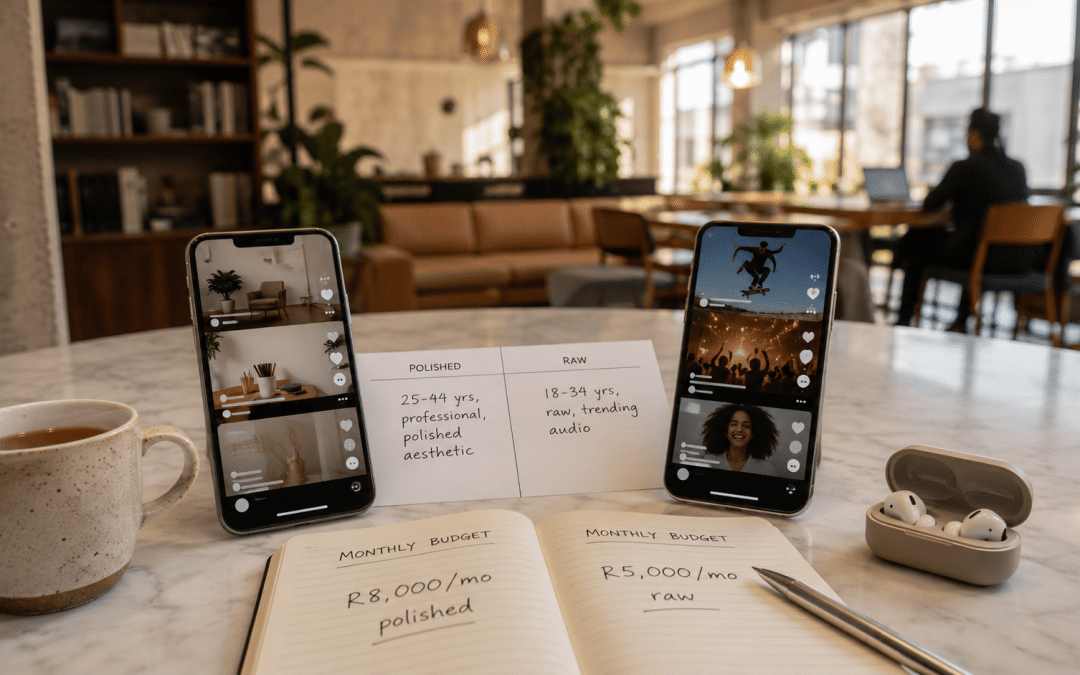
The honest answer to instagram vs tiktok south africa is that neither platform wins universally — Instagram wins for SA brands selling visually-driven premium products to 25-44 year-old professionals with disposable income, while TikTok wins for SA brands building cultural relevance with 18-34 year-old audiences through authentic content rather than polished production.
Most successful SA businesses ultimately use both platforms, but the one you should prioritise depends on three specific variables: your buyer demographic, your product visual potential, and your team's content production capacity.
This guide breaks down the head-to-head comparison for SA businesses — covering audience size, demographic skew, content format performance, paid advertising costs, lead conversion patterns, and the strategic decision framework that determines which platform deserves your primary focus in 2026. For the broader context, see our complete social media marketing guide for Johannesburg businesses.
Quick Answer
For SA businesses in 2026, choose Instagram if your buyer is 25-44, your product photographs well, and you can produce polished visual content consistently. Choose TikTok if your buyer is 18-34, your brand can produce raw authentic content, and you want viral reach potential. Use both if your budget supports R12,000+ monthly content production. Instagram has approximately 7.4 million SA users with stronger commercial intent and shopping behaviour; TikTok has roughly 10.6 million SA users aged 18+ with higher organic reach but lower direct purchase intent. The instagram vs tiktok south africa decision is rarely either-or for established brands — it is sequencing, with most successful SA businesses starting on one platform and adding the second after 6-12 months of consistent execution.
Want a platform recommendation tailored to your specific SA business and buyer profile?
Get a Free Platform RecommendationInstagram vs TikTok South Africa: Audience Size and Demographics
The audience comparison for instagram vs tiktok south africa starts with raw user numbers and demographic skew — and the picture is more nuanced than either platform's marketing materials suggest. Instagram has approximately 7.4 million active SA users in 2026, while TikTok reaches roughly 10.6 million SA users aged 18 and above according to platform advertising data. The raw user count favours TikTok, but raw reach is not the same as commercial buyer concentration. That gap between reach and buyers is why platform choice deserves a plan, which our digital strategy guide for South Africa treats as a question of the right channel mix.
Instagram audience profile in SA
Instagram's SA user base skews toward 25-44 year-old professionals with higher disposable income, with strongest concentration in Johannesburg, Cape Town, and Durban. The platform's gender split is roughly balanced.
SA Instagram users are more likely to follow brands, save products to wishlists, and use Instagram Shopping for direct purchase research. Instagram's audience is structurally more commercially mature — meaning users expect branded content as part of the platform experience and engage with it less defensively than on other platforms.
TikTok audience profile in SA
TikTok's SA user base skews younger — concentrated in the 18-34 age bracket — with strong growth among university students and early-career professionals. Geographic distribution is broader than Instagram, with significant TikTok adoption in smaller SA cities and townships where Instagram penetration is lower.
According to DataReportal's Digital 2025 South Africa report, the average SA internet user spends approximately 3 hours 36 minutes on social media daily — more than 1.5 times the global average, meaning whichever platform an SA user adopts, they spend significant time on it.
The Demographic Decision Rule
The single biggest determinant of which platform wins for an SA business is buyer age and income profile. If your typical customer is a 35-year-old professional with R30,000+ monthly disposable income, Instagram wins — that buyer lives on Instagram and uses TikTok occasionally for entertainment. If your typical customer is a 24-year-old early-career professional with R8,000-R15,000 monthly discretionary spending, TikTok wins — that buyer lives on TikTok and uses Instagram defensively for brand verification. The platforms are not interchangeable audiences with different aesthetics; they are structurally different demographic concentrations.
Instagram vs TikTok South Africa: Content Format Performance
Content format performance differs fundamentally between the platforms, and this difference often matters more than audience size for SA businesses evaluating instagram vs tiktok south africa as a strategic choice. Each platform rewards different content production approaches, and the wrong format on the wrong platform underperforms even with strong execution.
| Content Format | Instagram Performance | TikTok Performance |
|---|---|---|
| Polished product photography | Strong — feeds reward visual quality | Weak — feels like an ad in disguise |
| Behind-the-scenes raw video | Moderate — works in Stories, weak in feed | Strong — algorithm explicitly favours authentic content |
| Educational carousel posts | Strong — high save and share rates | Weak — format does not exist natively |
| Trending audio short-form video | Moderate — Reels works but lags TikTok | Strong — core platform format |
| Long-form thought leadership | Weak — platform structurally caps length | Moderate — TikTok now supports up to 10-minute videos |
| User-generated content campaigns | Strong — Instagram Stories integration | Strong — duets and stitches built-in |
| Direct shoppable content | Strong — Instagram Shopping mature locally | Limited — TikTok Shop not yet available in South Africa |
The production cost difference
SA brands often underestimate that the two platforms require fundamentally different content production approaches and budgets. Instagram rewards polished production — professional photography, considered captions, branded visual identity across the feed. Producing high-quality Instagram content typically requires R8,000-R20,000 monthly for an SA SMB working with freelance photographers and content creators.
TikTok rewards authentic raw content shot on a smartphone, which is genuinely cheaper to produce — typically R3,000-R8,000 monthly for an SA SMB committed to consistent native content creation, primarily covering creator time and basic editing rather than production equipment.
Instagram vs TikTok South Africa: Paid Advertising Costs and ROI
Paid advertising costs and ROI patterns vary significantly between platforms for SA businesses considering instagram vs tiktok south africa as paid channels. The headline metric most marketers focus on — cost per click — only tells part of the story. The more useful comparison is cost per qualified lead or cost per acquired customer, which factors in conversion rate differences between the platforms.
Instagram paid advertising in SA
Instagram ads in SA typically run R8-R25 CPC for competitive ecommerce and consumer service audiences, with cost-per-thousand-impressions (CPM) ranging from R45-R120 depending on targeting precision. Instagram's audience structure produces stronger purchase intent — SA Instagram users clicking ads are often in active research or comparison mode for considered purchases. Conversion rates from Instagram ads to ecommerce purchase typically land at 1.5-3.5% for properly targeted SA campaigns with strong landing page execution.
TikTok paid advertising in SA
TikTok ads in SA typically run R4-R12 CPC — significantly lower than Instagram — with CPMs ranging from R25-R70. The lower CPCs reflect TikTok's larger total impression inventory and the entertainment-first user mindset.
However, conversion rates are also typically lower — 0.5-1.8% for SA ecommerce campaigns — because TikTok users are in discovery and entertainment mode rather than purchase research mode. The net cost-per-acquired-customer math often favours Instagram for direct-response ecommerce, while TikTok favours brand awareness and top-of-funnel audience building.
Need help calculating which platform will actually produce ROI for your specific SA business?
Get a Free Platform ROI AnalysisInstagram vs TikTok South Africa: Commercial Use Cases by Business Type
The right platform choice depends substantially on business type for SA businesses navigating the instagram vs tiktok south africa decision. Below is the realistic mapping of which platform structurally favours which SA business categories, based on observed platform performance patterns across multiple industries. If your category does not fit neatly into either column, our Growth Pulse Matrix strategy service maps your stage, audience, budget and timeline before you commit to a platform.
| Business Type | Primary Recommendation | Reasoning |
|---|---|---|
| Premium fashion and apparel | Polished product photography drives 25-44 buyer purchase decisions. | |
| Mass-market fashion (lower price points) | TikTok | Young audience, viral discovery, trending audio content fits naturally. |
| Beauty and skincare brands | Both — sequence Instagram first | Instagram for purchase research, TikTok for product discovery and reviews. |
| Premium home and decor | Aspirational visual content; older buyer demographic. | |
| Food and beverage delivery | TikTok | Younger urban audience, entertainment-driven food content thrives. |
| Professional services (legal, financial, B2B) | Neither — use LinkedIn | Audience mismatch on both platforms; LinkedIn structurally appropriate. |
| Health and wellness products | Both — sequence Instagram first | Instagram for credibility, TikTok for community. |
| South African ecommerce stores (small to mid-sized) | Shopping integration mature; TikTok Shop unavailable locally. | |
| Restaurants and hospitality | TikTok | Discovery-driven, location-tagged content drives foot traffic. |
| Educational and training services | TikTok | Younger audience seeks skill content; algorithm rewards educational hooks. |
Instagram vs TikTok South Africa: The Sequencing Strategy
The most successful SA businesses do not treat instagram vs tiktok south africa as an either-or choice — they sequence platforms strategically based on their growth stage and content production capacity. Trying to launch on both platforms simultaneously with the same content production capacity typically produces mediocre output on both rather than strong output on either.
The 6-12 month sequencing approach
Pick the platform that aligns with your primary buyer demographic and content production strengths. Build to consistent posting cadence on that platform for 6-12 months — typically 4-5 posts weekly for Instagram, 5-7 posts weekly for TikTok.
Once execution is stable on the first platform and producing measurable business outcomes, add the second platform with adapted content rather than identical content. The adaptation matters because Instagram audiences reject reposted TikTok content and TikTok audiences reject polished Instagram content.
The content adaptation rule
When SA brands eventually run both platforms, the content cannot be mechanically reposted. Instagram Reels need to be reshot or significantly recut from TikTok originals because the audience expects different production values. TikTok content reshared on Instagram Reels often performs at 20-40% of native Instagram Reels reach because the algorithm detects the format mismatch and demotes the post.
The Sequencing Trap
The most common strategic mistake SA businesses make with instagram vs tiktok south africa is launching on both platforms simultaneously with the same content production budget. The economics of social media content production strongly favour concentration over fragmentation at SMB scale. R12,000 monthly spent entirely on one platform produces 3-8x more business impact than R6,000 split across both, because algorithm distribution rewards posting consistency that fragmented effort cannot sustain. Sequence platforms — execute one exceptionally for 6-12 months, then add the second with adapted content rather than identical content reposted across both.
The Before-After Reality for SA Brands
The operational difference between an SA brand making the instagram vs tiktok south africa decision strategically versus making it reactively crystallises into specific business outcomes over a 12-month execution period. Below is a realistic comparison for an SA SMB investing R15,000/month total social media budget split between organic content production and paid amplification.
| Metric | Reactive Approach (Before) | Strategic Sequencing (After) |
|---|---|---|
| Monthly post output across platforms | 8-12 posts split awkwardly across both | 20-28 posts on primary platform only |
| Average post reach (primary platform) | 400-1,200 per post | 2,500-9,000 per post |
| Engagement rate | 0.8-1.5% average across both | 3.5-7% on focused platform |
| Follower growth monthly | 20-60 net followers across both | 250-800 net followers on primary |
| Direct message conversations | 2-5 monthly | 18-45 monthly |
| Profile-to-website click-through | 20-60 monthly | 180-600 monthly |
| Attributable monthly revenue | R2,000-R8,000 | R15,000-R60,000 |
| Cost per qualified lead | R450-R1,200 (when measurable) | R85-R280 |
The table makes the strategic point clear — splitting effort across both platforms at SMB budget levels produces fragmented output that underperforms focused execution on one platform. The 3-8x productivity difference comes from content production focus, algorithm consistency, and audience compounding on a single platform rather than diluted effort across two platforms simultaneously.
Why GPM Approaches Platform Strategy Differently
Most SA agencies handle social media platform selection by defaulting to whichever platform the agency team prefers personally rather than the platform that fits the specific business. That approach produces consistent agency execution but inconsistent business outcomes because platform fit varies dramatically across SA business types and buyer profiles.
Growth Pulse Media builds digital marketing programmes for South African businesses by starting with buyer demographic analysis and content production capacity before recommending platforms. We have run instagram vs tiktok south africa execution for our own brand, ghostwritten content for B2B and B2C clients across both platforms, and tracked post-level performance against attributable pipeline value monthly. The platform recommendation is grounded in the specific business context, not in agency preferences or platform marketing material.
Our typical platform selection engagement starts with a 7-day strategic audit — analysing the buyer demographic, mapping content production capacity honestly, evaluating which platform structurally fits the product visual potential, and building the 6-12 month sequencing plan for primary platform execution before any secondary platform addition. The strategic work happens before content production starts, not after.
Who This Platform Comparison Is NOT For
The instagram vs tiktok south africa decision matters most for SA brands with clear commercial intent on social platforms. Some SA businesses should not be optimising this decision at all — being upfront about that saves wasted strategic time.
B2B businesses targeting professional buyer audiences. Neither Instagram nor TikTok is structurally the right primary platform for SA B2B businesses targeting CEOs, marketing directors, or procurement leaders. LinkedIn is the appropriate primary platform for B2B in 2026, with Instagram or TikTok used opportunistically for brand-building rather than lead generation. Spending strategic time choosing between Instagram and TikTok for B2B audiences is choosing between two structurally wrong platforms.
SA businesses without consistent content production capacity. Both platforms require sustained content production to produce results — Instagram demands 4-5 weekly posts plus Stories activity, TikTok demands 5-7 weekly posts. SA businesses that can produce 1-2 posts monthly will underperform on either platform and would be better served by paid Google Ads or SEO content where the work compounds without daily activity demands.
Premium luxury brands with average sale prices above R50,000. Social media platforms structurally favour broad reach over depth, which mismatches luxury buyer journeys that involve research, comparison, and relationship-building over weeks or months. SA luxury brands typically achieve better outcomes through SEO, targeted PR, and curated email marketing than through Instagram or TikTok primary execution.
SA brands seeking immediate revenue results within 30 days. Both Instagram and TikTok are compound-return channels — pipeline arrives in months 3-6 of consistent execution, not weeks. SA businesses needing immediate sales should run Google Ads or paid Meta campaigns while organic social builds in the background. Pure organic execution on either platform takes 90-180 days to reach attributable revenue scale even with strong content.
Want help deciding which platform deserves your primary focus for the next 12 months?
Book a 20-Minute Platform Fit CallFrequently Asked Questions
Questions that come up most often when SA business owners and marketing managers start seriously evaluating which platform deserves primary investment.
Can SA businesses succeed on both Instagram and TikTok simultaneously?
SA businesses with R25,000+ monthly content production budgets and dedicated content team members can execute on both platforms simultaneously and achieve strong results on each. Below that budget level, focused execution on one platform consistently outperforms split execution across both because content production economics favour concentration over fragmentation.
Most successful SA brands sequence rather than parallelise — they execute one platform exceptionally well for 6-12 months, then add the second platform with adapted (not duplicated) content once primary platform execution is stable.
Does TikTok Shop work for South African ecommerce stores?
TikTok Shop is not currently available in South Africa as of 2026, which significantly limits the direct ecommerce conversion potential of TikTok for SA stores compared to Instagram Shopping. SA TikTok users discover products on the platform but typically convert on websites linked from bio links or directly in Instagram Shopping for the same brands.
This availability gap is meaningful for SA ecommerce strategy — direct shopping integration favours Instagram for SA stores until TikTok Shop launches locally. SA brands using TikTok for ecommerce should treat it as a discovery and brand-building channel feeding conversions on owned channels.
Which platform produces better ROI for SA ecommerce specifically?
For most SA ecommerce stores with average order values between R500-R3,000, Instagram produces higher direct-response ROI than TikTok primarily because of Instagram Shopping integration and the platform's older, higher-disposable-income audience. Typical Instagram ROAS for properly executed SA ecommerce campaigns runs 3-6x, while TikTok ROAS for the same business typically runs 1.5-3.5x.
The trade-off is that TikTok produces meaningfully more top-of-funnel awareness and follower growth, which feeds long-term Instagram and email retargeting performance. Many successful SA ecommerce brands use TikTok as the discovery engine and Instagram as the conversion engine.
What does realistic content production cost in SA?
For an SA SMB executing Instagram seriously, monthly content production typically costs R8,000-R20,000 covering photography, video production, copywriting, and creator fees. For TikTok at the same execution level, monthly content production runs R3,000-R8,000 because the platform rewards authentic smartphone-shot content over polished production.
Running both platforms at strong execution levels typically requires R15,000-R30,000 monthly in content production alone, before paid amplification budgets are added. This is the practical reason most SA SMBs should sequence platforms rather than running both simultaneously.
How long does it take to see results on either platform?
Initial engagement improvements (rising post reach, engagement rate, follower growth) typically appear within 30-45 days of consistent execution on either platform. Inbound conversations and direct messages from prospects typically start within 60-90 days. Attributable pipeline and revenue contribution arrive between months 4-6 as the audience compounds and the algorithm consistently distributes content.
The single biggest factor in time-to-results is posting consistency — gaps in posting cadence reset the algorithm's distribution learning and significantly extend time to results regardless of content quality.
Should an SA business use Instagram Reels or TikTok for short-form video?
SA businesses producing short-form video should produce native content for each platform rather than choosing between them. TikTok rewards trending audio, raw authenticity, and platform-native effects. Instagram Reels rewards polished production aligned with the brand's broader Instagram aesthetic.
If forced to choose only one, the decision returns to the audience demographic and content production capacity questions above. TikTok offers higher organic reach potential for younger audiences with authentic content; Instagram Reels offers stronger commercial intent for older audiences with polished content.
Get Your Custom Instagram vs TikTok Platform Plan for Your SA Business
Receive a custom instagram vs tiktok south africa platform recommendation covering your buyer demographic analysis, content production capacity assessment, 6-12 month sequencing plan, realistic budget recommendation, and platform-specific content strategy. Built by operators who run both platforms for SA brands daily, not by agencies pretending to do platform strategy. No obligation — we will get back to you within 24 hours.
Request Your Custom Platform Plan