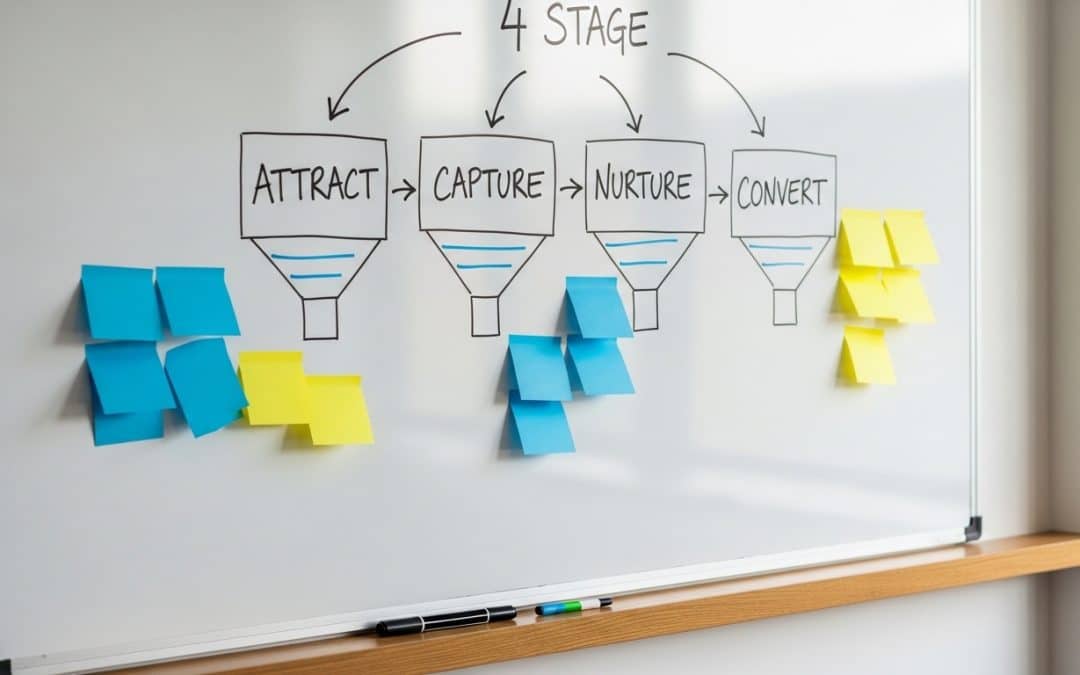
B2B lead generation South Africa is the end-to-end process of attracting SA business buyers, capturing their contact details, nurturing them until they are ready to buy, and converting them into clients. It is built around a repeatable strategic framework rather than ad-hoc campaigns. Most SA B2B businesses treat lead generation as a single tactic — "run Google Ads" or "send cold emails" — when it is actually a four-stage engine.
This guide explains the framework we use at Growth Pulse Media, called The 4-Stage Lead Engine™, and shows exactly how South African B2B businesses use it to generate qualified leads consistently — not just when a campaign happens to be running. If you would rather have this built for you, see our B2B lead generation service.
Quick Answer
B2B lead generation South Africa works when you build a system across four stages — Attract, Capture, Nurture, Convert — rather than relying on one channel. SA B2B buyers take 3–9 months to make purchase decisions, so the business that nurtures consistently wins. Expect R500–R3,500 cost per qualified lead depending on industry and channel mix, with SEO and email producing the lowest long-term cost per lead in the SA market.
Want a custom 4-Stage Lead Engine mapped to your SA business and industry?
Get a Free Lead Engine AuditB2B Lead Generation South Africa: What It Actually Means
B2B lead generation in South Africa is the structured process of moving a stranger from never having heard of your business to becoming a qualified sales conversation. It is not a single channel. It is not cold outreach on its own. It is not LinkedIn posting alone. It is the combined system that runs underneath all of those tactics and turns traffic and outreach into revenue.
The reason most SA B2B businesses struggle with lead generation is that they confuse a tactic with a system. A tactic is running a LinkedIn ad or sending a cold email. A system is what happens when that lead lands on your site, what nurtures them for the next six months while they are not ready to buy, and what converts them when they finally are.
SA B2B buyers behave differently to SA ecommerce buyers. Where an ecommerce buyer might convert in a single session, a typical SA B2B buyer takes between three and nine months from first website visit to signed agreement — especially in services, SaaS, and considered-purchase industries. The business that captures them early and nurtures them consistently is almost always the business that wins the deal when they finally decide to buy.
That is the core logic behind the 4-Stage Lead Engine. Each stage exists because there is a specific failure point in SA B2B lead generation that the stage is designed to fix.
The 4-Stage Lead Engine™ — Framework Overview
The 4-Stage Lead Engine is the framework Growth Pulse Media uses to build B2B lead generation systems for South African businesses. Each stage has a specific job, a specific set of channels that fit it, and a specific metric that tells you whether it is working.
| Stage | Purpose | Primary SA Channels | Key Metric |
|---|---|---|---|
| 1. Attract | Generate qualified traffic and visibility with SA B2B buyers | SEO, Google Ads, LinkedIn Ads, content marketing | Qualified sessions per month |
| 2. Capture | Convert visitors into leads by exchanging value for contact details | Landing pages, gated content, lead magnets, webinars | Lead conversion rate (%) |
| 3. Nurture | Build trust and stay top-of-mind during long SA B2B decision cycles | Email sequences, retargeting, LinkedIn engagement | Marketing qualified leads (MQLs) |
| 4. Convert | Move qualified leads into sales conversations and signed deals | Sales enablement content, case studies, proposals, follow-up systems | Sales qualified leads (SQLs) and close rate |
Why Four Stages
Most SA B2B businesses invest heavily in Stage 1 — driving traffic through ads or SEO — but have almost nothing built in Stages 2 to 4. The result is expensive traffic that leaves and never comes back. The 4-Stage Lead Engine ensures every Rand spent at Stage 1 has a chance to become revenue in Stage 4, rather than evaporating at the point of first visit.
Stage 1: Attract — Generating Qualified SA B2B Traffic
The Attract stage is about getting your business in front of South African B2B buyers at the exact moment they are searching for what you offer, or when they fit the profile of a buyer who should know you exist. This is the top of the funnel. Everything downstream depends on whether the traffic at this stage is actually qualified.
The biggest mistake SA B2B businesses make at the Attract stage is optimising for volume instead of fit. Ten thousand visitors who are not your buyer are worth less than two hundred who are. Every channel choice at this stage should be judged on whether it brings SA B2B buyers in your exact industry, size, and decision-maker role — not whether it brings traffic.
SA B2B Traffic Channels That Consistently Work
SEO: The highest-quality source of B2B leads over time. SA B2B buyers research extensively before making contact — typically consuming 7 to 13 pieces of content before ever reaching out. Ranking for the exact questions and commercial terms those buyers are searching means you are there at the research stage, not trying to interrupt them with ads when they are not ready.
SEO is the slowest channel to activate but produces the lowest cost per qualified lead at scale. See our guide on how SEO works in South Africa.
Google Ads: The fastest channel to generate immediate B2B leads. Works best for commercial-intent queries — "[service] company South Africa", "[service] agency Johannesburg", "best [solution] for SA business". Expect R8–R35 cost per click in most SA B2B verticals, with a typical landing page conversion rate of 3–6% and a resulting cost per lead of R500–R2,500. Our detailed breakdown is in the Google Ads for small business SA guide.
LinkedIn Ads and outreach: The most under-used channel by SA B2B businesses. LinkedIn allows targeting by company size, industry, job title, and seniority — which is precisely how SA B2B buyers are identified. Costs are higher per click (R30–R80 range), but lead quality is substantially better than broad channels. Compare LinkedIn to Google Ads in our LinkedIn Ads vs Google Ads South Africa comparison.
Content marketing: The engine that makes SEO, LinkedIn, and email all work harder. Every piece of content published becomes a Stage 1 asset (search visibility) and a Stage 3 asset (nurture material). SA B2B businesses that publish consistently for 12+ months generate significantly more leads at lower cost than those that only run paid campaigns.
Not sure which Stage 1 channel to prioritise for your SA B2B business?
Get a Free Channel RecommendationStage 2: Capture — Converting Visitors Into Leads
The Capture stage is where qualified traffic becomes a named, contactable lead. This is the stage most SA B2B businesses under-invest in — they pour money into Stage 1 traffic but send it all to a homepage with a "Contact Us" form and wonder why conversion is under 1%.
Capture is not about tricking people into giving you their email. It is about offering something valuable enough that a qualified buyer is willing to exchange contact details for it. The exchange must feel fair to the buyer, or the lead quality collapses.
What High-Converting SA B2B Capture Looks Like
Every Stage 2 capture asset has three things in common: it is specific to one buyer problem, it promises a clear deliverable, and it is easy to consume within 15 minutes of download. Generic "subscribe to our newsletter" forms do not count as capture assets — they capture almost nothing because they offer almost nothing.
✅ Works — specific, valuable, easy to consume
"Download the SA Industrial Equipment Buyer's Checklist — 12 questions to ask any supplier before signing a quote. PDF, 8 pages, sent instantly."
❌ Does not work — vague, no clear value
"Subscribe to our newsletter for the latest industry updates."
The second biggest Capture-stage failure is the landing page itself. SA B2B businesses regularly send R20,000 of Google Ads traffic to a landing page with no clear offer, no social proof, no friction removal, and no urgency. The industry benchmark for a well-built B2B landing page is 4–10% conversion. The average SA B2B landing page converts at well under 2%. That difference is the entire economics of the channel.
Capture Assets That Work for SA B2B
Lead magnets that consistently work for SA B2B businesses include: buyer's checklists, pricing guides, comparison templates, ROI calculators, industry benchmark reports, and on-demand webinars. Each one exchanges a specific, high-value resource for contact details. Each one qualifies the lead by its topic — someone downloading a pricing guide is closer to buying than someone downloading a generic industry report.
The Capture Rule
If you cannot clearly explain why a qualified buyer should give you their email in exchange for this asset, the asset is not good enough. Every Capture asset should pass the "would I actually download this" test from the perspective of your target buyer — not from the perspective of someone internally approving marketing copy.
Stage 3: Nurture — Building Trust Over Long SA B2B Cycles
Stage 3 is the stage that separates SA B2B businesses that generate consistent leads from those that generate occasional ones. Nurture is where trust is built during the months between first contact and buying decision.
Most SA B2B leads are not ready to buy when they first enter your funnel — they are researching, comparing, and waiting for the right trigger. If you are not staying in front of them during that window, a competitor will be.
The reality of SA B2B sales cycles is that 70–90% of leads will not buy in the first 30 days. If your Nurture system does not exist, those leads go cold and your Stage 1 and Stage 2 investment is wasted. If your Nurture system works, a meaningful percentage of those leads return when they are ready — and they return already pre-sold because they have been consuming your content for months.
What SA B2B Nurture Looks Like In Practice
Email sequences: Automated email flows that deliver value, build authority, and keep your business visible over 30, 60, 90, and 180-day windows. Our email marketing strategy guide breaks down sequence architecture in detail. For SA B2B, sequences that mix teaching content with case studies and low-friction calls to action consistently outperform pure promotional sequences.
Retargeting: Paid ads that follow leads who have visited your site or downloaded an asset but not converted. SA B2B retargeting is especially effective because of the long decision cycle — staying visible during the 3-to-9-month consideration window is often the single biggest driver of eventual conversion.
LinkedIn engagement: For SA B2B businesses where buyers are active on LinkedIn, consistent personal posting by decision-makers builds warm familiarity that makes cold outreach dramatically more effective. A buyer who has seen the founder's posts for six months is far more likely to respond to a cold message than one who has not.
Stage 4: Convert — Turning Qualified Leads Into Clients
Stage 4 is where nurtured leads become paying clients. This is the stage closest to sales — but it is still a marketing stage, because what happens here is defined almost entirely by the systems, content, and follow-up processes that sit behind the sales conversation itself.
SA B2B businesses often lose qualified leads at Stage 4 for one of three reasons: follow-up is inconsistent, sales enablement content is missing, or the handoff between marketing and sales has gaps. A lead who downloaded a pricing guide three weeks ago, received no follow-up, and is then cold-called by a salesperson who does not know what they downloaded is effectively a new lead — the entire nurture investment has been wasted.
The Core Stage 4 Systems
Structured follow-up: Every qualified lead needs a defined follow-up sequence — same-day outreach, Day 3 check-in, Day 7 case study, Day 14 offer. Without this, leads fall through cracks and close rates suffer dramatically.
Sales enablement content: Case studies, pricing one-pagers, industry-specific proposals, and objection-handling FAQs. When a sales conversation stalls, the right piece of content unblocks it. SA B2B businesses that do not invest in sales enablement find that sales teams spend hours manually producing the same explanations again and again.
Lead scoring: A simple system for identifying which leads are ready to buy now and which are still nurturing. As few as five scoring criteria — industry fit, company size, role, engagement level, and buying intent signals — already make a significant difference to where sales time is spent.
Real-World SA B2B Lead Engine Example
A Johannesburg-based professional services firm approached Growth Pulse Media with a common problem: they were generating occasional leads from Google Ads and referrals, but nothing predictable. The sales pipeline felt random, not systematic. We built a complete 4-Stage Lead Engine over four months and tracked the before/after.
| Metric | Before Lead Engine | After Lead Engine | Improvement |
|---|---|---|---|
| Qualified monthly sessions | 620 | 2,840 | +358% |
| Landing page conversion rate | 1.2% | 6.4% | +433% |
| Leads generated per month | 7 | 182 | +2,500% |
| Marketing qualified leads (MQLs) | 3 | 64 | +2,033% |
| Sales qualified leads (SQLs) | 1 | 22 | +2,100% |
| Average cost per qualified lead | R4,200 | R1,150 | −73% |
| Monthly pipeline value | R85,000 | R1,980,000 | +2,229% |
What Drove The Result
The lead count and pipeline value increases did not come from one channel. They came from fixing the broken handoffs between stages — adding proper capture assets behind Google Ads traffic, building a 60-day email nurture, adding retargeting, and putting a structured follow-up system behind every qualified lead. Each individual improvement was modest. The compounded effect across four stages was transformative.
Why Growth Pulse Media Builds SA B2B Lead Engines Differently
Growth Pulse Media is a South African digital marketing agency that built its expertise on the operator side before becoming an agency. We have personal experience scaling large SA ecommerce businesses — which means we understand the economics of lead generation from the inside, not from a textbook.
When we recommend a Stage 1 channel mix or a Stage 3 nurture sequence, it is because we have run those systems ourselves with our own money on the line.
Every B2B lead engine we build is executed in-house by senior practitioners. We do not outsource. We do not white-label agency work. We work with a limited client load — fewer clients, more senior attention per client, better outcomes. For SA B2B businesses that want a complete lead engine built and managed end-to-end, our B2B lead generation service covers every stage from Attract to Convert.
The SA B2B lead generation market is full of agencies that will run ads, send reports, and bill retainers without ever building an actual system. We build systems. We focus on revenue and qualified pipeline — not impressions, clicks, or vanity metrics. Every 4-Stage Lead Engine we deliver is measured on the same question: is this producing a predictable, growing flow of qualified sales conversations for the business?
External benchmarks support the framework. According to HubSpot B2B marketing statistics, lead generation is the single most important metric for measuring content marketing effectiveness — which is exactly what the 4-Stage Lead Engine is designed to optimise end-to-end.
Need an SA B2B nurture sequence built end-to-end — no templates, no outsourcing?
Get a Custom Nurture Sequence BuiltWho This Is NOT For
The 4-Stage Lead Engine is not the right fit for every SA business. Before engaging with Growth Pulse Media, it helps to know whether you are the kind of business this framework is built for.
❌ Not For: Businesses looking for the cheapest agency option
The Lead Engine requires senior in-house execution across SEO, ads, email, and CRO. If the evaluation criterion is the lowest monthly retainer, a junior-executed agency is a better fit. We are not the cheapest and do not try to be.
❌ Not For: Businesses expecting leads in 30 days
Stages 1 and 2 produce early signals at 30–60 days, but the full compounding effect of the Lead Engine takes 3–6 months to build and another 3–6 to mature. If the timeline is shorter than 90 days, the fit is wrong.
❌ Not For: Businesses with under R15,000/month marketing budget
A complete Lead Engine across four stages needs a minimum budget to sustain traffic generation, capture assets, nurture infrastructure, and sales enablement content. Below R15,000/month, the system cannot produce the compounding effect it is designed to produce.
❌ Not For: Businesses that want tactics without a strategy
If the brief is "just run our Google Ads" with no interest in the rest of the engine, the Lead Engine is overkill. A standalone Google Ads management engagement fits that need better than the full four-stage framework.
Frequently Asked Questions
How much does B2B lead generation cost in South Africa?
B2B lead generation South Africa costs typically range from R500 to R3,500 per qualified lead depending on industry, channel mix, and deal size. Enterprise B2B verticals (R500,000+ deal size) often accept R3,000–R10,000 cost per lead because lifetime value justifies it. SMB-focused SA B2B typically targets R500–R1,500 per qualified lead. SEO and email produce the lowest long-term cost per lead, while Google Ads and LinkedIn Ads produce the fastest but more expensive leads.
How long does it take to build a B2B lead generation system in South Africa?
A complete 4-Stage Lead Engine takes 3 to 6 months to build and another 3 to 6 months to mature into consistent qualified lead flow. Stage 1 (Attract) and Stage 2 (Capture) produce early signals within 30–60 days.
Stage 3 (Nurture) compounds over 90+ days. Stage 4 (Convert) improves as more data feeds back into the system. Businesses expecting predictable leads in under 90 days will be disappointed — the framework works, but it works on B2B timelines, not ecommerce timelines.
What is the best channel for B2B lead generation in South Africa?
There is no single best channel — the 4-Stage Lead Engine deliberately combines channels because each has a specific role. For fast commercial leads, Google Ads and LinkedIn Ads work best.
For long-term compounding lead flow at the lowest cost per lead, SEO is the highest-ROI channel over 12+ months. For nurturing leads through long SA B2B decision cycles, email sequences and retargeting outperform every other channel. The right mix depends on industry, budget, and sales cycle length.
What is the difference between B2B and B2C lead generation in South Africa?
SA B2B lead generation involves longer decision cycles (3–9 months vs 1 session for ecommerce), higher deal values, multiple stakeholders per decision, and extensive research before first contact. SA B2C and ecommerce is about creating demand and converting in-session.
South African B2B is about capturing research-stage buyers, nurturing them for months, and converting when they are ready. The 4-Stage Lead Engine is built specifically around B2B timelines — it would be overkill for a simple ecommerce business but essential for any considered-purchase SA B2B offer.
Do I need a CRM for B2B lead generation in South Africa?
Yes — a CRM is the operational backbone of Stages 3 and 4. Without one, leads fall through cracks, nurture sequences cannot be personalised, and sales cannot identify which leads are ready to buy. HubSpot, Pipedrive, and Zoho CRM are all used successfully by SA B2B businesses, with HubSpot being the most common for businesses running structured inbound lead generation. The choice matters less than whether the CRM is actually used consistently.
Can small SA B2B businesses build a 4-Stage Lead Engine on a limited budget?
Yes, but with realistic expectations. A minimum viable Lead Engine for small SA B2B businesses prioritises SEO (Stage 1), one well-built landing page with a single strong lead magnet (Stage 2), a 5-email welcome sequence (Stage 3), and a simple structured follow-up process (Stage 4).
This can be built and operated on R15,000–R25,000 per month. Scaling up means adding Google Ads, LinkedIn Ads, retargeting, and deeper nurture — but the framework scales down as cleanly as it scales up.
How is B2B lead generation different from sales prospecting in South Africa?
Lead generation is the system that produces inbound qualified leads — buyers who have raised their hand by downloading an asset, filling a form, or booking a call. Sales prospecting is outbound outreach to buyers who have not raised their hand.
Both can work, but lead generation produces warmer, more qualified conversations because the buyer has already demonstrated intent. Most high-performing SA B2B businesses run both — inbound lead generation as the primary engine, outbound prospecting as a supplement for specific target accounts.
The 4-Stage Lead Engine is not theory — it is the same framework we use internally and the same framework we deliver to SA B2B clients. Every stage exists to fix a specific failure point in SA B2B lead generation. Every stage compounds into the next. Building one stage in isolation produces marginal results. Building all four produces predictable, growing lead flow that does not depend on a single channel or campaign.
Build Your 4-Stage Lead Engine With Growth Pulse Media
Growth Pulse Media builds complete B2B lead generation systems for South African businesses — Attract, Capture, Nurture, Convert — all four stages executed in-house by senior practitioners with real SA operator experience. Limited client load, no outsourcing, revenue and qualified pipeline reporting over vanity metrics.
Request a free Lead Engine Audit and receive a prioritised 3-page report covering your current performance at each of the four stages and the highest-leverage next move for your business. No obligation — we will get back to you within 24 hours.
Get Your Free Lead Engine Audit