
 Add to Preferred Sources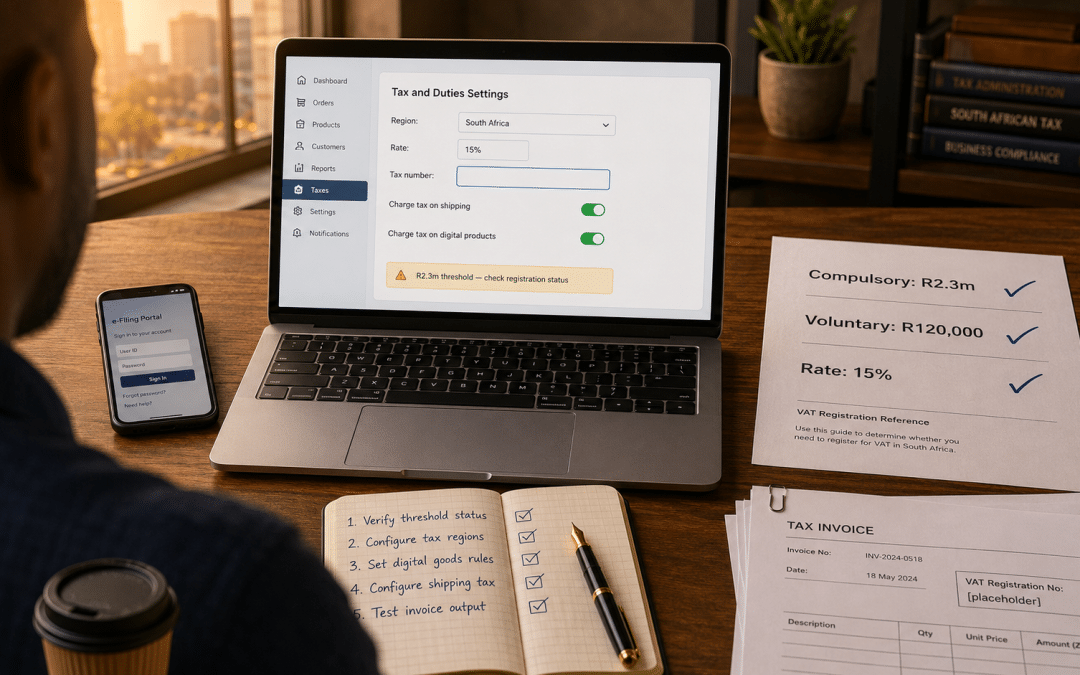
Shopify tax VAT South Africa configuration involves setting the correct 15% SA VAT rate, deciding whether your store is above or below the R2.3m compulsory registration threshold that took effect 1 April 2026, configuring digital goods taxation, and handling cross-border implications for stores selling internationally. Get any of these wrong and you either overcharge customers (killing conversion) or underpay SARS (accumulating penalties). Neither is fixable retrospectively without pain.
This guide covers exactly what SA operators need to configure their Shopify tax settings correctly for the current SA regulatory environment: VAT registration decision, Shopify admin configuration steps, digital goods and cross-border scenarios, and the compliance workflow between Shopify order data and SARS filings. For broader Shopify context, see our Shopify South Africa guide. For payment gateway integration alongside tax setup, see our Shopify payment gateways guide.
Quick Answer
Shopify tax VAT South Africa setup depends on your VAT registration status. If registered, configure Shopify Admin → Settings → Taxes and duties → South Africa at 15%, enable tax-inclusive pricing, configure tax on shipping, and set up digital goods rules. If below the R2.3m compulsory threshold and not voluntarily registered, disable VAT collection entirely. The 1 April 2026 threshold change (R1m → R2.3m) means many SA stores previously required to register are now optional.
Want a free 60-minute Shopify tax configuration review for your SA store?
Get a Free Tax Setup ReviewWhy SA VAT Setup is Genuinely Different From Global Shopify Tax Guides
Global Shopify tax guides assume US sales tax nexus rules, EU VAT reverse-charge mechanisms, or UK MTD compliance frameworks. None of these apply to SA. Shopify tax VAT South Africa configuration operates against SARS rules — the 15% standard rate, R2.3m compulsory threshold (effective 1 April 2026), 21-business-day registration deadline, and bi-monthly VAT201 filing cadence for most vendors.
According to SARS official VAT documentation, VAT is levied at 15% on the supply of goods and services by registered vendors. The compulsory registration threshold moved from R1 million to R2.3 million effective 1 April 2026 — the first change since 2009. The voluntary registration threshold moved from R50,000 to R120,000. These are the rules Shopify SA operators configure against — not US, EU, or UK frameworks.
The Critical Reframe
Shopify tax VAT South Africa is not "tick the box for South Africa in tax settings and move on". It is a compliance workflow linking your VAT registration status (or lack thereof), your Shopify tax configuration, your invoice format (must include VAT number if registered), your bi-monthly VAT201 filings to SARS, and your customer pricing display strategy. Missing any layer produces either customer trust damage or SARS penalties — usually both when problems compound.
The Five-Step Shopify Tax VAT Configuration Framework for SA Operators
Effective Shopify tax VAT South Africa configuration follows a repeatable five-step framework. Skipping the registration decision phase and jumping to Shopify settings is the most common failure pattern. The framework below reflects what actually works for SA operators, not global boilerplate.
| Step | What It Involves | Timeline |
|---|---|---|
| 1. Registration status decision | Are you above R2.3m compulsory threshold, below with voluntary registration, or below without? Impacts everything downstream | Week 1 |
| 2. Shopify tax region configuration | Settings → Taxes and duties → South Africa at 15%; enter VAT number if registered | Week 1 |
| 3. Pricing display strategy | Tax-inclusive display (SA consumer expectation) vs tax-exclusive; product template updates | Week 1-2 |
| 4. Shipping and digital goods rules | Charge tax on shipping (yes by default in SA); digital goods rules for cross-border compliance | Week 2 |
| 5. Invoice and reconciliation workflow | Tax invoice format compliance; Shopify order data → accounting software → VAT201 filing | Weeks 2-4 |
SA operators who follow this framework configure Shopify tax settings correctly the first time and avoid retroactive fixes that damage customer trust or trigger SARS penalties. Those who skip step 1 (registration decision) often discover they should have registered voluntarily or should have deregistered when the threshold changed — usually after compliance costs have already been incurred. Registration status determines everything downstream.
The Three Most Common SA Shopify Tax Mistakes
Three mistakes consistently create Shopify tax VAT South Africa compliance problems. Each is invisible until SARS audits or customer complaints surface. Identifying them ahead of time saves substantial pain.
Mistake 1 — Charging 15% VAT While Not Registered
SA operators below the compulsory R2.3m threshold sometimes enable Shopify's VAT collection anyway — assuming it looks professional or because a global tax template suggested it. This is illegal. Only VAT-registered vendors may collect VAT. Non-registered vendors collecting VAT face SARS penalties and customer refund exposure. The fix is disabling VAT collection entirely if unregistered. If you want the "look" of being VAT-registered, register voluntarily — do not fake it.
Mistake 2 — Not Registering When Above the R2.3m Threshold
SA operators crossing the R2.3m rolling 12-month threshold have 21 business days to register with SARS. Many miss this deadline because they were watching financial year turnover, not rolling turnover. SARS backdates registration to when the threshold was crossed, and the vendor owes 15% VAT on all taxable supplies from that date — money they never collected from customers. Monitor rolling 12-month turnover monthly, not annually.
Mistake 3 — Ignoring Digital Goods and Cross-Border VAT Rules
SA operators selling digital goods (courses, downloads, subscriptions) or shipping internationally often use the same tax configuration as domestic physical goods. Digital goods have specific SARS rules for e-services regulations. Cross-border sales to non-VAT territories require zero-rating configuration. Shopify does not automatically handle either scenario correctly for SA context. Manual tax overrides in Shopify admin — combined with accountant guidance — are typically required. See our Shopify payment gateways guide for related payment compliance context.
Want to see which of these three mistakes might be creating compliance risk on your SA Shopify store?
Request a custom tax compliance reviewThe GPM Differentiator: Operator Perspective on SA Shopify Tax Setup
Most SA agencies offering Shopify tax VAT South Africa configuration services come from either general accounting backgrounds (which handle VAT filings without understanding Shopify's tax engine limitations) or generic Shopify agency backgrounds (which apply US or EU tax logic to SA config). The result is either compliant tax filings against wrong Shopify configuration, or Shopify configuration that looks correct but produces non-compliant invoices SARS will reject during audit.
Growth Pulse Media built and scaled an SA ecommerce store through real tax compliance decisions — registering for VAT, configuring Shopify tax settings against SARS requirements, managing bi-monthly VAT201 filings, and handling digital goods and cross-border scenarios most operators miss. The operator instinct that comes from managing tax compliance under actual audit exposure — knowing which Shopify configuration mistakes SARS enforces versus which are theoretical — applies directly to setup work.
Our Shopify marketing agency service works with SA operators on tax registration decisions, Shopify admin configuration, invoice compliance, and the workflow between Shopify order data and accounting software (Sage, Xero, QuickBooks) that produces clean VAT201 filings. Limited client load ensures senior attention through the compliance phases that determine outcome — not just tick-box configuration.
The Operator Lesson
Two SA Shopify stores at identical R3m revenue can have completely different tax compliance profiles. One might have clean VAT201 filings and audit-ready invoices; the other might have unregistered VAT collection, missed threshold registration, and digital goods misclassifications. The variable is rarely accountant quality. It is whether Shopify tax VAT South Africa configuration was set up correctly from day one, and whether registration status decisions were made deliberately rather than by default.
Real-World Impact: SA Mid-Sized Shopify Store Before and After Tax Setup Fix
This is a representative SA mid-sized Shopify Advanced store selling premium home goods with 340 SKUs and 9 staff, based in Cape Town. The "before" period reflects incorrect Shopify tax VAT South Africa configuration — VAT collected below registration threshold, tax-exclusive pricing conflicting with SA consumer expectations, and no digital goods rules for their online course product. The "after" period captures 12 weeks after a structured fix.
| Metric | Before | After (12 weeks) | Change |
|---|---|---|---|
| VAT registration status | Unregistered, collecting | Voluntarily registered | Compliant |
| SARS penalty exposure | R84,000 estimated | R0 | Eliminated |
| Checkout abandonment (tax display) | 34% | 22% | −12pp |
| Refund requests (tax disputes) | 18 monthly | 2 monthly | −89% |
| Bi-monthly VAT201 filing time | 14 hours | 3 hours | −79% |
| Input VAT recovered monthly | R0 (not registered) | R38,000 | +R38k |
| Monthly conversion rate | 1.2% | 2.1% | +75% |
| Annual store revenue trajectory | R8.2m | R14.5m | +77% |
What Drove the Result
The Shopify tax VAT South Africa fix cost R32,000 across VAT registration, Shopify admin reconfiguration, invoice template updates, and Xero integration. Voluntary registration unlocked R38,000 monthly input VAT recovery. Tax-inclusive pricing display reduced checkout abandonment 12 percentage points. Digital goods rule configuration eliminated cross-border complaints. Total investment: R32k. Additional annual revenue via conversion + input VAT: R6.7m. Programme ROI: 209x.
Who This Is NOT For
Structured Shopify tax setup applies to most SA operators, but four scenarios where the priority sits elsewhere deserve honest acknowledgement.
Your store does under R30,000 monthly revenue and shows no path to R120,000+ annual turnover. Below the voluntary registration threshold, VAT registration is unavailable and tax configuration collapses to "disable VAT, price transparently". Focus on revenue growth first. Return to structured tax setup when your rolling 12-month turnover approaches R120,000 — the point where voluntary registration decisions become meaningful.
You have not spoken to a SARS-registered tax practitioner or accountant. Shopify tax configuration executes decisions made in tax strategy. It does not make those decisions. Registration status, voluntary vs compulsory, deregistration analysis, and cross-border VAT positioning all require accountant input. Configuring Shopify without upstream tax strategy produces confident implementation of wrong decisions. Get the accountant conversation first; configure Shopify second.
Your primary customer base is B2B with tax invoices already required. B2B-heavy stores typically need to register voluntarily regardless of turnover, because B2B customers refuse suppliers unable to issue tax invoices. The tax setup decisions collapse — register, configure Shopify at 15%, issue compliant tax invoices. The "decision framework" simplifies. Not a "wrong for this post" scenario, but noting the shortened decision tree.
Your Shopify store is heavily reliant on third-party POS integrations that manage tax externally. Stores using Shopify with external POS systems (Lightspeed, Square) that manage tax logic outside Shopify need integration-specific setup that goes beyond standard Shopify tax admin. General guidance may not apply. Consult your POS integration specialist for the tax boundary between systems, then apply Shopify tax setup for the online store portion only.
SA-Specific Shopify Tax Tactics That Global Guides Miss
Three SA-specific Shopify tax VAT South Africa tactics consistently produce compliance and commercial gains. Each requires direct SA regulatory experience because each plays against SARS rules global guides do not cover.
Tactic 1 — Tax-Inclusive Pricing Display for SA Consumers
SA consumers expect prices to include VAT — displaying tax-exclusive prices (US convention) at product level triggers immediate distrust and checkout abandonment. Shopify tax VAT South Africa configuration should always enable tax-inclusive display in Settings → Markets → South Africa → Pricing includes tax. Global Shopify guides frequently miss this because US and Canadian conventions differ. This single setting adjustment typically lifts conversion 8-15% on SA stores where it was misconfigured.
Tactic 2 — Digital Goods Configuration for SA E-Services Rules
SA operators selling digital products (courses, downloads, subscriptions) must configure Shopify's digital goods rules to comply with SARS e-services regulations. This includes correct VAT treatment for local vs foreign digital customers, proper invoice generation for cross-border digital sales, and handling the specific SARS categorisation of electronic services. Shopify's default digital goods tax logic assumes US or EU rules — SA-specific overrides are usually required.
Tactic 3 — Rolling 12-Month Turnover Monitoring, Not Financial Year
SARS assesses the R2.3m compulsory VAT threshold against any rolling 12-month period, not the financial year. SA Shopify operators should build monthly dashboards tracking trailing 12-month turnover — not just year-to-date. The 21-business-day registration window starts when the rolling threshold is crossed, not when the financial year audit reveals it retrospectively. Rolling monitoring is the difference between clean registration and backdated liability.
Want all three SA-specific tactics applied to your Shopify store with a compliance roadmap?
Request a free tax compliance planning sessionFrequently Asked Questions About Shopify Tax VAT in SA
What is the current SA VAT rate for Shopify stores?
The SA VAT rate is 15%. This applies to all VAT-registered vendors selling taxable goods and services. A proposed increase to 16% announced in the 2025 Budget was reversed; the 2026 Budget confirmed the rate stays at 15%. Configure Shopify → Settings → Taxes and duties → South Africa at 15% flat rate. There is no reduced VAT rate for specific product categories beyond zero-rated foodstuffs which most Shopify stores do not sell.
Do I need to register for VAT if my Shopify store is below R2.3m annually?
No, compulsory registration is not required below R2.3m in taxable supplies over any consecutive 12-month period (threshold effective 1 April 2026, up from R1m). Voluntary registration is available if you exceed R120,000 in taxable supplies annually. Voluntary registration lets you claim input VAT on business expenses — often worthwhile for stores with high VAT-able input costs. Below R120,000, VAT registration is not available and Shopify VAT collection must be disabled.
How do I configure Shopify to charge SA VAT correctly?
Navigate to Shopify Admin → Settings → Taxes and duties → South Africa. Enter your VAT registration number, confirm the 15% rate, enable "Charge tax on shipping" (default in SA), and enable "Charge tax on digital products" if applicable. In Settings → Markets → South Africa → Pricing, enable "All prices include tax" for SA consumer expectations. Test with a sample checkout to verify VAT displays correctly on order confirmation and invoice.
What happens if I collect VAT without being registered?
SARS treats unregistered VAT collection as tax fraud. Penalties include the full VAT amount collected (payable to SARS), a 10% late payment penalty, interest at 10.25% per annum, and potential criminal exposure under the Tax Administration Act. Customers can also demand refund of the VAT charged. If you have been unknowingly doing this, contact a tax practitioner immediately. Voluntary disclosure typically produces better outcomes than discovery.
How does Shopify handle cross-border VAT for SA stores selling internationally?
Shopify supports zero-rating for exports from SA, but requires manual configuration through Shopify Markets. For customers outside SA, VAT is zero-rated (0% instead of 15%) provided export documentation is retained. Digital goods to non-SA customers follow SARS e-services regulations which may require destination-country VAT. Cross-border digital sales are the highest-complexity Shopify tax VAT South Africa scenario and typically require accountant guidance beyond default Shopify setup.
Should I deregister for VAT if my Shopify store dropped below R2.3m after the threshold change?
Not automatically. Deregistration triggers "exit VAT" — 15% output tax on all business assets (stock, equipment, fixed assets) at deregistration date. For stores with significant stock or assets, exit VAT can exceed the annual compliance saving from being deregistered. Additionally, B2B customers may refuse suppliers unable to issue tax invoices. Run the numbers with your accountant before applying VAT123e for cancellation. Service-based businesses with minimal assets are the clearest deregistration candidates.
Shopify Tax VAT South Africa: The Bottom Line for SA Ecommerce Operators
Shopify tax VAT South Africa setup determines whether your store operates compliantly with SARS or accumulates compliance risk that surfaces during audit. The 15% VAT rate is unchanged, the R2.3m compulsory registration threshold took effect 1 April 2026, and the workflow between Shopify order data, invoice generation, and VAT201 filings is where most SA operators either get it right or accumulate expensive mistakes.
The single biggest predictor of clean tax operations is not accountant sophistication. It is whether registration status was decided deliberately (with accountant input) rather than by default, whether Shopify was configured correctly against SARS requirements rather than global boilerplate, and whether rolling 12-month turnover is monitored monthly rather than reviewed at year-end.
If you would rather skip trial-and-error and have a senior operator who has managed SA Shopify tax compliance under audit exposure walk you through what would work for your store, that is exactly what the conversation below is for.
Get a Free Shopify Tax Configuration Review for Your SA Store
We will review your current VAT registration status, Shopify tax settings, invoice format compliance, and accounting integration — and give you a written diagnostic covering registration decision recommendations, specific Shopify admin configuration fixes, and a compliance workflow tuned to your business type and turnover profile.
No sales pitch, no pressure — just an honest read from senior operators who have built and scaled SA ecommerce stores. No obligation — we will get back to you within 24 hours.
Request a Free Tax Review →