
 Add to Preferred Sources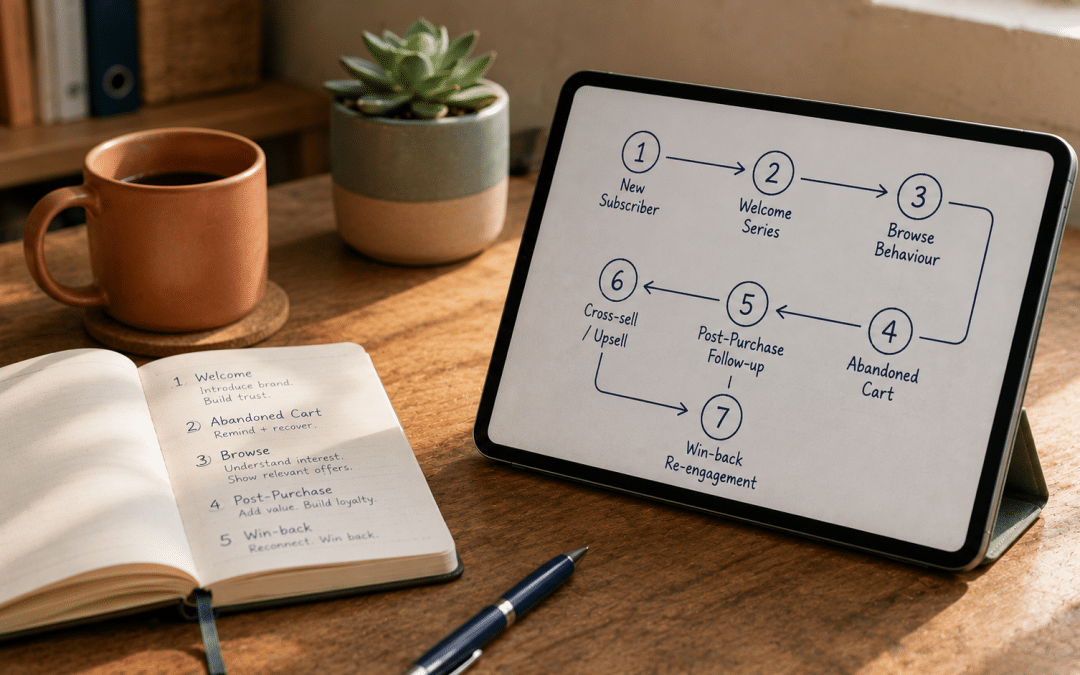
Shopify email automation flows are the single most under-utilised revenue lever on SA stores in 2026 — most owners run zero or one (the default abandoned-checkout message) when the working setup needs at least seven. Built properly, lifecycle sequences routinely produce 25-40% of total store revenue while the campaigns get most of the attention and most of the manual labour.
This post walks through the seven sequences every SA Shopify store should have live, the count and timing inside each one, and the platform mapping (Shopify Email vs Klaviyo vs Omnisend) that determines which sequences are even possible. For the broader context this sits inside, start with our Shopify South Africa guide.
Quick Answer
The seven shopify email automation flows every SA store needs are: welcome series (3-4 messages on signup), abandoned cart (3-4 on checkout-started), browse abandonment (2-3 touches on product view without add-to-cart), post-purchase (3-5 touches on order), win-back (2-3 on 60-90 day inactivity), replenishment (1-2 on predicted reorder date), and back-in-stock (1 on inventory restock). Live across all seven, these sequences typically produce 25-40% of total store revenue.
Klaviyo's 2026 benchmarks across 183,000 stores show automated sequences generate 41% of total revenue from just 5.3% of sends — meaning the revenue-per-recipient on triggered messages is roughly 18x higher than broadcast campaigns. SA stores see similar multiples once the seven shopify email automation flows are configured properly.
Want a quick read on which sequences your SA store should build first based on revenue tier?
Get a Free Flow Priority AuditWhy Shopify Email Automation Flows Outperform Campaigns
The economics are not subtle. A weekly broadcast goes to the entire list and converts a fraction of a percent; a triggered sequence reaches only customers showing relevant intent and converts at multiples of that rate. The question is not whether to invest in shopify email automation flows but which sequences to build first.
| Metric | Campaigns | Triggered Sequences |
|---|---|---|
| Share of sends | 94.7% | 5.3% |
| Share of channel revenue | 59% | 41% |
| Revenue per recipient (avg) | R 1.80 | R 33-R 65 |
| Manual work required | Ongoing weekly | One-time build |
For shopify email automation flows specifically, the economics scale. According to Klaviyo's 2026 ecommerce email benchmarks across 183,000 stores, automated sequences produce roughly 18 times the revenue-per-recipient that broadcasts do. For SA operators this changes how to think about the channel — the campaigns get the spotlight, but the shopify email automation flows do the heavy lifting on actual revenue.
The 7-Sequence Floor Top SA Shopify Stores Hit
Klaviyo's benchmark data shows top-performing stores run a minimum of seven lifecycle sequences and average ten. The compounding effect comes from coverage — a customer who triggers no sequence at all goes silent; a customer who triggers two or three sees the brand at multiple decision moments. SA stores with three sequences live typically attribute 8-12% of revenue to the channel; SA stores with all seven typically attribute 25-40%.
That gap is the difference between sequences being a "channel we have" and being a top-three revenue contributor on the store.
The Seven Shopify Email Automation Flows in Order of Priority
The order below is what we recommend for SA stores building shopify email automation flows from scratch. The first three carry the bulk of the revenue uplift; the next four compound the system into the 25-40% revenue territory once the foundation is live.
| Priority | Sequence | Sends | Typical SA RPR |
|---|---|---|---|
| 1 | Welcome series | 3-4 | R 45-R 60 |
| 2 | Abandoned cart | 3-4 | R 55-R 75 |
| 3 | Browse abandonment | 2-3 | R 18-R 28 |
| 4 | Post-purchase | 3-5 | R 25-R 40 |
| 5 | Win-back | 2-3 | R 12-R 22 |
| 6 | Replenishment | 1-2 | R 30-R 55 |
| 7 | Back-in-stock | 1 | R 40-R 80 |
1. Welcome series
Triggered when someone joins the list — typically through a popup signup, footer subscribe, or checkout opt-in. The welcome runs three to four messages over 7-10 days and does the highest-stakes first-touch work in any program: it converts the new subscriber from "interested" to "first-time buyer". SA stores commonly see 8-12% placed-order rates on the welcome touch, compared to 0.1-0.3% on a broadcast.
2. Abandoned cart
Triggered when a shopper reaches checkout, enters contact details, but does not complete payment. This sequence runs three to four touches across 7 days (1 hour, 4-12 hours, 24 hours, 72 hours). It is the single highest-RPR triggered sequence on most SA stores because the buyer has already shown explicit intent. Cover this layer in depth on our dedicated abandoned-cart guide.
3. Browse abandonment
Triggered when a shopper views a product but never adds to cart — fires only on identified visitors (contact already captured). Runs two to three messages over 3-5 days and works hardest for considered-purchase products (apparel, beauty, supplements). Stores selling impulse products under R 200 typically skip this one because the conversion math does not work.
4. Post-purchase
Triggered on order placement. Runs three to five touches covering order confirmation, shipping update, delivery, request for review, and cross-sell. The cross-sell touch at the 30-day mark is where most stores leave revenue — it converts roughly 4-7% of recent buyers into second-time customers without paid acquisition cost.
Not sure which of the four foundation sequences is your weakest right now? Tell us your store stage and we will map it.
Get a Free Foundation Sequence Audit5. Win-back
Triggered when a customer has not purchased in 60-90 days (varies by product category — apparel 60, beauty 75, supplements 90). Runs two to three messages over two weeks and typically reactivates 3-6% of dormant customers. Worth running on any store with more than 200 past purchasers.
6. Replenishment
Triggered on a predicted reorder date based on the customer's purchase history and product consumption rate. Highest-impact on consumables (beauty, supplements, pet food, coffee) — SA stores in those categories report 8-15% conversion rates on the first replenishment send. Worth investing only after the first four sequences are humming.
7. Back-in-stock
Triggered when a previously-out-of-stock product becomes available again, sent only to customers who explicitly subscribed to the "notify me" option. A single send, but among the highest-RPR sequences on the store because the customer has already requested it. Apparel and beauty stores see particularly strong results — 20-30% placed order rates are common.
Platform Mapping: Shopify Email vs Klaviyo vs Omnisend
Not every platform can build every sequence in the priority list. The platform choice determines which lifecycle work is even possible — and the right choice depends on the store's revenue stage rather than the marketing pitch from any one vendor.
| Sequence | Shopify Email | Omnisend | Klaviyo |
|---|---|---|---|
| Welcome series | ✅ Basic | ✅ Full | ✅ Full |
| Abandoned cart | ✅ 2-step only | ✅ Full | ✅ Full |
| Browse abandonment | ❌ Not available | ✅ Full | ✅ Full |
| Post-purchase | ✅ Limited | ✅ Full | ✅ Full |
| Win-back | ❌ Manual only | ✅ Full | ✅ Full |
| Replenishment | ❌ Not available | ⚠ Limited | ✅ Full |
| Back-in-stock | ⚠ App required | ✅ Native | ✅ Native |
| Monthly cost (ZAR) | R 0 - R 200 | R 300 - R 2,500 | R 450 - R 5,000+ |
The practical reading: Shopify Email is fine to validate the welcome and basic abandoned-cart layers but caps the program at two of the seven sequences. Omnisend covers six of the seven well at a moderate price point. Klaviyo covers all seven with the deepest segmentation and is the right choice once monthly revenue clears around R 300-500k. The platform discovery context is in our best email marketing platforms for SA guide.
The SA Platform Upgrade Path Most Stores Get Wrong
Many SA stores stay on Shopify Email or basic Mailchimp for years past the point where the platform is costing them more in missed revenue than the upgrade would cost them in monthly fees. The decision rule is simple: when missing sequences (browse abandonment, replenishment, advanced post-purchase) would plausibly produce R 5,000+/month in additional revenue, the Omnisend or Klaviyo upgrade pays back in the first month.
The other common error is upgrading too soon — pre-revenue stores running zero traffic do not need Klaviyo's segmentation power. Build the foundation on Shopify Email, prove the welcome and cart sequences work, then upgrade.
Timing and Sequence Length for the SA Inbox
SA buyer behaviour shifts the timing recommendations away from the global defaults in three meaningful ways. Get these adjustments right and the same sequence content performs 15-25% better on placed-order rate.
| SA Timing Adjustment | Why It Matters |
|---|---|
| Send between 7-9am SAST | Mobile inbox check window — highest open attention |
| Avoid 12-2pm sends | Lunch break, low engagement; messages buried by afternoon |
| 5-7pm second window | SA evening browse peak — strongest for browse abandonment |
| Skip Sunday sends entirely | SA opens are 35-45% lower on Sundays vs weekday baseline |
| Load-shedding rescheduling | Stage 4+ days shift evening windows earlier by 60-90 min |
The Sunday avoidance is the SA-specific finding most operators miss. Global benchmark data suggests Sunday is fine; SA data shows it produces 35-45% lower opens and a meaningful unsubscribe spike. Schedule sequences to skip Sunday entirely and pick up Monday morning.
POPIA Consent and Sequence Triggers
Every shopify email automation flow that fires to a customer must be backed by explicit POPIA consent collected at signup or checkout. The consent is collected once; the sequence triggers off behaviour later. SA stores get this mostly right on Shopify by default, but two specific gotchas trip up implementations.
Pre-ticked subscribe boxes at checkout: Not POPIA-compliant. The checkbox must be unchecked by default and the customer must actively opt in. Shopify allows pre-ticked configuration; do not use it. The legal risk is real and the deliverability damage from spam complaints is worse than the lost subscribers.
Implied consent from a single purchase: Buying a product does not constitute marketing consent under POPIA. Use the checkout opt-in box and only add the customer to marketing sequences if they explicitly tick it. Post-purchase transactional sends (order confirmation, shipping) are exempt; cross-sell and win-back are not.
Real SA Outcome: From 2 Sequences to 7
A Cape Town apparel store running R 480,000/month built out its shopify email automation flows from 2 sequences (default cart + a basic welcome) to all 7 sequences on Klaviyo over a 6-week project in late 2025. The before-and-after numbers show why this is worth the lift.
| Metric | Before (2 Sequences) | After (7 Sequences) |
|---|---|---|
| Channel-attributed revenue / month | R 38,000 | R 168,000 |
| Channel % of total revenue | 7.9% | 28.4% |
| Welcome series placed-order rate | 4.1% | 11.3% |
| Abandoned-cart recovery rate | 4.4% | 14.6% |
| Post-purchase second-order rate | not measured | 6.2% |
| Klaviyo monthly cost | R 0 | R 1,400 |
| Net additional channel revenue | — | R 128,600/month |
The 92x ROI on the Klaviyo cost is not unusual for SA stores in the R 300k-R 1m monthly revenue range. The math gets even stronger once the program runs for 6+ months and the segmented behavioural data deepens the personalisation in each sequence.
How Growth Pulse Media Approaches Lifecycle Automation
Most agencies install the platform, switch on the default templates, and call the project done. We treat shopify email automation flows as a continuously-optimised system — each sequence A/B-tested every 6-8 weeks, the timing tuned to SA buyer behaviour, and POPIA-compliant consent flows configured at signup and checkout. Dirk built this exact stack on a real SA business before the agency existed, so the recommendations come from operator experience rather than agency theory.
That usually means the seven sequences live on either Klaviyo or Omnisend, with quarterly performance reviews and content refreshes. We work with a deliberately limited client load so the senior team stays close to sequence performance.
For SA stores ready to run lifecycle programmes properly, our Shopify marketing agency service covers the channel layer alongside the broader growth programme — with cross-channel integration into the wider strategy and WhatsApp where relevant.
Who This Sequence Build Is NOT For
The seven-sequence approach above suits SA Shopify stores doing meaningful revenue (R 100k+/month) selling considered-purchase products with repeat buyer potential. Here is who should look elsewhere first.
Stores under R 50k/month with under 500 subscribers: Building seven sequences for a 200-person list is over-engineering. Focus on growing traffic and signup capture rate first — the welcome and cart sequences are enough to start, and the volume to justify the rest does not exist yet.
One-and-done product stores with no repeat buyer pattern: If your product is a single-purchase item with no replenishment, refill, or upsell logic, the win-back and replenishment sequences will fire to disengaged audiences. The first three sequences (welcome, cart, browse) cover the addressable revenue; the others waste effort.
Stores using bought lists or scraped contacts: POPIA does not allow outreach to addresses you did not collect consent from, regardless of how clever the sequence content is. Deliverability damage from sending to unconsented addresses tanks sender reputation, which then hurts the sequences you have built legitimately. Clean the list first; build the program second.
Stores unwilling to maintain the system: Sequences degrade over time as the brand voice drifts, product mix shifts, and the SA seasonal patterns change. Without a quarterly review the open and click rates drop 15-25% per year. If nobody owns the upkeep, do not build all seven — build three and run them well.
Not sure whether your store is at the stage to build all seven sequences or just the foundation three? We will tell you straight.
Get a Free Lifecycle Readiness CheckOne discipline carries everything above: build the foundation first, then layer the compounding pieces only when the data justifies them. The strongest SA Shopify stores started with welcome and cart, proved the math, then added browse, post-purchase, win-back, replenishment, and back-in-stock in that order over 6-12 months.
The right shopify email automation flows are not a static install but a living revenue system that compounds as the data deepens. Stores that build with that mindset routinely hit 30-40% of revenue from the channel by month 18 — without changing the product, the traffic, or the platform once it is selected correctly.
Frequently Asked Questions
How many shopify email automation flows should an SA store have live?
The minimum is three (welcome, cart, post-purchase); the working baseline for serious revenue contribution is seven (those three plus browse abandonment, win-back, replenishment, back-in-stock). Klaviyo's 2026 benchmarks show top-decile ecommerce stores average ten live sequences, but seven is the threshold where shopify email automation flows typically clear 25%+ of total revenue.
Can Shopify's built-in handle all the sequences?
No. Shopify Email handles welcome and a basic two-step cart well, but it lacks browse abandonment, replenishment, advanced post-purchase, and behavioural segmentation. Stores under R 100k/month can start on Shopify Email; stores above R 300k/month almost always justify upgrading to Omnisend or Klaviyo.
Klaviyo vs Omnisend for SA stores?
Omnisend is the better starting point for SA stores under R 500k/month — pricing in ZAR equivalent is more accessible, and the platform covers six of the seven priority sequences well. Klaviyo wins above R 500k/month because the segmentation depth, predictive analytics, and replenishment-flow logic translate to meaningful additional revenue at that scale.
When should an SA store send its welcome series — immediately or with a delay?
Send the first message within 10 minutes of signup — open rates drop 40-60% if the first message arrives after the customer has moved on. Subsequent sends space across 7-10 days with one to two day gaps. The "instant first email" rule is the single highest-ROI welcome-sequence finding from the Klaviyo benchmark data.
How long should an abandoned cart sequence run before stopping?
Seven days, with three or four messages spaced 1 hour, 12 hours, 24 hours, and 72 hours after the abandonment. Beyond 7 days, the shopper has either bought elsewhere or moved on; further sends just lift unsubscribe rates without recovering revenue. The discount escalation typically starts at the 24-hour mark, not the first send.
Do these sequences violate POPIA in South Africa?
Not if consent is collected correctly at the original signup or checkout. The customer must actively opt in (no pre-ticked boxes), every message must offer a clear unsubscribe path, and opt-out requests must be honoured within 24 hours. Transactional messages (order confirmation, shipping) are exempt from the marketing-consent rule; lifecycle marketing sends are not.
Ready to Build the Seven-Sequence Engine?
Growth Pulse Media builds shopify email automation flows for SA stores — Klaviyo or Omnisend setup, seven priority sequences live, SA-tuned timing, POPIA-compliant consent at signup and checkout, quarterly reviews. Real operator experience scaling an SA Shopify business, in-house execution, limited client load. No obligation — we will get back to you within 24 hours with a frank assessment of where your program is leaving the most revenue on the table.
Get Your Free Sequence Plan