
 Add to Preferred Sources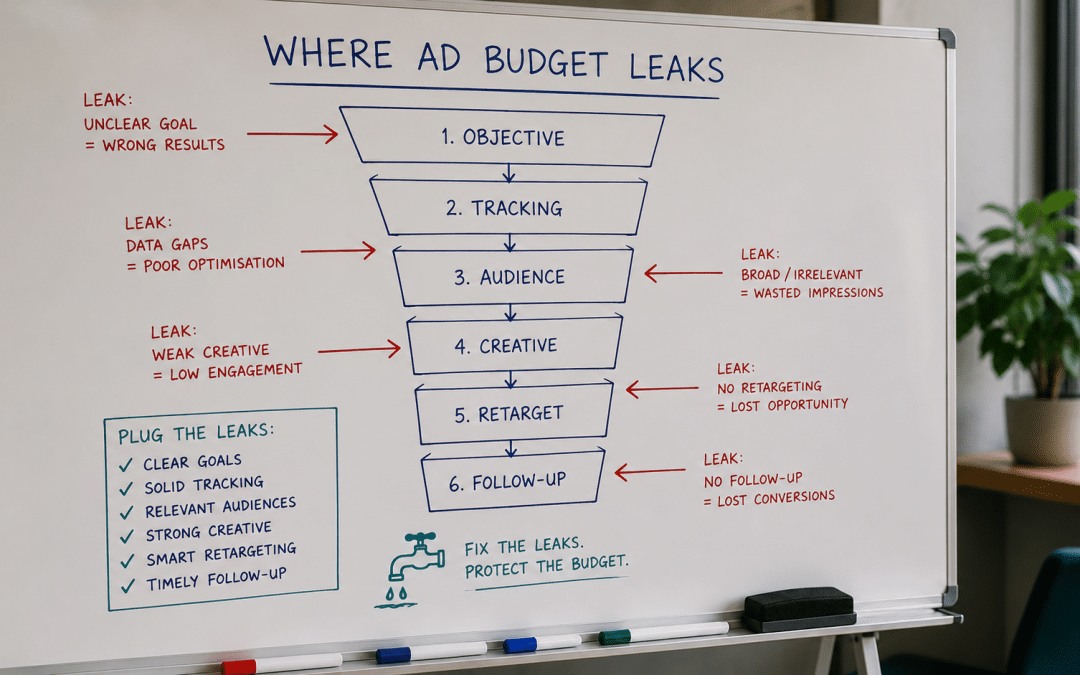
Most Meta ads mistakes South Africa businesses make are not exotic — they are the same handful of avoidable errors quietly leaking budget out of otherwise decent accounts. For the strategy that prevents them, see our complete Meta Ads South Africa guide; this post is about where the money actually leaks, so you can plug the holes you are almost certainly paying for right now.
It matters because the stakes are real. According to IAB South Africa's Online AdSpend Report, local digital advertising revenue hit R17.7 billion and now makes up nearly 40% of the country's total ad market — and paid social, led by Meta, takes a major share of that. A lot of that spend is leaking through errors that take an afternoon to fix.
Quick Answer
The most expensive Meta ads mistakes South Africa businesses make are boosting posts instead of running structured campaigns, having no proper conversion tracking, targeting too broadly for local audience sizes, and constantly editing campaigns so they never stabilise. After the click, the leaks are ad fatigue, no retargeting, judging success on vanity metrics, and no follow-up on the leads the ads produce. Each one is fixable.
Want to know which of these is leaking your budget right now?
Get a Free Meta Ads AuditThe Mistakes That Leak Budget Before the Click
These first errors waste money at the campaign-setup stage, before a single person clicks. They are the most common and, fortunately, the most fixable — usually in the way the account is structured rather than how much you spend.
Mistake 1 — Boosting posts instead of running campaigns
The single most expensive habit is hitting the blue "Boost" button instead of building a structured campaign in Ads Manager. Boosting optimises for cheap engagement — likes and comments — not leads or sales. You pay for vanity activity while the real objective goes unserved. A proper campaign lets you choose a conversion or lead objective, which is where the money actually comes back.
Mistake 2 — No conversion tracking in place
If the Meta pixel and Conversions API are not set up, the platform is flying blind — and so are you. Without conversion data, the algorithm cannot optimise toward buyers, and you cannot see which campaigns produce revenue. This is the most damaging of the technical errors because it silently caps every other improvement you try to make.
Mistake 3 — Targeting too broad, or too narrow, for local audiences
South African audience pools are smaller than the global examples most tutorials assume. Target too broadly and budget sprays across people who will never buy; target too narrowly and you exhaust the audience in days, driving frequency and cost up. Right-sizing the audience for the local market is a judgement call that generic, imported playbooks consistently get wrong.
Mistake 4 — Constantly editing so campaigns never stabilise
Meta's delivery system needs a stable run of conversions to learn who to show your ads to. Every significant edit — budget, targeting, creative — resets that learning and pushes the campaign back into its volatile, expensive early phase. Owners who tweak daily out of impatience keep paying the "learning" premium and never reach the stable, efficient delivery their budget should buy.
The Setup Leaks
Four errors waste budget before anyone clicks: boosting instead of building campaigns, running with no conversion tracking, mis-sizing the audience for a smaller local market, and editing so often the campaign never stabilises. None of these requires more spend to fix — only a better-structured account and the discipline to leave it alone while it learns.
Not sure if your account is making these setup errors? Let us look.
Get a Free Campaign TeardownThe Mistakes That Waste Spend After the Click
The second group of errors leaks money after you have already paid for the click or impression. These are where good campaigns quietly underperform — the spend goes out, but the return never fully comes back because of what happens next.
Mistake 5 — Ignoring ad fatigue in small audience pools
Because local audiences are smaller, the same people see your ads more often, faster. Frequency climbs, response drops, and cost per result creeps up while the dashboard still looks busy. Refreshing creative regularly is non-negotiable in the local market — far more so than in the large international audiences most advice is written for.
Mistake 6 — No retargeting of warm traffic
Most people do not buy on the first visit, yet many accounts spend everything chasing cold audiences and ignore the warm prospects who already engaged. Skipping retargeting leaves the cheapest, highest-intent conversions on the table. The discipline of re-engaging warm traffic is covered in our Meta retargeting guide, and its absence is one of the most common leaks we see.
Mistake 7 — Judging success on vanity metrics
Reach, likes, and impressions feel good but pay no bills. The only numbers that matter are cost per qualified lead, cost per sale, and return on ad spend against your real customer value. Optimising toward vanity metrics — covered properly in our Facebook ads ROI guide — is how accounts look healthy while losing money.
Mistake 8 — No follow-up process for the leads
Even a perfectly run campaign fails if nobody calls the leads back. Enquiries that sit for a day go cold, and the ad spend that produced them is wasted. This is not really an ads problem, but it is where the most ad budget ultimately leaks — the campaign did its job and the business dropped the ball after the click. Our Meta ads management service checks the whole path from ad to follow-up, including how fast new leads are called back.
The After-The-Click Leaks
The second four leaks happen after you have paid: letting creative fatigue in small local pools, ignoring warm retargeting audiences, optimising toward vanity metrics instead of cost per qualified lead, and failing to follow up the leads. The first four waste the click; these waste the result you already paid for — which makes them, rand for rand, just as costly.
Why These Mistakes Cost More in South Africa
The reason these meta ads mistakes South Africa businesses make hurt more here than abroad comes down to market size and habit. Local audience pools are smaller, so wasted targeting and creative fatigue bite faster, and there is far less room for a leaking account to quietly absorb the loss the way a large international audience would.
Most tutorials and courses are also written for big markets, with audience sizes, budgets, and benchmarks that simply do not translate. Owners follow these imported playbooks faithfully and cannot understand why the results never match — when the playbook itself assumed an audience ten times the size of the one they are actually advertising to.
Cost sensitivity compounds the problem. Many local businesses run lean budgets where every rand has to convert, so an error a big-budget advertiser would barely notice can erase a small account's return entirely. The same leak that is a rounding error overseas is the difference between profit and loss here.
There is also less local benchmarking to lean on. With fewer published local case studies, owners struggle to tell whether a R200 cost per lead is good or terrible for their sector. That uncertainty makes the vanity-metric trap especially easy to fall into, because reach at least feels like a number that is going up.
What Fixing the Leaks Looks Like
The encouraging part is that fixing these errors rarely needs more budget — it needs better structure and discipline. The table below shows a representative local business that plugged the leaks on the same monthly spend. The shift is entirely the result of structure, tracking, and follow-up, not a bigger budget.
| Metric (monthly) | Before — leaking budget | After — leaks fixed | Change |
|---|---|---|---|
| Ad spend | R15,000 | R15,000 | Same |
| Leads | 31 | 78 | +152% |
| Cost per lead | R484 | R192 | −60% |
| Qualified leads | 8 | 26 | +225% |
| Cost per qualified lead | R1,875 | R577 | −69% |
The last row is the whole story. The spend never moved, but the cost of a genuinely qualified lead dropped by nearly 70% once the obvious leaks were closed — proper objective, tracking in place, audience right-sized, creative refreshed, retargeting switched on, and leads followed up. None of that required a single extra rand of budget.
It is worth stressing that the fixes are sequential, not simultaneous. Tracking comes first, because without it you cannot measure whether anything else worked. Then the objective and audience, then creative and retargeting, then follow-up. Trying to fix everything at once makes it impossible to tell which change moved the needle — and the whole point of closing leaks methodically is knowing which one was costing you most.
What Drove the Result
Nothing here was clever or expensive. The account switched from boosting to a conversion objective, added tracking, right-sized the audience, refreshed creative before fatigue set in, turned on retargeting, and put a same-day follow-up process behind the leads. The same R15,000 produced more than triple the qualified leads — proof that the leaks, not the budget, were the problem.
The GPM Differentiator
Most accounts we audit are leaking money to several of the meta ads mistakes South Africa owners rarely catch themselves, because the dashboard still shows plenty of activity. We come at it from an operator's seat, having scaled local businesses where the only number that mattered was revenue — so our digital marketing services start by finding the leaks before spending a cent more.
That means an honest teardown of your objective, tracking, audience, creative, and follow-up — then a structured rebuild that ties every rand to a qualified lead or sale. If you want the strategy side rather than the error list, our Facebook ads strategy guide covers how to build it right from the start. Either way, we will tell you honestly which leaks are costing you most.
What we will not do is sell you more ad spend as the answer. In nearly every audit, the budget is not the problem — the structure is. Pouring more money into a leaking account just loses it faster, which is why every engagement starts with the leaks, not the spend.
Who This Is NOT For
Plugging these leaks pays off for committed businesses, but the approach is wrong for some. Being honest about that saves everyone wasted spend — so here is who should hold off.
Anyone unwilling to set up conversion tracking. If you will not install the pixel and Conversions API, the biggest leak stays open and everything else is patching around a hole. Fixing the other errors without tracking is like bailing a boat without finding the leak — pointless effort.
Owners who tweak campaigns daily and cannot stop. If you cannot resist editing budget and targeting every day, the learning never stabilises and no fix will hold. The discipline to leave a campaign alone while it learns is a prerequisite, not an optional extra.
Businesses with no follow-up capacity. If nobody can call leads back the same day, plugging the ad leaks just produces enquiries that go cold. Fix the follow-up process first, or the improved campaigns simply waste money more efficiently.
Anyone chasing reach and likes as the goal. If your definition of success is engagement rather than leads or sales, our entire approach will frustrate you. We optimise toward cost per qualified lead, so a business that measures vanity metrics is the wrong fit.
Ready to find and fix the leaks in your account? Start with a free look.
Get a Free Meta Ads Leak ReportFrequently Asked Questions
What is the most expensive Meta ads mistake?
Running with no conversion tracking is usually the costliest, because it caps every other improvement. Without the pixel and Conversions API feeding data back, the algorithm cannot optimise toward buyers and you cannot see which campaigns produce revenue. Boosting posts instead of building structured campaigns is a close second for sheer wasted spend.
Why are my Facebook ads not converting in South Africa?
The common causes are a wrong objective (boosting for engagement rather than conversions), no proper tracking, an audience that is too broad or too narrow for the local market, or creative that has fatigued in a small pool. It is rarely one big problem — usually two or three of these leaks compounding at once.
Is boosting a post ever worth it?
Occasionally, for genuine brand awareness or to amplify a piece of content. But for leads or sales it is almost always the wrong tool, because it optimises for cheap engagement rather than business outcomes. For anything tied to revenue, build a structured campaign in Ads Manager with the right objective instead.
How often should I change my Meta ads?
Avoid significant edits while a campaign is still stabilising, since each one resets the learning and pushes you back into the expensive early phase. Refresh creative on a planned schedule to fight fatigue, but resist daily tweaks to budget and targeting. Batch necessary changes together rather than making them one at a time.
Do small budgets make these mistakes worse?
Yes. Smaller budgets have less room to absorb waste, so a leaking objective or missing tracking hurts proportionally more. Smaller local audiences also fatigue and saturate faster, which means right-sizing targeting and refreshing creative matter even more when every rand has to work hard.
Can I fix these mistakes myself?
Many of them, yes — setting a conversion objective, installing tracking, and tightening the audience are all learnable. The harder part is the ongoing judgement: when to refresh creative, how to read the data past vanity metrics, and when to leave the account alone. That experience is what separates a stable account from a constantly leaking one.
If you suspect your account is leaking but are not sure where, that hesitation is completely reasonable — most owners simply cannot see these errors, because the dashboard still looks active and busy. The fix starts with a clear-eyed audit of objective, tracking, audience, creative, and follow-up, so you know exactly which leaks to close first and in what order.
Get a Free Meta Ads Leak Report
We will audit your Facebook and Instagram account and send back a one-page report showing exactly where your budget is leaking — objective, tracking, audience, creative, and follow-up — with the highest-impact fixes ranked first. No obligation — we will get back to you within 24 hours.
Get My Free Leak Report