
 Add to Preferred Sources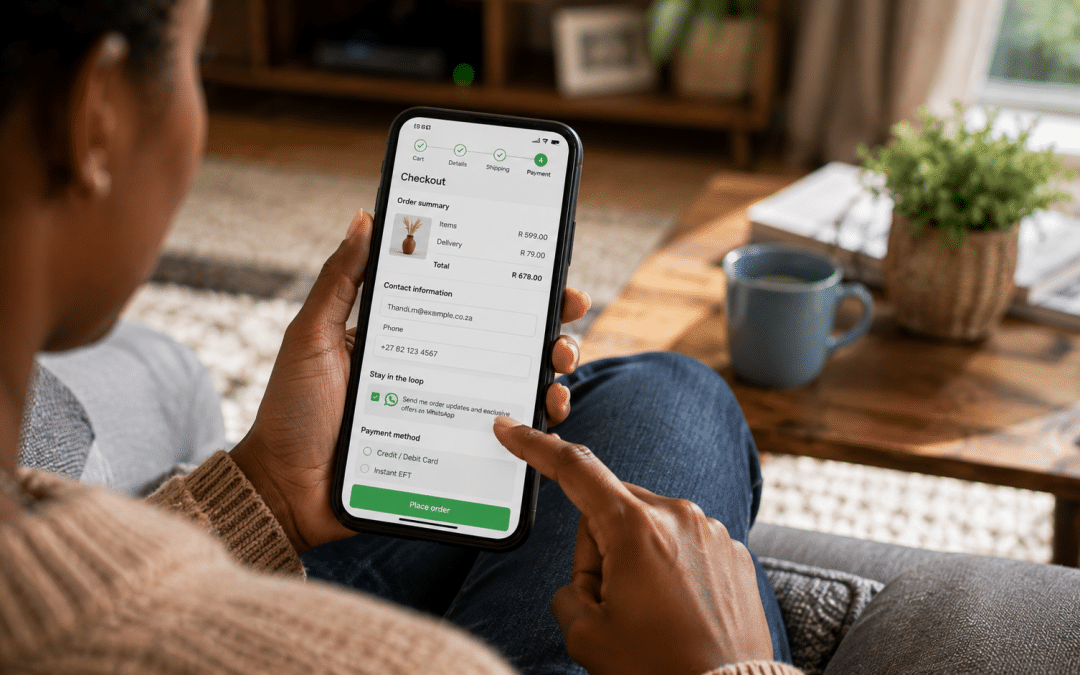
Building a compliant WhatsApp marketing list South Africa in 2026 means active opt-in, category disclosure, and proper consent records — not buying a database of phone numbers and hoping for the best. Most SA businesses get this wrong and get their WhatsApp Business account suspended within 90 days.
This guide breaks down how to build a WhatsApp marketing list South Africa the right way — capture mechanics, compliance under POPIA and Meta's 2026 policy, and the four entry points that actually grow opt-in lists fast. For the broader picture of how lists fit into a complete WhatsApp programme, start with our complete WhatsApp marketing guide for South Africa.
Quick Answer
A WhatsApp marketing list is built through four primary entry points: website opt-in widgets, checkout consent, Click-to-WhatsApp ads, and offline QR codes. Each captures the phone number and active opt-in consent. SA businesses doing this correctly grow lists from zero to 2,000-5,000 opted-in subscribers in 90 days — and convert at 8-15x email rates. The compliance requirements are strict but manageable. The rewards are pipeline you cannot build any other way.
Want a free audit of your current WhatsApp opt-in setup and the fastest path to a compliant 1,000-subscriber list?
Get a Free WhatsApp List AuditWhat Counts as a Valid WhatsApp Marketing List
A WhatsApp marketing list South Africa is the set of phone numbers that have actively consented to receive marketing messages from your business via WhatsApp. The key word is "actively." Meta and POPIA both reject pre-checked boxes, assumed consent from past purchases, or numbers harvested from forms that did not explicitly mention WhatsApp marketing.
According to Meta's WhatsApp Business Messaging Policy, businesses may only contact people on WhatsApp if the recipient has provided their mobile number AND given opt-in permission to receive subsequent messages. Displaying your WhatsApp number publicly does not count as opt-in. The user must take an affirmative action.
Practically, every WhatsApp marketing list South Africa opt-in must tick four boxes: the user clearly agrees to receive messages, your business name is specified, the types of messages are disclosed (marketing, transactional, or both), and the user knows how to opt out. Skipping any one of these breaks the consent chain — and breaks the list.
Why a WhatsApp Marketing List Is Worth Building
For SA businesses, the case for a WhatsApp marketing list South Africa is simpler than any other channel. WhatsApp message open rates in South Africa sit at 85-95% within 5 minutes — compared to 20-25% for email and under 5% for organic social. SA consumers check WhatsApp 50-70 times per day on average. There is no channel where your message reaches more eyeballs faster.
The conversion follow-through is where the channel pays for itself. SA retailers running compliant WhatsApp lists report 8-15× higher conversion rates than email campaigns to the same audience. The reason is simple: a WhatsApp opt-in is a much higher commitment signal than an email signup. People only give their personal mobile number to brands they actually want to hear from.
The Compounding Effect
Every WhatsApp marketing list South Africa subscriber is worth approximately 10× an equivalent email subscriber over a 12-month window — measured by revenue per subscriber. A 1,000-subscriber WhatsApp list does what a 10,000-subscriber email list does, with a fraction of the deliverability headaches. This is the single highest-leverage owned channel currently available to SA businesses.
The Four Entry Points for Building a WhatsApp Marketing List
Effective WhatsApp marketing list South Africa building runs four channels in parallel — each captures a different visitor type at a different moment of intent. Running only one entry point caps growth artificially. Running all four compounds.
| Entry Point | Where It Captures | Conversion Rate | Best For |
|---|---|---|---|
| 1. Website opt-in widget | Browsing visitors with interest signals | 2-5% of page views | Content-driven traffic |
| 2. Checkout opt-in | Customers placing orders | 30-50% of buyers | Ecommerce stores |
| 3. Click-to-WhatsApp ads | Paid social audiences | 4-8% of ad clicks | Active acquisition |
| 4. Offline QR codes | In-store + print + events | 1-3% of impressions | Physical businesses |
Entry Point 1: Website Opt-In Widgets
Building a WhatsApp marketing list South Africa starts with a floating WhatsApp widget on every page — captures browsers who want to talk now. Two flavours work for SA stores.
The first is the "Chat With Us" button that opens a WhatsApp conversation — useful for service businesses where buyers want immediate human contact. The second is the "Join Our WhatsApp Updates" form that captures a phone number and explicit opt-in checkbox — useful for content sites and ecommerce stores building marketing lists.
The form-based widget must include: a clear consent statement ("By submitting your number, you agree to receive marketing messages from [Business Name]"), the message categories you will send, the frequency (e.g. "1-2 messages per week"), and a clear opt-out instruction. Without these, the consent is not valid under Meta's policy or POPIA.
Entry Point 2: Checkout Opt-In
For WhatsApp marketing list South Africa builds, this is the highest-converting entry point for ecommerce stores. At checkout, the customer has already given their phone number for delivery purposes. Adding a separate, unchecked consent box at checkout — "Get order updates and exclusive offers on WhatsApp" — converts 30-50% of buyers into subscribers.
Critical compliance detail: the box must be unchecked by default. Pre-checked boxes invalidate the consent. The wording must mention "marketing" or "offers" if you plan to send marketing — limiting the opt-in to "order updates" only gives consent for transactional messages. Many SA stores get this subtly wrong and find their Meta account flagged later.
Entry Point 3: Click-to-WhatsApp Ads
For WhatsApp marketing list South Africa growth via paid, Click-to-WhatsApp (CTWA) ads run on Facebook and Instagram. The ad's call-to-action button opens a WhatsApp chat directly with your business. The user starts the conversation — which under Meta's policy counts as opt-in for marketing messages within a 24-hour window, and for ongoing marketing if they explicitly opt in during that window.
For SA businesses, CTWA ads typically cost R8-R20 per opted-in subscriber acquired — far cheaper than traditional Facebook lead ads which run R30-R80 per lead. The reason is that WhatsApp conversation completion rates are much higher than form completion rates on Facebook. Build CTWA ads with a specific opt-in trigger inside the first chat exchange — "Reply YES to get our weekly deals on WhatsApp" — to lock in compliant marketing consent.
Entry Point 4: Offline QR Codes
SA businesses with physical presence underuse this WhatsApp marketing list South Africa entry point. A WhatsApp QR code printed on receipts, packaging, in-store signage, vehicle wraps, and event materials converts offline attention into list growth. Scanning the QR opens a pre-filled WhatsApp message ("Hi, I'd like to subscribe to your WhatsApp updates"). The store agent then sends an opt-in confirmation message disclosing categories and frequency.
QR codes are particularly powerful for SA retail businesses, restaurants, and service trades. A salon putting a QR code on every till slip can capture 1-3% of customers as subscribers — and over 12 months that compounds into hundreds of high-intent contacts at near-zero cost per acquisition.
Want us to map which of these four entry points fits your specific business and would deliver fastest?
Get a Free Entry-Point MapCompliance: POPIA + Meta's 2026 Policy
Building a WhatsApp marketing list South Africa means meeting two regulatory layers simultaneously: POPIA (the Protection of Personal Information Act, the SA equivalent of GDPR) and Meta's WhatsApp Business Messaging Policy. They overlap heavily but are not identical, and a list compliant under one is not automatically compliant under the other.
POPIA Requirements for SA Businesses
POPIA requires that personal information — including phone numbers — be collected for a specific stated purpose, with informed consent, and processed only for that purpose. Practically, this means your opt-in form must state who is collecting the number, what it will be used for, and how the user can withdraw consent. Records of when and how consent was given must be retained for audit purposes.
POPIA also gives users the right to access, correct, and delete their data. Your business must have a mechanism to honour these requests — typically a documented process where an unsubscribe request triggers full data deletion within 30 days. SA businesses without this process exposed themselves to Information Regulator complaints, which carry fines up to R10 million.
Meta's 2026 WhatsApp Business Policy Updates
Meta tightened its policy in early 2026. Three changes matter most for SA businesses. First, the Marketing Opt-Out Button is now mandatory for all marketing templates — text commands like "Reply STOP" are no longer sufficient on their own. Second, Meta now allows General Consent (a single opt-in covering marketing, utility, and authentication categories) but specific category opt-ins remain the safest path for protecting quality scores.
Third, category disclosure at opt-in time is now strongly encouraged. Your opt-in form must specify which categories of messages the user will receive — marketing, transactional, or both. Failing to disclose pushes the account quality rating down quickly when users start reporting messages they did not expect.
POPIA + Meta Compliance Checklist
Every opt-in mechanism must include: business name, message categories, expected frequency, opt-out instructions, and a consent record timestamped to a specific user action. Pre-checked boxes, implied consent from past purchases, and "displayed number" capture do not qualify. Document everything — Meta's review process and the Information Regulator's audit process both ask for proof.
Real-World Example: SA Ecommerce Store, 90-Day List Build
Here is what a structured WhatsApp marketing list South Africa build looks like in practice. We worked with a Johannesburg ecommerce store in February 2026. They had zero WhatsApp subscribers, only an email list of 4,800. We deployed all four entry points over 90 days and tracked the build.
| Metric | Day 0 Baseline | Day 90 Result | Difference |
|---|---|---|---|
| WhatsApp opted-in subscribers | 0 | 3,180 | +3,180 |
| Email subscribers (for comparison) | 4,800 | 5,120 | +320 |
| Subscribers from website widget | 0 | 620 | +620 |
| Subscribers from checkout | 0 | 1,840 | +1,840 |
| Subscribers from CTWA ads | 0 | 540 | +540 (R6,800 ad spend) |
| Subscribers from QR codes | 0 | 180 | +180 (packaging only) |
| Avg revenue per WhatsApp send | — | R 14.80 | vs R 1.20 email |
| Monthly revenue from WhatsApp | R 0 | R 188,400 | +R 188,400/mo |
The interesting comparison is checkout vs paid ads. Checkout opt-in added 1,840 subscribers at zero acquisition cost — purely from existing buyers. CTWA ads added 540 subscribers at R12.60 per opt-in. Both are valuable for different reasons. Checkout grows the list passively as the business runs; CTWA accelerates growth when you need volume fast.
What Drove The Result
Checkout opt-in delivered 58% of total list growth at zero ad spend. Click-to-WhatsApp ads delivered the next-fastest growth at R12.60 per opt-in — cheap by SA digital standards. The website widget and QR codes contributed slower but compounding tail growth. The critical detail: every opt-in was logged with timestamp, consent text shown, and category disclosed. When Meta reviewed the account in month 4, the documentation passed instantly.
How Growth Pulse Media Builds WhatsApp Lists Differently
Most SA agencies treat WhatsApp marketing list South Africa building as "drop a widget on the site and hope." That gets you 50-100 subscribers a year. We build differently because we have run WhatsApp marketing for our own SA ecommerce businesses — capturing opt-ins through PayFast and Peach Payments checkout flows, integrating with Klaviyo and HubSpot for cross-channel orchestration, and managing the Meta policy compliance layer through real account reviews.
Every WhatsApp list build we deliver is configured for the specific SA business context — POPIA-compliant opt-in flows, integration with The Courier Guy and Aramex for transactional message anchoring, and category-segmented opt-in that protects Meta quality scores while still enabling marketing sends. We work with a limited client load so every list build gets senior-level attention through buildout and the critical first 90 days of optimisation.
For SA businesses wanting their WhatsApp programme built end-to-end — list capture through nurture flow through paid orchestration — our WhatsApp marketing South Africa service covers the full scope.
Common Mistakes That Kill WhatsApp Marketing Lists
Pre-checked opt-in boxes: The single fastest way to get a Meta account suspended. Pre-checked boxes invalidate consent under both POPIA and Meta's policy. Every opt-in checkbox must be unchecked by default, requiring the user to actively tick it. No exceptions.
Buying or importing phone number lists: For any WhatsApp marketing list South Africa build, this is a tempting shortcut and guaranteed account ban. Meta detects bulk imports of un-opted-in numbers within 48 hours of the first marketing send. Even if some numbers were legitimately collected elsewhere, importing them as a WhatsApp marketing list without re-collecting opt-in specifically for WhatsApp triggers immediate suspension.
Not disclosing message categories: Capturing "join our WhatsApp" without specifying whether you will send marketing, transactional, or both. Users report messages they did not expect, account quality rating drops, and your sending privileges get restricted. Disclose explicitly at opt-in.
Ignoring opt-out requests: Every marketing message must honour opt-out keywords AND include the mandatory Marketing Opt-Out Button. SA businesses that continue sending after a user opts out face account restrictions AND POPIA complaints. Both are recoverable; neither should happen.
Who This Guide Is NOT For
Building a structured WhatsApp marketing list is not the right next move for every SA business. Here is who should look elsewhere first.
Businesses without WhatsApp Business or WhatsApp Business API access: List building presumes you have an approved messaging platform set up. If you are using the personal WhatsApp app for business messaging, no marketing list is compliant. Set up WhatsApp Business API or at minimum the WhatsApp Business app first.
Businesses with no content plan for what to send subscribers: A list with nothing to send to it decays fast. Opt-in lists that go silent for 30+ days see 40-60% engagement drops when messaging resumes. Plan your content cadence and templates before you start collecting opt-ins. For framework, see our WhatsApp marketing strategy guide.
Service businesses with under 20 sales per month: WhatsApp list building rewards volume. A plumbing business doing 5 jobs a month gets more value from manual WhatsApp outreach to existing customers than from a structured list. Build the customer base first, layer list mechanics later.
Businesses unwilling to handle two-way conversation volume: Every WhatsApp message can trigger a reply. A list of 2,000 subscribers can generate 50-200 inbound messages per send. If you cannot respond within 24 hours, the channel breaks. Plan for response capacity before scaling the list.
Not sure if you have the foundations for WhatsApp list building to work? We will tell you honestly.
Get a Free Foundation CheckFrequently Asked Questions
How long does it take to build a 1,000-subscriber WhatsApp marketing list in South Africa?
For ecommerce stores with active sales volume and all four entry points deployed, 30-60 days. For service businesses or content sites with lower transaction volume, 60-120 days. The pace depends almost entirely on checkout opt-in volume — if your business has 500+ monthly transactions, the list grows fast; if you have 50, it grows slowly regardless of widget design.
Is buying a WhatsApp marketing database ever legal in South Africa?
No. POPIA requires consent specific to the purpose. A purchased database has not consented to receive marketing from your business specifically. Even if the data was originally legally collected, re-using it for WhatsApp marketing without fresh opt-in violates both POPIA and Meta's policy. The list will get the Meta account banned within weeks.
Do existing customers need to opt in again for WhatsApp marketing?
Yes, in almost all cases. Past order acceptance does not constitute marketing opt-in. Even if you have a customer's phone number from a previous sale, you must explicitly collect WhatsApp marketing consent before sending promotional messages. The simplest way is to re-opt-in existing customers via a transactional message that includes a clear opt-in question.
Can I send marketing messages to anyone who messages my business first?
Within the 24-hour customer service window, you can reply freely to a user who initiated the conversation. Outside that window, or for proactive marketing messages, you need explicit opt-in for marketing. The window is for service responses, not for assumed marketing consent. Many SA businesses confuse this and run into Meta restrictions.
What is the cost of running a compliant WhatsApp marketing list in South Africa?
WhatsApp Business app is free for basic messaging. WhatsApp Business API runs R600-R3,000 monthly depending on volume and Business Solution Provider chosen. Add marketing template message costs at R0.50-R1.20 per message. A 2,000-subscriber list sending weekly typically costs R4,800-R10,000/month all-in. For detailed cost breakdowns, see our WhatsApp marketing costs guide.
Does WhatsApp list building work for B2B businesses in South Africa?
Yes — particularly for SA B2B services with shorter sales cycles (30-90 days). B2B WhatsApp lists tend to be smaller (200-800 subscribers vs 2,000-10,000 for ecommerce) but convert at much higher rates because the audience is more qualified. For B2B-specific frameworks, see our guide on WhatsApp for lead generation.
Ready to Build a Compliant WhatsApp Marketing List That Converts?
Growth Pulse Media builds end-to-end WhatsApp marketing programmes for South African businesses — opt-in flows, list capture, POPIA + Meta compliance, and nurture sequences. Real operator experience, in-house execution, limited client load. No obligation — we will get back to you within 24 hours with a frank assessment of what would deliver in your specific business.
Get Your Free WhatsApp List Audit