
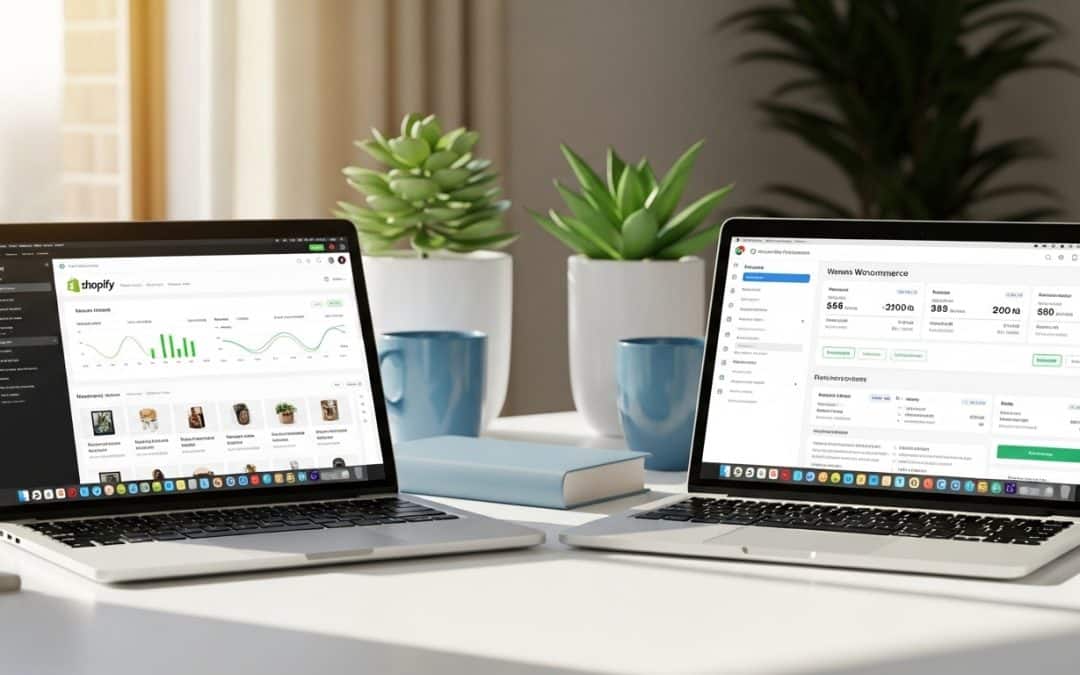
WooCommerce vs Shopify South Africa comes down to control versus convenience — Shopify costs R730–R5,600/month and handles all technical infrastructure for you, while WooCommerce is free but requires separate hosting (R100–R500/month), security management, and ongoing maintenance. For most SA entrepreneurs launching their first online store, Shopify South Africa is the faster, simpler path to market. For businesses with WordPress experience that prioritise SEO and deep customisation, WooCommerce offers more power at lower ongoing costs. This guide compares both platforms across every factor that matters to SA businesses — cost, ease of use, payment gateways, SEO, scalability, and local support. If you want your store professionally built on either platform, we cover agency options at the end.
Not sure whether WooCommerce or Shopify is right for your SA business?
Get a Free Platform RecommendationWooCommerce vs Shopify South Africa: The Quick Answer
The WooCommerce vs Shopify South Africa decision is best understood as a build-vs-buy choice — Shopify is a complete package you subscribe to, while WooCommerce is a toolkit you assemble yourself.
Choose Shopify if you want a simple, reliable online store that handles all the technical work for you. You pay a monthly fee and everything just works — hosting, security, updates, and support are all included.
Choose WooCommerce if you want complete control over every aspect of your store, lower long-term costs, and the flexibility to build exactly what you need. You will need to manage hosting, security, and updates yourself or hire someone to do it.
WooCommerce vs Shopify South Africa: Platform Overview
WooCommerce vs Shopify South Africa platforms take fundamentally different approaches — Shopify is a hosted all-in-one service you subscribe to, while WooCommerce is a free open-source plugin that turns a WordPress website into an online store.
Shopify handles the servers, security, backups, and software updates. You focus on your products and customers. According to Shopify’s official data, the platform powers over 4 million online stores globally.
WooCommerce is free to install, but you need to arrange your own hosting, security certificate, and handle ongoing maintenance. WooCommerce gives you complete ownership of your store and unlimited customisation potential.
WooCommerce vs Shopify South Africa comes down to control versus convenience. Shopify handles the technical infrastructure so you do not have to. WooCommerce gives you total control but requires more technical involvement. For most SA businesses selling physical products who want to focus on selling rather than managing a website, Shopify is the stronger starting point.
WooCommerce vs Shopify South Africa: Cost Comparison
WooCommerce vs Shopify South Africa cost comparison reveals that the gap is narrower than most SA entrepreneurs expect — WooCommerce looks cheaper on paper, but hidden maintenance costs and time investment close the difference significantly.
| Cost Item | WooCommerce | Shopify (Basic Plan) | Winner |
|---|---|---|---|
| Platform/software | R0 (free plugin) | R730/month | WooCommerce |
| Hosting | R100 – R500/month | Included | Shopify |
| SSL certificate | R0 – R500/year | Included | Shopify |
| Theme | R0 – R3,500 (one-time) | R0 – R7,500 (one-time) | WooCommerce |
| Essential plugins/apps | R0 – R1,500/month | R500 – R2,500/month | WooCommerce |
| Payment gateway fees | 3.5% + R2 (PayFast) | 5.5% + R2 (PayFast + Shopify fee) | WooCommerce |
| Security and maintenance | R500 – R2,000/month (or DIY) | Included | Shopify |
| Typical monthly total | R600 – R4,500 | R1,230 – R5,730 | Depends on volume |
The biggest cost difference is in transaction fees. Because Shopify Payments is not available in South Africa, Shopify charges an additional 2% fee on top of your payment gateway fees. On R100,000 in monthly sales, that is R2,000 extra per month that WooCommerce does not charge. For a detailed cost analysis, read our Shopify pricing South Africa breakdown.
On paper WooCommerce is cheaper, but when you factor in hosting, security, maintenance time, and the opportunity cost of managing technical infrastructure instead of growing your business, WooCommerce vs Shopify South Africa total costs are often within R1,000–R2,000 per month of each other for stores doing under R100,000 in monthly revenue. Above R100,000/month, WooCommerce’s lower transaction fees create a meaningful cost advantage that grows with volume.
WooCommerce vs Shopify South Africa: Ease of Use
WooCommerce vs Shopify South Africa ease of use favours Shopify by a significant margin — if you are not technically inclined, Shopify removes virtually all technical friction from running an online store.
| Task | WooCommerce | Shopify | Winner |
|---|---|---|---|
| Initial setup | Moderate — install WordPress, WooCommerce, configure hosting | Easy — sign up and start building | Shopify |
| Adding products | Easy once set up | Very easy — intuitive interface | Shopify |
| Theme customisation | Flexible but can be complex | Simple drag-and-drop editor | Shopify |
| Payment setup | Install gateway plugin, configure | Select gateway in settings | Shopify |
| Ongoing maintenance | Regular updates, security, backups | Automatic — Shopify handles everything | Shopify |
| Troubleshooting | Community forums, developer needed | 24/7 support included | Shopify |
Want your store built on the right platform by SA ecommerce specialists?
Get a Free Ecommerce Store QuoteWooCommerce vs Shopify South Africa: Payment Gateways
WooCommerce vs Shopify South Africa payment gateway support is comparable — both platforms integrate with all major SA payment gateways including PayFast, Peach Payments, and Yoco, so your customers get the same checkout experience regardless of platform.
| Payment Gateway | WooCommerce | Shopify |
|---|---|---|
| PayFast | Yes — free plugin | Yes — native integration |
| Peach Payments | Yes | Yes |
| Yoco | Yes | Yes |
| PayGate | Yes | Limited |
| Ozow (instant EFT) | Yes | Through PayFast |
| Additional platform transaction fee | None | 0.6% – 2.0% |
The key difference is cost: WooCommerce does not charge any additional transaction fee on top of what your payment gateway charges. Shopify adds 0.6–2.0% depending on your plan. For a complete overview of payment gateway options, see our Shopify payment gateways South Africa guide.
WooCommerce vs Shopify South Africa: SEO Capabilities
WooCommerce vs Shopify South Africa SEO comparison gives WooCommerce a clear advantage — WordPress was built as a content platform, and plugins like Rank Math give you granular control over every SEO element that matters for organic search visibility.
| SEO Factor | WooCommerce | Shopify | Winner |
|---|---|---|---|
| URL structure control | Full control | Limited — /products/ forced | WooCommerce |
| SEO plugins | Rank Math, Yoast — powerful | Basic built-in, apps available | WooCommerce |
| Blog functionality | Excellent — WordPress core strength | Basic — functional but limited | WooCommerce |
| Page speed | Depends on hosting | Generally fast | Tie |
| Schema markup | Full control with plugins | Limited — apps required | WooCommerce |
| Sitemap control | Full customisation | Auto-generated, limited | WooCommerce |
If organic search traffic is a primary growth channel for your business — and for most ecommerce stores in South Africa it should be — WooCommerce gives you more tools and flexibility. That said, many successful Shopify stores rank well — good SEO is more about content quality and technical fundamentals than platform choice alone.
WooCommerce vs Shopify South Africa: Customisation and Flexibility
WooCommerce vs Shopify South Africa customisation comparison gives WooCommerce a decisive advantage — because it is open-source, you can modify literally anything from the checkout flow to the database structure.
| Customisation Area | WooCommerce | Shopify | Winner |
|---|---|---|---|
| Theme customisation | Unlimited — full code access | Good within theme framework | WooCommerce |
| Checkout customisation | Fully customisable | Limited (Plus only for full) | WooCommerce |
| Custom functionality | Any PHP/JS development | Liquid templating and apps | WooCommerce |
| Third-party integrations | Thousands of WordPress plugins | Shopify App Store + API | WooCommerce |
| Multi-language | WPML, Polylang | Shopify Markets or apps | WooCommerce |
For most standard ecommerce stores selling physical products, Shopify’s customisation is more than sufficient. The limitations become apparent when you need complex product configurations, heavily customised checkout flows, or deep integrations with third-party systems.
WooCommerce vs Shopify South Africa: Scalability
WooCommerce vs Shopify South Africa scalability differs in approach — Shopify scales effortlessly because the infrastructure is managed for you, while WooCommerce requires you to progressively upgrade hosting as your store grows.
Shopify handles load automatically. Whether you process 10 orders or 10,000 per day, Shopify’s servers manage the traffic. You never worry about server capacity during flash sales or Black Friday spikes.
WooCommerce requires hosting upgrades as volume increases. A basic shared hosting plan that works for 50 orders per month will struggle under 500. You need to progressively upgrade to VPS or dedicated hosting, which increases both cost and complexity.
For SA businesses expecting rapid growth or seasonal traffic spikes, Shopify’s managed infrastructure removes scaling risk entirely. For businesses growing steadily and willing to manage hosting upgrades, WooCommerce scales cheaper at high volumes because it avoids Shopify’s per-transaction platform fee — saving R2,000+ per month on every R100,000 in sales.
WooCommerce vs Shopify South Africa: Who Should Choose What
Choose Shopify if: You want to launch quickly without technical hassle. You prefer paying a predictable monthly fee over managing infrastructure. You do not have WordPress experience. You want reliable 24/7 support. You prioritise simplicity over total control.
Choose WooCommerce if: You are comfortable with WordPress or willing to learn. You want the lowest possible transaction fees. SEO and content marketing are primary growth channels. You need deep customisation or complex product configurations. You want full ownership of your store and data.
Whichever platform you choose, the fundamentals of ecommerce success in South Africa remain the same: great products, strong product photography, effective marketing through channels like Google Ads and email marketing, and a relentless focus on customer experience. For professional ecommerce web design, both platforms deliver excellent results when configured correctly.
Want expert advice on which platform suits your specific SA business?
Get a Free Platform ConsultationWooCommerce vs Shopify South Africa: Frequently Asked Questions
Which is cheaper, WooCommerce or Shopify in South Africa?
WooCommerce has lower base costs — the plugin is free and hosting starts at R100–R500/month. However, when you factor in security, maintenance, and the time to manage updates, WooCommerce vs Shopify South Africa total costs are often within R1,000–R2,000/month of each other for stores under R100,000 in monthly revenue. Above that, WooCommerce becomes meaningfully cheaper due to lower transaction fees.
Is Shopify or WooCommerce better for SEO in South Africa?
WooCommerce has a clear SEO advantage. WordPress was built for content, and plugins like Rank Math provide granular control over URLs, schema, sitemaps, and on-page optimisation. Shopify’s SEO is adequate but limited by forced URL structures and a basic blogging platform. If organic search is your primary traffic source, WooCommerce is the stronger choice.
Can I switch from Shopify to WooCommerce or vice versa?
Yes — migration is possible in both directions. Products, customers, and order history can be exported and imported. However, URL structures change during migration, which means you need proper 301 redirects to preserve SEO rankings. Budget R5,000–R15,000 for professional migration depending on store size and complexity.
Which payment gateways work with both platforms in South Africa?
PayFast and Peach Payments work with both WooCommerce and Shopify. The key difference is that Shopify charges an additional 0.6–2.0% transaction fee on top of the gateway’s own fees, while WooCommerce does not. On R100,000 in monthly sales, this difference costs R600–R2,000/month more on Shopify.
Which platform is better for a new SA online store?
For most first-time SA store owners, Shopify is the safer choice. It gets you to market faster with less risk of technical problems. You can always migrate to WooCommerce later if you outgrow Shopify’s capabilities or want lower transaction fees at higher volumes.
Need Help Choosing the Right Ecommerce Platform?
Growth Pulse Media builds ecommerce stores on both Shopify and WooCommerce for South African businesses — with PayFast and Peach Payments integration, The Courier Guy shipping setup, Klaviyo email automation, and Rank Math SEO configuration. We are a registered Shopify Partner with hands-on WordPress and WooCommerce expertise. No lock-in contracts — we will get back to you within 24 hours.
Get Your Free Ecommerce Consultation