
 Add to Preferred Sources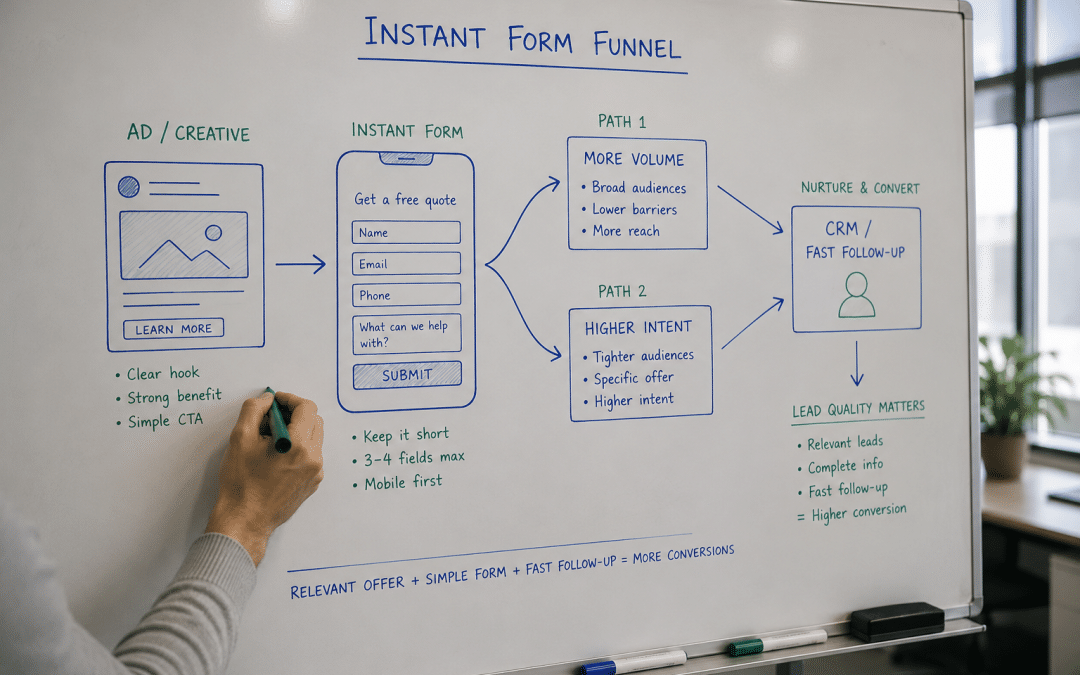
Meta lead ads south africa campaigns let people submit an enquiry through an instant form inside Facebook or Instagram, without ever leaving the app — and that frictionless convenience is both their greatest strength and their biggest trap.
The auto-filled form drives high volume cheaply, but unless you design it for intent and follow up fast, an SA business ends up with a long list of contacts who barely remember signing up. This guide covers how the format works and how to make it deliver quality, not just quantity.
It sits within our Meta Ads South Africa guide and covers the instant-form ad format specifically. The format is one capture tool inside a bigger picture — for the broader strategy, see our B2B lead generation guide, and for what to do once enquiries arrive, our lead nurturing strategy. Here the focus is the ad format and its quality trade-off.
Quick Answer
Meta lead ads use an instant form — a native form that opens inside Facebook or Instagram and pre-fills the person's contact details from their profile. Because submitting takes two taps, they generate enquiries cheaply and at volume. The catch is intent: the same low friction that lifts volume also lets people submit without much thought, so quality varies widely.
For an SA business, the format works best when you deliberately trade some volume for intent — using the Higher Intent form type, adding a qualifying question, and connecting submissions to a CRM for fast follow-up. Used carelessly, it produces cheap contacts that never convert. Used well, it is one of the most cost-effective enquiry sources on paid social.
Getting plenty of Facebook enquiries but finding most of them go nowhere? The form design is usually the culprit.
Get a Free Lead Ad Quality ReviewWhat Meta Lead Ads Actually Are
The meta lead ads south africa format is built around the instant form: when someone taps your ad, a form opens inside the app and pre-fills their name, email, and phone number from their Facebook or Instagram profile. They confirm or edit the details, tap submit, and you have their contact information — all without the person ever visiting your website. That removal of friction is the whole point of the format.
This matters in the SA market because mobile data is expensive and connections are often slow, so sending someone to a separate landing page loses a meaningful share of them before the page even loads. Keeping the form inside the app sidesteps that drop-off entirely.
The trade-off is that a website landing page can qualify and warm up a visitor in ways a two-tap form cannot, which is exactly the tension this format forces you to manage.
The Form Lives Inside the App — That Changes Everything
Because the instant form never sends the person to your website, it removes the data cost and load-time drop-off that hurt SA landing pages on mobile connections. That is a genuine advantage in a market where many users are on capped data and mid-range devices. More people complete an in-app form than ever reach a separate page.
But the same convenience that lifts completion rates also strips out the natural qualification a landing page provides. A visitor who reads a page, scrolls, and chooses to enquire has shown more intent than someone who tapped twice on autopilot. Neither is wrong — but an SA business needs to know which it is optimising for, because the format defaults to volume unless you deliberately steer it toward intent.
The Volume-Versus-Quality Trade-Off
The defining decision with the meta lead ads south africa format is where you sit on the volume-versus-quality scale, and Meta builds that choice right into the form type. The "More Volume" form is quick to fill and submit, maximising the number of enquiries.
The "Higher Intent" form adds a review step that asks the person to confirm their details before submitting, which lowers volume but raises quality. Most SA businesses default to More Volume and then wonder why the contacts are weak.
The honest answer is that cheap, high-volume enquiries are rarely a bargain once your sales team has wasted hours on people who never really wanted anything. A smaller number of higher-intent prospects usually costs more per submission but far less per actual customer. The right setting depends on your sales capacity and what a wasted follow-up costs you — but defaulting to maximum volume without thinking is the most common and costly mistake. If you want help choosing the right form setting for your sales capacity, our Facebook and Instagram ads service starts with a free audit and focuses on return on ad spend.
| Form Setting / Choice | Effect on SA Campaigns |
|---|---|
| More Volume form | Most enquiries, lowest cost each, weakest average intent |
| Higher Intent form | Fewer enquiries, higher cost each, far better quality |
| Add a qualifying question | Filters out casual submissions before they reach your team |
| Custom question vs profile auto-fill | Manual answers signal more intent than pre-filled fields |
Cheap Enquiries Are Not the Same as Cheap Customers
The metric that traps SA businesses is cost per enquiry. The More Volume form makes that number look brilliant — but it is the wrong number to optimise. What matters is cost per qualified prospect who actually becomes a customer, and on that measure a flood of low-intent submissions is usually the most expensive option, not the cheapest.
Judge the format on cost per customer, not cost per form fill. An SA business that switches to Higher Intent forms and adds a qualifying question will often see its cost-per-enquiry rise and its cost-per-sale fall at the same time. That is the trade working correctly. Optimising for the cheap headline number is how good campaigns quietly waste a sales team's week.
Want your form rebuilt to filter for intent so your team only chases prospects worth chasing?
Get a Free Form & Targeting AuditMaking Meta Lead Ads Work in South Africa
Turning the format from a volume machine into a quality enquiry source comes down to three habits, and the first is speed of follow-up. Research across markets is consistent: the odds of converting a prospect drop sharply within minutes of submission, yet many SA businesses take hours or days to respond. Connecting your instant forms to a CRM so a submission triggers an immediate response is the single highest-impact change most SA businesses can make.
The second habit is designing for intent — Higher Intent forms, a qualifying question, and a clear intro that sets expectations so casual tappers self-select out. The third is matching the offer to the format: instant forms suit straightforward offers like a quote, a callback, or a webinar registration, not complex high-consideration sales that need a full landing page to explain. Get those three right and the format earns its place in an SA campaign.
Speed of Follow-Up Beats Almost Everything Else
The most common reason SA businesses get poor results from instant forms has nothing to do with the form and everything to do with what happens after submission. An enquiry contacted within five minutes converts dramatically better than one contacted the next day, yet slow follow-up is the norm. The format delivers the prospect; the business loses them in the gap.
Connect submissions to a CRM or an automated first response so no enquiry sits waiting. Even a simple automated acknowledgement that buys time, followed by a fast human call, beats silence. For an SA business, fixing follow-up speed often lifts conversion more than any change to targeting or creative — the prospects were there; they were just left to go cold.
| Before (volume-led) | After (intent-led) |
|---|---|
| More Volume form, R40 per enquiry | Higher Intent form — R75 per enquiry, half the waste |
| No qualifying question | One qualifying question added — casual sign-ups filtered out |
| Enquiries followed up next day | CRM triggers reply in minutes — far higher conversion |
| Judged on cost per form fill | Judged on cost per customer — true value clear |
How Growth Pulse Media Approaches Meta Lead Ads
Most SA agencies run instant forms on the More Volume setting because it makes the cost-per-enquiry line on the report look impressive, then hand over a spreadsheet of weak contacts and call it a result. The honest approach treats the form fill as the start of the job, not the end — designing for intent, connecting to follow-up, and measuring on customers won rather than forms collected.
Dirk built and scaled an SA business where enquiries had to convert to revenue, not just accumulate in a list — so the instinct is to qualify hard at the form and follow up fast, because an unconverted enquiry is a cost, not an asset.
That operator habit means the format is treated as a pipeline tool judged on closed business, with form design and follow-up speed tuned to your sales capacity rather than to a vanity cost-per-enquiry figure.
SA businesses wanting instant forms built for quality and tied to real follow-up can use our B2B lead generation service, covering form design for intent, CRM connection, and measurement on closed customers. We pair it with the full Meta Ads South Africa framework so the capture format sits inside a complete paid-social plan rather than running in isolation.
Who Meta Lead Ads Are NOT For
The instant-form format is not the right capture tool for every SA business or offer. Here is who should approach it with caution.
Complex, high-consideration sales: The format suits simple offers a person can decide on in seconds — a quote, a callback, a webinar seat. An SA business selling complex, expensive solutions that need explanation will get curious tappers rather than serious buyers, because the two-tap form gives no room to qualify or educate. A full landing page serves these offers far better.
Businesses with no follow-up system: Because conversion collapses when enquiries go cold, an SA business that cannot respond within minutes will waste most of what the format delivers. If submissions land in an inbox nobody watches and get a reply two days later, the format simply manufactures contacts you then fail. Fix follow-up before scaling spend, not after.
Teams optimising for cost per form fill: If your reporting celebrates a low cost per enquiry and ignores what those enquiries become, the format will flatter you while wasting money. An SA business fixated on the cheap headline number will keep the More Volume setting and keep burning sales time on people who never wanted to buy. The format punishes vanity metrics.
Offers needing rich qualification up front: Some SA businesses genuinely need detailed information before a conversation is worthwhile — budget, timeline, specifications. While you can add questions, a long instant form defeats the format's frictionless advantage and a proper landing page with a structured form usually does this job better. Match the tool to how much qualification the sale truly requires.
Not sure whether instant forms or a landing page suit your offer and sales process?
Get a Free Capture Strategy SessionThe discipline that ties this together is treating the enquiry as the beginning of the work, not the win. Per Meta's own lead ads documentation, instant forms are designed to help you generate and qualify enquiries — that word "qualify" is the part most SA businesses skip, defaulting to raw volume and inheriting the quality problem that follows. The format gives you the choice; the quality of your enquiries reflects which choice you made.
Seen correctly, the format is a capture mechanism that belongs inside a wider plan, not a standalone source. It feeds the top of a pipeline that still needs qualification, nurturing, and a sales process to turn enquiries into revenue.
That is why it works best linked to a real lead-generation strategy rather than run as a quick volume play. Design for intent, follow up fast, measure on customers, and the format rewards an SA business handsomely.
Frequently Asked Questions
What are Meta lead ads in South Africa?
They are ads that open a native instant form inside Facebook or Instagram, pre-filled with the person's profile contact details. The person confirms and submits without leaving the app, so you collect their enquiry directly. For SA businesses on expensive mobile data, keeping the form in-app avoids the load-time drop-off that costs landing pages a share of visitors.
Why are my Meta lead ads producing poor-quality leads?
Almost always because you are using the More Volume form type, which is so quick to submit that people sign up with little intent. Switch to the Higher Intent form, add a qualifying question, and write a clear intro so casual tappers self-select out. The low friction that lifts volume is the same thing that lowers average quality unless you design against it.
What is the difference between More Volume and Higher Intent forms?
More Volume forms are quick to fill and submit, maximising the number of enquiries at the lowest cost each. Higher Intent forms add a review step asking the person to confirm their details before submitting, which lowers volume but raises quality. Most SA businesses should use Higher Intent unless they have the sales capacity to work through large volumes of weaker contacts.
Should I use Meta lead ads or send people to a landing page?
Instant forms suit simple offers — a quote, callback, or webinar seat — and win where SA mobile data costs and slow connections hurt landing-page completion. A landing page is better for complex, high-consideration sales that need explanation and richer qualification. Many SA businesses test both; the right choice depends on offer complexity and how much qualification the sale requires.
How do I follow up on Meta lead ads quickly in South Africa?
Connect your instant forms to a CRM so each submission triggers an immediate response, rather than downloading leads manually from Ads Manager hours later. Conversion drops sharply within minutes of submission, so an automated acknowledgement followed by a fast human call dramatically outperforms next-day replies. Fixing follow-up speed is often the highest-impact change an SA business can make.
How do Meta lead ads fit into a wider lead generation strategy?
They are a capture tool at the top of the pipeline, not a complete strategy. The enquiries they generate still need qualification, nurturing, and a sales process to become revenue. The format works best linked to a full lead-generation plan and a nurturing sequence, rather than run as an isolated volume play judged on cost per form fill.
Want Meta Lead Ads That Fill Your Pipeline, Not Just a Spreadsheet?
Growth Pulse Media builds instant-form campaigns for SA businesses designed around intent and tied to fast follow-up — Higher Intent form design, qualifying questions, CRM connection, and measurement on customers won rather than forms collected. Real operator experience treating every enquiry as a cost until it converts. No obligation — we will get back to you within 24 hours with an honest read on why your current campaigns under-deliver and how to fix them.
Get Your Free Lead Ads Strategy Call