
 Add to Preferred Sources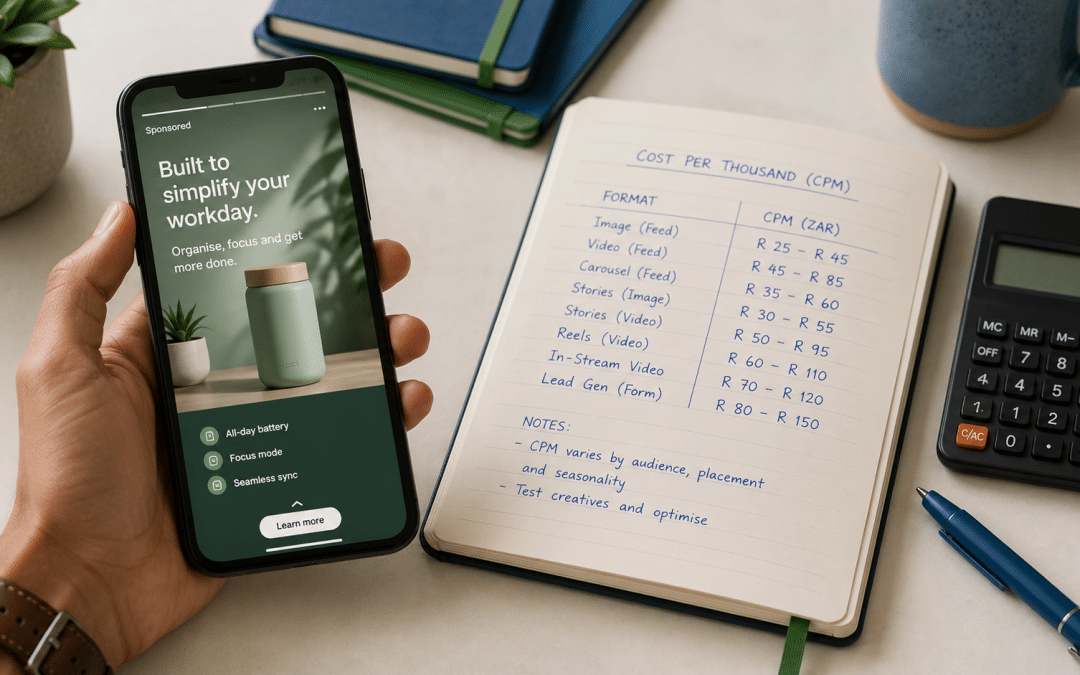
Instagram ads cost south africa rates run R55-R110 per thousand impressions on Feed, dropping to R30-R65 on Reels — broadly in line with Facebook, but with a younger, more visual audience that makes the platform worth its rate for the right products.
Cost-per-click typically lands between R2 and R12 depending on format and targeting. This guide breaks down what you actually pay on the platform specifically, by placement, why the rate moves the way it does, and when it is justified for an SA business rather than wasted on a poor audience-and-creative fit.
It sits within our Meta Ads South Africa guide and focuses on these rates in particular. For the full cross-placement view across Facebook and the platform together, see our Meta and Facebook CPM benchmarks; for the platform-versus-platform decision, our Facebook vs Instagram ads comparison. Here the focus is IG pricing on its own terms.
Quick Answer
On Instagram in the SA market, expect roughly R55-R110 per thousand impressions on Feed, R30-R65 on Reels, and R35-R70 on Stories, with cost-per-click between R2 and R12. Reels is consistently the cheapest placement because the platform is pushing that inventory, and these rates have eased slightly year-on-year as Reels takes a larger share of impressions. Instagram ads run in the Meta auction, so our SA Digital Cost Index of dated South African Meta ads benchmarks is a useful cross-check for these rates.
The key point for SA businesses: the rate is similar to Facebook's, so the platform choice should turn on audience fit and creative, not price. IG earns its rate when you have visually strong products and a younger target audience — and wastes it on text-heavy offers better suited to Facebook Feed.
Want to know whether these rates make sense for your specific SA product and audience?
Get a Free Platform Fit CheckWhat You Actually Pay on Instagram in South Africa
The instagram ads cost south africa figure varies by placement more than by anything else, and knowing the per-format rates lets an SA business weight its creative toward the cheaper, better-performing inventory. The channel sells advertising through the same auction as Facebook, so the underlying mechanics are identical.
But its placements price differently because audience competition and inventory supply differ across Feed, Reels, and Stories. The table below gives realistic 2026 SA rates by placement. These are working local benchmarks, not global averages — applying US pricing to an SA budget produces wildly wrong projections, since local rates run a fraction of North American ones. Treat them as a sanity check on your own account rather than fixed targets.
| Placement | Typical SA Rate (CPM, 2026) | Best For |
|---|---|---|
| Instagram Feed | R55 - R110 | Conversion campaigns, detailed product shots |
| Reels | R30 - R65 | Cheapest reach, younger audience, video-led brands |
| Stories | R35 - R70 | Full-screen offers, time-sensitive promotions |
| Cost per click (blended) | R2 - R12 | Varies by format, creative, and targeting |
One structural change worth noting for 2026: Explore was removed as a standalone placement in January, so the rate picture now centres on Feed, Reels, and Stories. Reels continues to gain share of impressions, which is part of why blended rates have softened slightly year-on-year rather than climbing.
SA advertisers feel this as marginally cheaper reach when their creative suits the format, and as wasted budget when it does not — the rate trend rewards advertisers who adapt their creative to where the impressions actually are.
Why Reels Is the Cheapest Inventory in SA
Reels consistently delivers the lowest rate per thousand impressions because the platform is actively pushing advertiser demand into that growing inventory, and supply outpaces competition. For SA businesses chasing efficient reach, producing vertical, Reels-native creative rather than recycled square Feed posts is one of the simplest ways to lower a blended rate.
The catch is the same as on any placement: cheap reach only matters if it converts. Reels excels at awareness and discovery for visual brands; Feed often converts better for considered purchases despite the higher rate. Match the placement to the job rather than simply chasing the lowest number, because cheap impressions that never convert are the most expensive kind.
Why Instagram Costs Differ From Facebook
These rates sit close to Facebook's because both run through one auction, but the small differences come down to audience and format, not a separate pricing system. The platform skews younger and more visual, so industries targeting that demographic — fashion, beauty, lifestyle, food — often see competitive rates and strong engagement there.
Businesses targeting older or more text-driven audiences may find Facebook Feed more efficient for the same Rand. The practical implication is that platform choice should rarely be made on rate alone. Because the two platforms price so similarly in the SA market, the deciding factor is where your audience actually pays attention and how well your creative suits the format. A visually weak advert will underperform here regardless of how its rate compares to Facebook's. If you would like a fresh view on placement and creative before you spend, our Instagram and Facebook ads management starts with a free audit and comes with no lock-in contract.
The Rate Gap Is About Audience, Not Pricing
Because both platforms share one auction, there is no separate IG premium baked into the system. Any rate difference an SA business sees reflects how hard the relevant audience is to reach and how well the creative performs — not a structural price gap between the two channels. This reframes the whole decision.
For a fashion or beauty brand targeting under-35s, the younger audience here often returns better engagement per Rand than Facebook Feed. For a B2B firm targeting senior decision-makers, the reverse usually holds.
The rate follows the audience and the creative, so the planning question is fit, never which platform's CPM looks lower on a rate card. An SA brand that internalises this stops shopping for the cheapest platform and starts matching each product to where its actual buyers spend their attention every day.
Curious whether your audience and creative are better suited to Instagram or Facebook for the rate you are paying?
Get a Free Placement RecommendationWhen the Rate Is Justified for an SA Business
The rate is justified when the platform's strengths match your business, and wasted when they do not — so the decision is about fit, not affordability. The channel earns its rate for visually-led products, younger target audiences, brand-building, and discovery-driven categories where strong imagery and video do the selling. For these, its engagement often delivers a lower true cost per result than the headline rate suggests.
It is harder to justify for text-heavy or highly considered B2B offers aimed at older decision-makers, where Facebook Feed or even other channels may convert more efficiently. The rate itself is rarely the problem; the mismatch between product, audience, and platform is. An SA business should ask not "is this expensive?" but "does this audience and format fit what I sell?"
| Before (rate-led thinking) | After (fit-led thinking) |
|---|---|
| Square Feed-only creative on the platform | Vertical Reels-native creative — R45 blended rate |
| Text-heavy B2B offer forced onto the channel | Moved to Facebook Feed — better cost per result |
| Judging the channel on headline CPM alone | Judged on cost per conversion — true value visible |
| Same creative across all placements | Format-matched creative per placement — lower blended rate |
The True Cost Is Per Result, Not Per Impression
An SA business fixated on the headline CPM can talk itself out of a placement that would have been its cheapest source of customers. A R90 Feed rate that converts at 4% can deliver a lower cost per sale than a R45 Reels rate that converts at 1% — the impression price is only half the equation, and on its own it is misleading.
Always carry the rate through to cost per result before judging it. The platform's value for an SA business shows up in what each Rand of spend actually returns, not in how its CPM compares to Facebook's on a benchmark table. Cheap reach that never converts is the most expensive line in any account.
How Growth Pulse Media Approaches These Costs
Most SA agencies quote Instagram and Facebook as if they were separate pricing decisions, when in reality they share one auction and the real question is fit, not rate. The honest approach is to place spend where the audience and creative actually perform — often a blend across both platforms — and to judge the channel on cost per result rather than the headline rate that catches a nervous advertiser's eye.
Dirk built and scaled an SA ecommerce business on paid social, where both platforms were managed as one budget allocated by performance, not by platform loyalty or rate anxiety — weighting spend toward whichever placement produced profitable results for each product. That operator habit means the rate is assessed against what it returns, never in isolation. The work runs in-house, with creative matched to each placement rather than copied across them.
SA businesses wanting this run as part of a performance-led paid social mix can use our digital marketing service, covering placement strategy, format-matched creative, and cost-per-result measurement across both channels together. We pair it with the full Meta Ads South Africa framework and the channel-mix view from SA Google Ads.
Who This Cost Guide Is NOT For
A rate breakdown will not suit every advertiser, and reading these benchmarks the wrong way can lead to worse decisions than having no benchmark at all. Here is who should approach it with caution.
Businesses choosing platform on rate alone: Because the two platforms price so similarly through the same auction, picking one purely on which looks cheaper misses the point entirely. An SA business that chases the lower headline rate while ignoring audience fit will pay less per impression and more per actual result. Decide on fit and creative suitability, not on the rate comparison.
Text-heavy or older-audience B2B offers: The younger, visual audience here makes it a poor home for dense, text-driven propositions aimed at older decision-makers. An SA B2B business forcing a detailed offer onto the channel because the rate looked attractive will usually get worse cost per result than a better-suited placement. Match the platform to the audience, not to the rate card.
Advertisers with no creative for vertical video: The cheapest and fastest-growing inventory is Reels, which demands vertical, native video. An SA business unwilling or unable to produce that creative will be stuck on the more expensive Feed placement, paying a higher blended rate. If you cannot commit to format-appropriate creative, the rate advantages stay out of reach.
Businesses wanting one fixed price: There is no single instagram ads cost south africa figure, because the rate shifts by placement, audience, season, and creative quality. Businesses hoping this guide hands them one number to copy will be disappointed. Use the per-format ranges as context for your own account's trend, not as a universal price to hold yourself to.
Want help deciding where this fits in your paid social mix and what rate you should realistically expect?
Get a Free Paid Social PlanThe discipline that ties this together is judging the channel on fit and result, not on its headline rate. Per Meta's own Instagram placement documentation, the platform delivers across Feed, Reels, and Stories through the same auction as Facebook — so the rate you pay reflects competition and creative quality, not a separate premium. The businesses that win match their product and creative to the format, then measure on cost per result.
The 2026 SA picture is favourable on raw rate: Reels growth has eased blended costs slightly, vertical video offers the cheapest reach, and local rates remain a fraction of developed-market ones. Weight creative toward Reels and Stories for efficient reach, reserve Feed for considered conversion, judge the platform on what it returns rather than its CPM, and it becomes a cost-effective pillar of an SA paid social mix rather than an expensive guess.
Frequently Asked Questions
How much do Instagram ads cost in South Africa?
In the SA market, expect roughly R55-R110 per thousand impressions on Feed, R30-R65 on Reels, and R35-R70 on Stories, with cost-per-click between R2 and R12. Rates vary by format, audience competition, season, and creative quality. These figures are a fraction of US rates, making reach comparatively affordable for SA businesses.
Which placement is cheapest in South Africa?
Reels consistently delivers the lowest rate per thousand impressions — roughly R30-R65 — because the platform is actively pushing advertiser demand into that growing inventory and supply outpaces competition. SA businesses producing vertical, Reels-native creative rather than recycled square Feed posts pay a lower blended rate for the same audience.
Are Instagram ads more expensive than Facebook ads in South Africa?
No — they price very similarly because both run through the same auction. Small differences come from audience and format rather than a separate pricing system. The platform skews younger and more visual, so it can deliver better value for fashion, beauty, and lifestyle brands, while Facebook Feed may be more efficient for older or text-driven audiences.
Why have these ad costs eased in South Africa?
Blended rates have softened slightly year-on-year largely because Reels has taken a growing share of impressions, and Reels carries a lower rate than Feed. The removal of Explore as a standalone placement in January 2026 also shifted the rate picture toward Feed, Reels, and Stories. More cheap Reels inventory pulls the blended average down.
What is a good cost per click in South Africa?
A blended cost-per-click of R2-R12 is typical in the SA market, depending on format, creative quality, and audience intent. Reels and Stories generally produce cheaper clicks than Feed. As with any metric, cost-per-click is only meaningful alongside what those clicks do — a cheap click that never converts is more expensive than a pricier one that buys.
Should I run Instagram or Facebook ads in South Africa?
Because the two price so similarly, the decision should turn on audience fit and creative, not rate. The platform suits visual products and younger audiences; Facebook Feed suits older or more text-driven propositions. Most SA businesses benefit from running both as one budget allocated by performance. See our Facebook vs Instagram ads comparison for the full decision framework.
Want Instagram Run by Fit and Result, Not Rate Anxiety?
Growth Pulse Media runs Instagram as part of a performance-led paid social mix for SA businesses — placement strategy, format-matched creative across Reels, Stories, and Feed, and honest cost-per-result measurement across both platforms together. Real operator experience managing them as one budget, allocated by what actually converts. In-house execution, no outsourcing. No obligation — we will get back to you within 24 hours with a frank read on where Instagram fits your mix.
Get Your Free Instagram Ads Plan