A working lead nurturing strategy for South African B2B businesses combines multi-channel cadences (email + LinkedIn + retargeting + WhatsApp) sequenced across a 60-90 day buyer journey to convert qualified prospects into booked meetings. Working programmes typically lift MQL-to-opportunity conversion rates from 8-14% baseline to 28-42% over a 90-day measurement window. Most SA mid-market operations leak 70-85% of qualified pipeline because no structured cultivation sequence exists between MQL handoff and sales engagement.
This guide breaks down the four stages of B2B prospect cultivation, the working SA 60-day sequence template, the multi-channel mix that fits South African buyer behaviour, and the implementation mistakes that wreck programmes before they compound. For broader cluster context, start with the B2B lead generation pillar; for the qualification model that feeds the cultivation engine, see our lead scoring guide.
Quick Answer
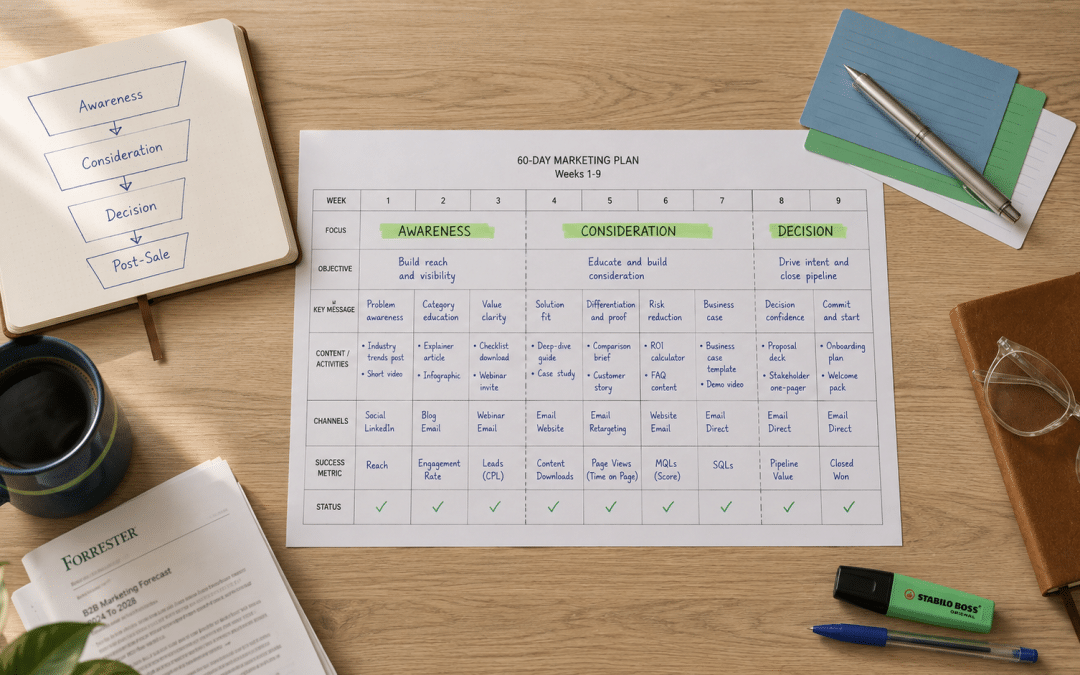
A working SA B2B lead nurturing strategy operates as a 60-90 day multi-channel buyer journey across four stages: (1) Awareness — educational content building problem recognition, 2-3 touches/week via email and LinkedIn over weeks 1-3; (2) Consideration — case studies, comparison frameworks, webinar invitations, 1-2 touches/week across weeks 4-7; (3) Decision — direct demo offers, ROI calculators, SDR connection sequences, 2-3 touches/week across weeks 8-12; (4) Post-Sale — retention and referral sequences for closed-won accounts.
Per Forrester’s 2025 B2B Buyer Journey Survey, the average B2B purchase decision now involves 13 internal stakeholders and 9 external influencers — meaning the prospect who downloaded your lead magnet must convince a 22-person buying network before closing. Cultivation isn’t optional for SA mid-market B2B; it arms internal champions with material to advocate for your solution.
Want a quick read on whether your current SA prospect cultivation engine actually moves leads through the funnel — or just queues them in a CRM?
Get a Free Nurture Health CheckThe Four Stages of B2B Prospect Cultivation
Every working SA lead nurturing strategy maps onto four buyer-journey stages — awareness, consideration, decision, post-sale — each with distinct content type, cadence intensity, and conversion goal. Most SA B2B operations get awareness roughly right (content marketing fills that bucket) but lose prospects across the consideration-to-decision transition where 60-75% of pipeline leakage actually happens.
Stage 1: Awareness (Weeks 1-3)
The awareness stage converts unqualified prospects into educated buyers who recognise they have a solvable problem. Content type: problem-framing blog posts, industry benchmarks, “is this you?” diagnostic checklists.
Cadence: 2-3 light-touch contacts per week across email and LinkedIn. Conversion goal: get the prospect to download a deeper resource (case study, ROI calculator) that signals consideration-stage intent. SA buyers in a lead nurturing programme respond particularly well to data-led problem framing — concrete benchmarks beat aspirational vision content.
Stage 2: Consideration (Weeks 4-7)
The consideration stage converts educated buyers into comparison-shoppers actively evaluating solutions. Content type: case studies matched to prospect’s industry vertical and company size, comparison frameworks, webinar invitations, expert-led teardown sessions. Cadence: 1-2 medium-touch contacts per week. Conversion goal: get the prospect to book a discovery call or attend a live session. This stage is where most SA lead nurturing operations underperform — generic case studies that don’t match buyer profile fail to advance prospects.
Stage 3: Decision (Weeks 8-12)
The decision stage converts comparison-shoppers into pipeline opportunities. Content type: direct demo offers, ROI calculators tuned to prospect vertical, customer-referenceable testimonials, pricing transparency content. Cadence: 2-3 higher-intensity contacts per week with SDR involvement. Conversion goal: scheduled demo or proposal request. This stage requires the kind of sales-marketing alignment that successful lead nurturing operations have built — most SA mid-market businesses haven’t — marketing hands off too early, sales engages too aggressively, prospects bounce.
Stage 4: Post-Sale (Ongoing)
The post-sale stage converts closed-won customers into retained accounts and referral sources. Content type: onboarding sequences, quarterly business reviews, expansion-opportunity content, NPS surveys, referral activation campaigns. Cadence: monthly to quarterly. Conversion goal: 110-130% net revenue retention. SA B2B operations routinely under-invest in post-sale cultivation — losing 25-40% more revenue to churn than necessary because no structured engagement programme exists past the closed-won handoff.
The Stage That Loses Most SA B2B Pipeline
Stage 2 (consideration) breaks more SA programmes than any other single stage. The typical pattern: awareness prospects download a lead magnet, the operation marks them MQL, but the consideration content the prospect needs — case studies in their vertical, comparison frameworks tuned to their stack, ROI calculators relevant to their pipeline volume — simply doesn’t exist.
The prospect goes silent for 8-12 weeks and the CRM ages them out as “unresponsive” when the actual problem was content insufficiency.
The fix isn’t more emails. The fix is consideration-stage content matching prospect’s specific vertical and stage of evaluation — and a content map aligning each prospect’s behavioural signal (job title, company size, intent score) to the next asset they need. SA mid-market businesses that build the consideration library see MQL-to-SQL conversion rates double within 90-120 days.
The Working SA 60-Day Lead Nurturing Strategy Template
The template below reflects what works for SA mid-market B2B businesses with sales cycles in the 60-120 day range. Adjust touch intensity based on your specific cycle: shorter cycles (under 60 days) compress the cadence; longer cycles (over 120 days) stretch it. The principle stays constant — match content to buyer-journey stage, escalate intensity as intent grows, withdraw gracefully when no engagement signals come back.
| Week | Stage | Email Touches | LinkedIn Touches | Other Channels |
|---|---|---|---|---|
| Week 1 | Awareness | 2 (welcome + diagnostic checklist) | 1 (connect + soft intro) | Retargeting ads activate |
| Week 2 | Awareness | 1 (industry benchmark report) | 0 | Retargeting ads continue |
| Week 3 | Awareness | 2 (problem framing + case study tease) | 1 (commented engagement on prospect’s post) | Retargeting ads continue |
| Week 4 | Consideration | 1 (vertical-matched case study) | 1 (DM with case study link) | Webinar invite |
| Week 5 | Consideration | 2 (comparison framework + ROI calculator) | 0 | Retargeting message-match |
| Week 6 | Consideration | 1 (testimonial + soft demo offer) | 1 (sharing prospect-relevant insight) | WhatsApp opt-in invite |
| Week 7 | Consideration | 2 (objection-handling + FAQ) | 0 | SDR LinkedIn voice message |
| Week 8 | Decision | 1 (direct demo offer + calendar link) | 1 (SDR connection follow-up) | Phone outreach if SQL |
| Week 9-12 | Decision | 1-2/week (pricing transparency + customer reference) | 1/week (SDR cadence) | Phone + WhatsApp escalation |
The cadence above shows the maximum activity profile — actual touch frequency should taper based on engagement signals. Prospects who open every email and click case studies get more frequent touches; prospects ignoring 5+ consecutive emails get the cadence reduced or paused. Engagement-responsive cadence outperforms fixed-frequency by 30-50% in measured campaigns.
Multi-Channel Cultivation Mix for SA B2B Buyers
SA B2B buyers respond differently to channel mix than US counterparts. The working SA split weighted by stage looks roughly like the breakdown below — email carries most of the load (familiar, low-friction, scales), LinkedIn handles higher-trust touches (peer-to-peer credibility), retargeting handles passive reinforcement (visibility without active outreach), and WhatsApp covers highest-intent later-stage moments where prospects expect a direct line.
| Channel | Stage Weight | SA-Specific Notes |
|---|---|---|
| 50-60% of all touches | Standard channel across all stages. HubSpot, Klaviyo, Mailchimp; segment by buyer-journey stage; SA deliverability needs SPF + DKIM + DMARC properly configured | |
| 20-25% of touches | High-trust channel; Sales Navigator essential for SA decision-maker targeting; voice messages outperform text DMs 3-4x for SA mid-market buyers | |
| Retargeting Ads | 10-15% of touches | Meta + Google retargeting; message-match content to email sequence; helps SA buyers who lurk before engaging visibly |
| WhatsApp Business | 5-10% of touches | Late-stage only — Decision onwards; SA buyers expect WhatsApp for high-intent moments but resent it for cold outreach |
| Phone | 2-5% of touches | SQL stage only; SA business hours 08h00-17h00 SAST; Tuesday-Thursday produces 60% higher answer rates than Monday/Friday |
The dominant pattern across high-performing SA B2B programmes is engagement-responsive multi-channel orchestration — not single-channel intensity. Prospects touched across 3+ channels convert at 2.4x the rate of email-only sequences in measured SA mid-market campaigns. The multi-channel premium compounds; single-channel saturation typically backfires past 8-12 contacts.
Trying to figure out the right channel mix and cadence for your specific SA B2B buyer profile and sales cycle length?
Get a Free Channel Mix RecommendationSA-Specific Lead Nurturing Strategy Considerations
US-focused B2B playbooks miss four considerations that significantly affect SA-market performance. South African operators applying global templates without adjusting for these factors routinely underperform by 30-50% relative to SA-tuned programmes with the same content investment.
| SA Consideration | Practical Impact on Programme Design |
|---|---|
| POPIA Section 11 consent | Sequences can only contact prospects who provided unbundled consent for the specific sequence type. Implied or bundled consent fails POPIA — fines up to R 10 million |
| Longer SA B2B buying cycles | SA mid-market cycles average 60-120 days vs US 45-90 days. Cadence should reflect 90-day base, not US 60-day default |
| SA business calendar dead zones | Mid-December to mid-January, Easter week, and July school holidays all produce 40-60% lower engagement rates — pause cadences or reduce intensity during these windows |
| SA buyer skepticism on US-style content | Aspirational US-tone “transform your business” copy underperforms data-led, frank-tone content by 35-50% with SA mid-market buyers |
| WhatsApp expectation gap | SA buyers expect WhatsApp availability at SQL/decision stage but resent WhatsApp cold outreach — opt-in gate WhatsApp until Stage 3 |
Common Cultivation Mistakes That Wreck SA B2B Pipelines
The six most common programme mistakes among SA B2B operators get repeated across SaaS, professional services, financial services, and industrial sectors. Each lead nurturing mistake costs 20-40% of potential conversion individually; combined, they typically waste 60-80% of the programme’s potential value. Per Forrester’s 2025 Buyer Journey Survey research, B2B buying groups now involve 22+ stakeholders on average — meaning mistakes get amplified across multiple decision-makers, not just one.
| Mistake | Why It Wrecks Pipeline |
|---|---|
| One generic sequence for all prospects | Different verticals, company sizes, and roles need different content — generic sequences convert at one-third the rate of segmented ones |
| No engagement-responsive cadence | Fixed-frequency emails to disengaged prospects burns sender reputation; responsive cadence preserves deliverability |
| Stopping after 5-7 touches | SA mid-market cycles need 12-18 touches across 60-120 days — short sequences leave 70%+ of conversion on the table |
| Email-only programmes | Single-channel sequences convert at 40% the rate of multi-channel orchestration — channel diversification compounds |
| No content for the buying network | The 22-person buying group needs content the champion can forward — internal-circulation content matters more than top-of-funnel assets |
| Manual sequence management | Manual cultivation drifts within 30 days; automated sequences via HubSpot/Klaviyo/ActiveCampaign compound — see our email automation guide |
The fix pattern across all six mistakes stays the same — treat cultivation as an operational system with weekly content additions, monthly cadence reviews, and quarterly conversion-rate measurement. For broader B2B operational context, see our B2B lead generation strategy guide; for the platform stack that supports cultivation at scale, see our B2B lead generation tools comparison.
Why Engagement-Responsive Cadence Beats Fixed Frequency
The biggest single performance differentiator between average and high-performing SA B2B lead nurturing programmes is engagement-responsive cadence — adjusting touch frequency based on what each prospect actually does, not what the calendar says.
Prospects who open every email and click case studies get accelerated cadences with deeper content; prospects ignoring 4+ consecutive emails get cooled to monthly touches; prospects who actively engage on LinkedIn but ignore email get the email cadence cut entirely while LinkedIn intensity increases.
This requires marketing automation platform configuration (HubSpot Workflows, ActiveCampaign Automations, Klaviyo Flows) plus quarterly review of which behavioural triggers actually correlate with downstream conversion. The investment in proper trigger logic pays back within 90-120 days through deliverability protection alone — fixed-frequency cadence to disengaged prospects burns sender reputation, while responsive cadence preserves it.
Real SA Before-and-After Cultivation Implementation
The pattern below reflects a Johannesburg-based B2B professional services firm, ACV around R 320,000/year, four-person sales team. The before-state: 47 MQLs/month entering a single email sequence (5 touches over 14 days), then “ageing out” of active engagement into a static newsletter list. The after-state reflects 5 months after implementing the four-stage 60-day multi-channel programme described above.
| Metric | Before (5-touch single-channel) | After (60-day multi-channel) |
|---|---|---|
| Monthly MQLs entering programme | 47 | 47 (unchanged — same demand generation) |
| MQL-to-SQL conversion rate | 11% | 34% |
| SQL-to-Opportunity conversion | 22% | 41% |
| Monthly opportunities created | 1.1 | 6.5 opportunities |
| Average sales cycle length | 132 days | 81 days |
| Email unsubscribe rate | 4.2% | 0.9% |
| Cost per opportunity | R 14,800 | R 2,500 |
What Drove the Result
Three changes produced the bulk of the lift. First, extending the window from 14 days to 60 days exposed prospects to consideration-stage content they were never previously offered — case studies, ROI frameworks, and webinar replays produced most of the new SQL volume. Second, adding LinkedIn voice messages at week 4 and week 7 doubled engagement among the silent-but-watching prospect segment that pure email never reached.
Third, segmenting the sequence by buyer-journey stage and vertical eliminated the generic content fatigue driving the 4.2% unsubscribe rate. The new segmented sequences felt relevant to each prospect’s specific situation, dropping unsubscribes to 0.9% while lifting click-through rates by 3x. The combined improvements compounded over months 2-4 as data accumulated and content quality improved against measured conversion signals.
How Growth Pulse Media Approaches Programme Design
Most SA agencies design lead nurturing programmes as standalone email sequences disconnected from CRM scoring, content strategy, sales handoff timing, and channel orchestration. That fragmentation produces 30-50% worse conversion economics than properly-integrated systems with the same content investment. Effective cultivation isn’t email scheduling — it’s behavioural orchestration across channels, tied to qualification scores, tuned to SA buyer cycles, and measured against MQL-to-opportunity conversion.
Dirk built and ran a real SA ecommerce business with the operational discipline of multi-channel buyer engagement — direct experience designing sequences, integrating them with CRM scoring, building the sales-marketing handoff timing that prevents over-aggression at SQL stage, and the iteration cycle that improves conversion rates over months. That same operational seat applied to SA B2B lead nurturing strategy work produces frameworks tuned to your actual buyer profile, sales cycle, and content capacity.
SA B2B businesses ready treating cultivation as an integrated operational system can use our B2B lead generation service, which covers strategy design, content architecture, channel orchestration, CRM integration, and the SDR handoff layer that converts opportunities into pipeline. We pair programme design with the qualification framework from B2B lead generation audit.
Who This Lead Nurturing Strategy Approach Is NOT For
The working SA cultivation approach described above fits businesses with monthly MQL volumes above 20, an existing CRM (HubSpot, Salesforce, Pipedrive, or Zoho), content production capacity (in-house or contracted), and sales cycles longer than 30 days. Here is who should look elsewhere first.
SA businesses with under 20 monthly MQLs: Programmes become operationally meaningful when prospect volume justifies the content investment and platform spend. Below 20 monthly MQLs, the operational overhead of segmenting sequences, building stage-matched content, and tuning cadence by behaviour exceeds the conversion lift. Sub-20 MQL operations should focus on demand generation first — build the funnel volume, then implement structured cultivation when MQL volume crosses the threshold where segmentation actually pays.
Operations expecting cultivation replaces sales execution: Working programmes warm prospects; they do not close deals. SA B2B businesses without trained SDR or AE capacity to handle the SQL handoff routinely build sophisticated sequences that produce qualified opportunities then leak them at the human-engagement stage. The post-cultivation sales process matters as much as the cultivation itself — without sales execution capacity, the investment cannot compound into pipeline.
Businesses with sales cycles under 30 days: Cultivation programmes pay back over 60-120 day buyer journeys; sales cycles under 30 days don’t need multi-stage orchestration because prospects move from MQL to closed-won faster than content can compound. Short-cycle businesses should invest in direct-response email and high-velocity SDR cadence instead — different operational model, different framework, different success metrics.
Operations without consideration-stage content capacity: Working cultivation requires consistent content production across all four buyer-journey stages — particularly the consideration stage where most pipeline leakage happens. SA B2B businesses without in-house content capacity or a reliable content retainer routinely build awareness-heavy sequences that fail to advance prospects. The content-capacity prerequisite gates the rest of the investment; without it, the framework produces measurably less than its potential.
Wondering whether your SA B2B operation actually meets the volume, sales-cycle, and content prerequisites for proper cultivation programme implementation?
Get a Free Implementation Readiness CheckThe discipline carrying all of this is treating cultivation as a buyer-journey orchestration system rather than an email scheduling task. The cadence, channel mix, content type, and intensity all flex with prospect behaviour signals.
The system improves over months as conversion data feeds back into segmentation rules. SA B2B businesses that commit to the operational discipline of monthly cadence reviews, quarterly content additions, and conversion-rate measurement produce dramatically better pipeline economics than businesses configuring a 5-touch sequence and never revisiting it.
The 2026 SA market carries favourable conditions for businesses willing implementing a lead nurturing framework properly. Marketing automation platforms (HubSpot, Klaviyo, ActiveCampaign) all support SA businesses; LinkedIn Sales Navigator covers SA decision-maker depth; WhatsApp Business API integration matures monthly. The binding constraint remains operator discipline — matching content and cadence to actual buyer behaviour rather than US-published templates copied at face value.
Frequently Asked Questions
What is a lead nurturing strategy in B2B marketing?
A lead nurturing strategy is a structured multi-channel programme that moves qualified prospects through the buyer journey from initial interest to purchase decision, typically across a 60-120 day cycle. The strategy combines email sequences, LinkedIn touches, retargeting ads, and (in SA mid-market B2B) WhatsApp engagement at decision stage. The goal is sustained relevant engagement that converts marketing-qualified prospects into sales-qualified opportunities at significantly higher rates than no-nurture baselines (28-42% vs 8-14% MQL-to-SQL conversion).
How long should a B2B lead nurturing sequence be in South Africa?
SA mid-market B2B sequences should run 60-90 days as a baseline, matching average SA B2B buying cycles of 60-120 days. Shorter sequences (under 30 days) leave 60-75% of conversion potential on the table; longer sequences (over 120 days) generate diminishing returns and risk fatigue. Enterprise SA cycles (12+ months for complex purchases) need longer windows but with reduced cadence intensity — fewer touches per month, more depth per touch.
How many touches should a SA B2B nurture programme include?
Working SA B2B programmes include 12-18 total touches across 60-90 days, distributed across email (50-60%), LinkedIn (20-25%), retargeting ads (10-15%), and WhatsApp/phone (5-10%). The exact count varies by sales cycle length and engagement signals — responsive cadence increases touches for engaged prospects and tapers for disengaged ones. Fixed 5-7 touch sequences typically convert at one-third the rate of properly-extended multi-channel programmes.
What’s the best email cadence for SA B2B nurturing?
The working SA B2B email cadence ranges from 2 touches/week during high-activity stages (awareness week 1, decision weeks 8-12) down to 1 touch/week during consideration stages. Total email volume should land at 8-14 emails over the 60-90 day window. Higher frequencies risk unsubscribes and POPIA complaints; lower frequencies fail to maintain mindshare across SA’s longer buying cycles. Tuesday-Thursday sends outperform Monday/Friday by 30-45% in SA mid-market B2B testing.
Does POPIA affect lead nurturing strategy in South Africa?
Yes — significantly. POPIA Section 11 requires explicit unbundled consent for processing personal information for marketing purposes. Sequences can only contact prospects who provided specific consent for the sequence type (e.g., “send me product updates” is separate consent from “send me educational content”). Bundled “we may contact you about marketing” language fails POPIA. Compliance failure exposes SA businesses to fines up to R 10 million plus reputational damage from public Information Regulator findings.
How do I measure lead nurturing strategy performance?
The four core metrics for SA B2B programme performance are: (1) MQL-to-SQL conversion rate within 90 days — target 18-35% for healthy programmes; (2) Average days from MQL to SQL.
(3) Email engagement metrics (open rates above 22%, click-through rates above 3.5%); (4) Cost per SQL opportunity created — should decrease over months 3-12 as content compounds. Track these quarterly and adjust segmentation rules based on observed patterns.
Ready Building a Programme That Converts SA B2B Prospects Into Booked Pipeline?
Growth Pulse Media builds and runs lead nurturing programmes for SA B2B businesses across SaaS, professional services, financial services, and industrial sectors. Full strategy design, content architecture, channel orchestration, CRM integration, and the iteration cycle that compounds conversion rates over months. Real operator experience designing programmes that lift MQL-to-SQL conversion from 11% to 34%+. No obligation — we reply within 24 hours with a frank read on whether your current funnel justifies the investment.
Get Your Free Nurture Readiness Audit