
 Add to Preferred Sources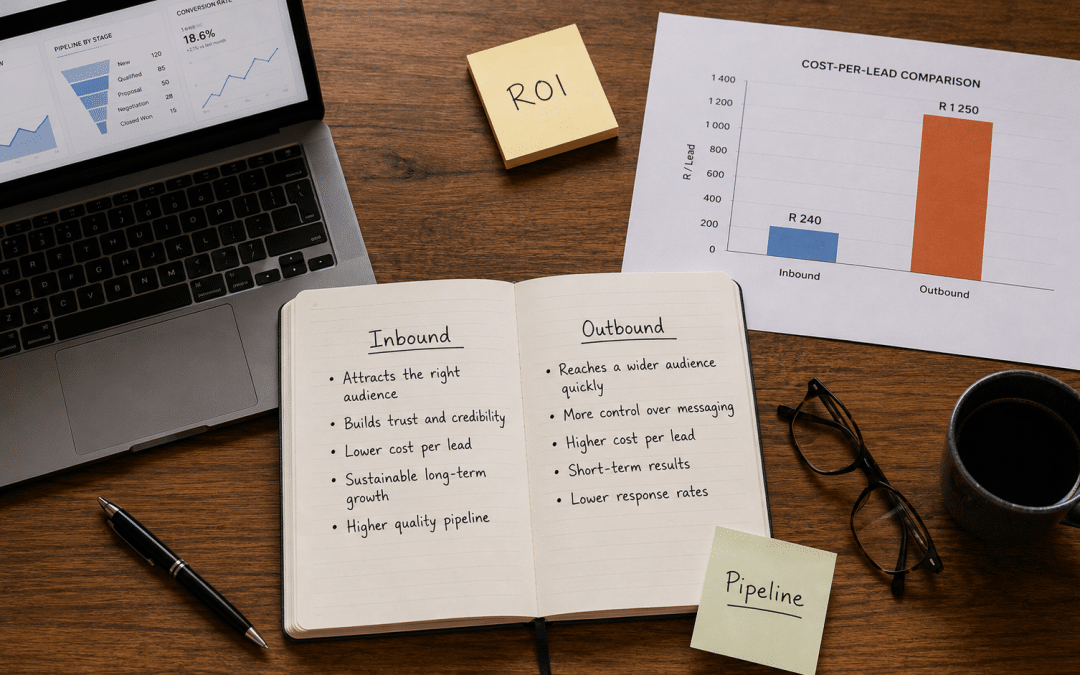
The right answer to inbound vs outbound lead generation in South Africa depends almost entirely on your deal size, sales cycle length, and buyer type — not on which approach sounds more modern or which methodology has the better marketing. SA B2B businesses with longer sales cycles and higher deal values typically benefit from inbound; SA businesses with shorter cycles and replicable target lists typically win with outbound; most successful SA B2B operations run both.
This guide breaks down inbound vs outbound lead generation for South African businesses — when each works, when each fails, the real Rand costs of running each, and how to choose between them. For the broader playbook, start with our complete B2B lead generation guide for South Africa.
Quick Verdict
Choose inbound if your average deal value exceeds R 30,000, your sales cycle is 30+ days, and your buyers research extensively before contacting vendors. Inbound builds defensible long-term pipeline at lower acquisition cost, but takes 4-6 months to start producing measurable results.
Choose outbound if you have a defined target list (under 5,000 named accounts), your buyer profile is consistent and reachable on LinkedIn or email, and you need pipeline in 30-60 days rather than 4-6 months. Outbound costs more per contact but produces faster ROI for SA B2B.
Choose both if your business clears R 1.5M+/year revenue and can sustain R 25,000+/month on lead generation activity. Most SA B2B businesses at this scale run both with a 60/40 inbound/outbound split.
Want a free assessment of whether inbound, outbound, or both fits your specific SA B2B business?
Get a Free Strategy AssessmentInbound vs Outbound Lead Generation: The Real Definitions
The choice between inbound vs outbound lead generation gets distorted by marketing rhetoric — most agencies sell inbound as if it has retired outbound, while most cold-call shops dismiss inbound as slow and overrated. Both views are wrong. They are different tools optimised for different jobs, and SA B2B businesses need both definitions clear before deciding.
Inbound attracts buyers actively searching for solutions. The buyer initiates contact — through search engines, content downloads, social media engagement, or referrals — because something the business published or shared resonated. Channels include SEO, blog content, gated downloads, webinars, LinkedIn thought leadership, and inbound paid search where the searcher's query indicates active intent.
Outbound reaches buyers who have not signalled active interest. The business initiates contact — through cold email, LinkedIn DMs, cold calls, direct mail, paid display targeting, or account-based marketing campaigns. The buyer may be a perfect fit for the offer but has not been searching, so the outreach creates awareness rather than capturing demand. According to HubSpot's official inbound methodology, the core distinction is permission-based versus interruption-based contact.
Inbound vs Outbound Lead Generation: Side-by-Side for SA B2B
The clearest way to evaluate this choice is to compare the two approaches across the dimensions SA B2B operators actually care about — cost, time-to-result, quality, scalability, and defensibility.
| Dimension | Inbound Lead Generation | Outbound Lead Generation |
|---|---|---|
| Cost per lead (SA B2B) | R 200-R 800 | R 600-R 2,400 |
| Time to first leads | 4-6 months | 14-30 days |
| Time to ROI clarity | 9-12 months | 2-4 months |
| Lead intent quality | High (buyer initiated) | Medium (buyer interrupted) |
| Reply rate (B2B SA) | N/A (passive) | 3-8% |
| Scalability ceiling | High (compounds) | Bounded by list size |
| Defensibility | Strong (SEO assets, brand) | Weak (channels copyable) |
| Upfront investment | R 30,000-R 80,000 (content/SEO build) | R 8,000-R 25,000 (tools + setup) |
| Monthly running cost | R 15,000-R 50,000 | R 12,000-R 40,000 |
What the Numbers Actually Mean
Inbound lead generation has lower cost per lead but higher upfront investment and longer payback. Outbound lead generation has higher cost per lead but faster payback. For SA B2B businesses with under 18 months of runway, outbound usually wins on cash flow.
For SA B2B businesses with 24+ months of runway and patience, inbound compounds into a defensible asset that outbound never matches. The cost-per-lead numbers above are SA-specific — global benchmarks understate inbound costs because SA-specific content production is more expensive per output unit than US-scale operations.
When Inbound Lead Generation Wins for SA B2B Businesses
Within the inbound vs outbound lead generation decision, inbound is the right primary choice for SA B2B businesses where three conditions hold: average deal value exceeds R 30,000, buyers research extensively before contacting vendors, and the business can sustain a 4-6 month build before measurable returns appear. These conditions describe most SA B2B SaaS, professional services, and high-ticket consulting businesses.
The mechanism: high-deal-value SA buyers do not respond well to cold outreach because the perceived risk of engaging with the wrong vendor is too high. They Google extensively, read reviews, consume vendor content, and only contact vendors who have already demonstrated expertise through published work. Inbound captures these buyers at the moment they decide they want to talk; outbound rarely reaches them because they filter out unsolicited contact aggressively.
SA inbound-friendly characteristics: longer sales cycles (60+ days), committee buying decisions, specialised industry expertise required, deal values above R 30,000, established brand or domain authority. Where all five hold, inbound typically delivers 3-5× better ROI than outbound over 12-18 months.
When Outbound Lead Generation Wins for SA B2B Businesses
Outbound is the right primary choice for SA B2B businesses where three different conditions hold: target accounts are identifiable and finite (under 5,000 named businesses), buyers are reachable on LinkedIn or email, and the business needs pipeline movement in 30-60 days. These conditions describe most SA B2B agencies, B2B services targeting specific industries, and SaaS targeting defined verticals.
The mechanism: outbound bypasses the inbound demand-generation problem by reaching buyers directly. If you can identify the 500 SA manufacturing CFOs who buy your category, you can email or LinkedIn-message all 500 of them within 60 days. Even at a 3% reply rate, that is 15 conversations — enough to validate or invalidate the offer. Inbound cannot deliver that speed regardless of execution quality.
Want us to walk you through which approach delivers fastest in your specific SA B2B context?
Get a Free Inbound vs Outbound DiagnosticInbound vs Outbound Lead Generation: Real SA Cost Comparison
Here is what running these two approaches actually costs for an SA B2B business at meaningful scale. The numbers below come from real SA engagements at the R 200,000-R 600,000/month revenue band.
| Cost Category | Inbound (Monthly) | Outbound (Monthly) |
|---|---|---|
| Content production (8-12 posts) | R 12,000-R 24,000 | — |
| SEO tools (Ahrefs, Semrush, Rank Math) | R 4,000-R 6,500 | — |
| Marketing automation (HubSpot/ActiveCampaign) | R 1,800-R 6,000 | R 1,800-R 6,000 |
| Apollo.io or similar prospecting | — | R 800-R 2,400 |
| LinkedIn Sales Navigator | — | R 1,300-R 1,800 |
| Email infrastructure (SendGrid, Smartlead) | — | R 800-R 3,500 |
| SDR or agency execution time | R 8,000-R 18,000 | R 10,000-R 28,000 |
| Total monthly run-rate | R 25,800-R 54,500 | R 14,700-R 41,700 |
| Plus initial setup (one-off) | R 30,000-R 80,000 | R 8,000-R 25,000 |
The numbers tell the real story. Outbound costs less to start and less to run, but produces a finite stream of pipeline that does not compound over time.
Inbound costs more to start and slightly more to run, but produces an asset (a body of ranked content + audience) that keeps producing leads after the spend stops. The cost framing depends on the time horizon you measure against. For deeper context, see our cost of B2B lead generation in SA guide.
The Hybrid Approach Most SA B2B Businesses Actually Need
The honest answer for most SA B2B businesses considering inbound vs outbound lead generation is not inbound vs outbound — it is inbound and outbound. They solve different problems and capture different buyer segments. Running both with a 60/40 split typically outperforms either alone for SA B2B businesses clearing R 1.5M/year in revenue.
Hybrid sequencing: outbound runs in months 1-3 to produce immediate pipeline while inbound is being built. Months 4-6, both run in parallel — outbound continues delivering 70-80% of qualified pipeline while inbound starts delivering its first leads. Months 7-12, inbound takes over majority share while outbound focuses on specific named-account targeting where inbound cannot reach.
Why the Hybrid Approach Works in SA Specifically
SA B2B markets are smaller than US/UK equivalents — total addressable market for most categories is 2,000-15,000 named accounts. That makes pure inbound impractical (TAM is too small to support content-only acquisition) and pure outbound risky (you exhaust the named-account list within 18 months).
The hybrid model uses outbound to reach the 5-15% of TAM ready to buy now, while inbound builds brand recognition with the remaining 85-95% so they choose you when they enter market.
Real-World SA Example: Switching From Pure Outbound to Hybrid
A typical inbound vs outbound lead generation example: An SA B2B financial services firm switched from pure outbound to hybrid in October 2025. Before: cold email and LinkedIn outbound delivering 12-15 MQLs/month at R 1,800 per MQL. After 8 months of hybrid: outbound delivering 9 MQLs/month at R 2,200 per MQL, inbound delivering 23 MQLs/month at R 380 per MQL.
| Metric | Pure Outbound (Before) | Hybrid (After 8 months) | Difference |
|---|---|---|---|
| Total MQLs / month | 14 | 32 | +129% |
| Avg cost per MQL | R 1,800 | R 880 | -51% |
| Discovery calls booked / month | 4 | 11 | +175% |
| Close rate (MQL → won) | 16% | 24% | +8 pp |
| Closed deals / month | 2.2 | 7.7 | +250% |
| Monthly new revenue | R 88,000 | R 312,000 | +R 224,000/mo |
| Total lead gen spend / month | R 25,200 | R 42,400 | +R 17,200/mo |
The R 17,200/month additional spend produced R 224,000/month in additional revenue — a 13× return on the incremental investment. The inbound channel did not produce its first close until month 5, but by month 8 it was producing more revenue than outbound at lower cost. This pattern is typical of well-executed hybrid in SA B2B.
How Growth Pulse Media Helps SA B2B Choose Between Inbound and Outbound
Most SA agencies sell one inbound vs outbound lead generation model — inbound agencies sell inbound, cold-outreach shops sell outbound — because they only operate one channel. We approach the question differently because Dirk built and scaled his own SA business using both inbound and outbound before starting Growth Pulse Media. That means our recommendation depends on what actually fits your business stage, not what we happen to sell.
Every engagement we run starts with a 90-minute assessment: average deal value, sales cycle length, named-account list size, current pipeline composition, runway, and existing assets. Then we recommend inbound, outbound, or hybrid based on what those numbers indicate — not what fits our preferred service mix. For SA B2B businesses ready to engage seriously with lead generation, our B2B lead generation service page covers what an engagement actually looks like.
Common Mistakes With Inbound vs Outbound Lead Generation
SA B2B businesses navigating the inbound vs outbound lead generation decision make four predictable mistakes that cost them pipeline.
Treating it as an either-or decision when both are needed: Most SA B2B businesses at meaningful scale need both inbound and outbound. Choosing one because the other "feels old-fashioned" or "takes too long" leaves leverage on the table. The right question is not "which one" but "what split, and in what sequence."
Expecting inbound to produce pipeline in 60 days: Inbound requires 4-6 months minimum before first measurable leads appear. SA B2B businesses that abandon inbound at month 3 because "it's not working yet" waste the entire setup investment. Either commit to the 6-month build window or do not start. For more context, see our B2B lead generation strategy guide.
Running outbound at volume without sales capacity: Outbound produces conversations quickly but those conversations need rapid sales follow-up. SA B2B businesses that scale outbound from 200 emails/month to 2,000 emails/month without scaling sales capacity destroy their lead conversion rates and burn their domain reputation. Scale outbound and sales capacity together.
Measuring inbound and outbound on the same KPIs: Inbound is measured on volume of qualified enquiries, organic ranking growth, content-asset compound returns. Outbound is measured on connect rate, reply rate, meetings booked. Mixing the KPIs (e.g. measuring inbound on monthly meeting count from month 1) produces wrong conclusions.
Who This Guide Is NOT For
The inbound vs outbound framework applies to SA B2B businesses ready to deploy meaningful lead generation budget. Here is who should look elsewhere first.
B2C businesses: The inbound vs outbound framework is calibrated for B2B. B2C ecommerce, retail, and consumer brands operate on different mechanics — paid social, influencer partnerships, and ecommerce CRO matter more than the inbound/outbound distinction. The lead generation logic does not transfer cleanly to B2C.
SA B2B businesses below R 800,000/year revenue: At this scale, neither inbound nor outbound infrastructure pays back fast enough. Better to use founder-led sales (direct outreach to networks, conference attendance, referrals) for 12-18 months until the business clears the threshold where systematic lead generation infrastructure makes sense.
Businesses with unresolved ICP: Neither inbound nor outbound rescues a business that has not defined its ideal customer profile. Outbound burns spend on wrong-fit prospects; inbound burns content production on topics the wrong audience cares about. Resolve ICP through customer interviews first, then deploy lead generation infrastructure.
Businesses without sales capacity to convert leads: Both approaches produce leads that need human sales follow-up. If sales capacity is bottlenecked, additional leads sit in the inbox unconverted. Build sales capacity first, then scale lead generation to match. See our B2B lead generation audit guide for the broader handoff context.
Not sure if your SA B2B business has the foundations for inbound, outbound, or hybrid? Let us check honestly.
Get a Free Foundation CheckFrequently Asked Questions
Which is cheaper for SA B2B: inbound or outbound lead generation?
For SA B2B businesses comparing inbound vs outbound lead generation costs: outbound is cheaper to start and cheaper monthly, but inbound has lower cost per lead once it matures (4-6 months after launch). Total 12-month cost for SA B2B inbound typically runs R 350,000-R 700,000. Outbound for the same period typically runs R 220,000-R 500,000. Per-lead cost in mature inbound is R 200-R 800; outbound stays at R 600-R 2,400.
How long until inbound lead generation starts producing leads in SA?
Realistic timeline for SA B2B inbound: month 1 setup and content production begin, month 2-3 first content publishes and indexes, month 4-5 first organic rankings reach page 2-3, month 6 first organic enquiries, month 9-12 inbound becomes a primary pipeline channel. Faster timelines exist but require either heavy existing domain authority or aggressive paid acceleration.
Can SA B2B businesses run outbound without LinkedIn?
Yes but with reduced effectiveness. LinkedIn is the dominant SA B2B prospecting channel for decision-maker outreach, particularly for executives, founders, and operations leaders. Alternatives include cold email (effective but slower), industry conference attendance, partnership channels, and direct mail (rarely used but distinctive). Most SA outbound programmes use LinkedIn as the primary channel with email as the secondary.
Should SA B2B startups choose inbound or outbound first?
Startups should typically start with outbound for the first 6-12 months because cash flow matters more than long-term compound returns. Outbound produces measurable pipeline in 30-60 days, which validates the offer and generates revenue while inbound infrastructure is being built. Layer inbound starting from month 4-6 once the business has stable cash flow.
Does inbound vs outbound lead generation differ for SA B2B SaaS specifically?
Inbound matters more for SA B2B SaaS than for most other B2B categories because SaaS buyers research extensively, evaluate multiple options, and self-serve through documentation before contacting sales. SaaS businesses without inbound presence lose deals to better-documented competitors regardless of product quality. Outbound still works for enterprise SaaS sales targeting specific named accounts.
What is the typical inbound vs outbound lead generation split for SA B2B operations?
Typical splits by business stage: early-stage (Year 1) 20% inbound / 80% outbound, growth-stage (Year 2-3) 40% inbound / 60% outbound, mature (Year 4+) 60-70% inbound / 30-40% outbound. The shift reflects inbound compounding while outbound stays linear. Mature SA B2B businesses rarely sustain 100% inbound or 100% outbound — both have specific jobs they do better.
Ready to Decide Between Inbound, Outbound, or Hybrid for Your SA B2B Business?
Growth Pulse Media runs comprehensive lead generation assessments for South African businesses — diagnosing whether inbound, outbound, or hybrid fits your specific stage, then executing the recommended approach. Real operator experience from running both at scale, in-house execution, limited client load. No obligation — we will get back to you within 24 hours with a frank assessment of which approach delivers fastest in your specific business.
Get Your Free Inbound vs Outbound Assessment