
 Add to Preferred Sources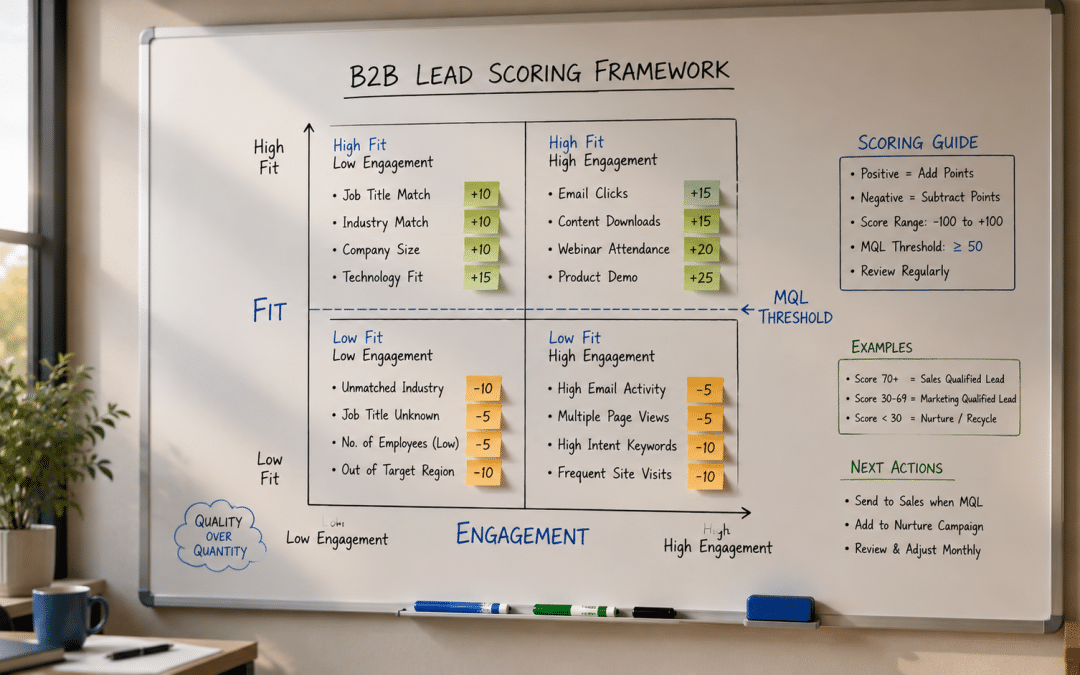
If you are asking what is lead scoring, the short answer is: a numerical system that ranks every lead in your pipeline by how likely they are to become a customer — so sales focuses on the leads worth calling and marketing keeps nurturing the leads who need more time.
South African B2B businesses running proper lead scoring close 2-3× more deals from the same lead volume because they stop wasting sales time on leads that will never buy.
This guide breaks down what lead scoring is, how it works in practice for South African businesses, the criteria that matter most, and the common mistakes that make scoring systems useless. For the bigger funnel picture, start with our complete B2B lead generation guide for South Africa.
Quick Answer
Lead scoring is the practice of assigning numerical points to leads based on two dimensions: fit (how well they match your ideal customer profile) and engagement (how actively they interact with your content and sales touchpoints).
Points accumulate from positive signals and decay from negative signals. When a lead crosses a threshold — typically 30-50 points — they get routed to sales as a marketing-qualified lead. Without lead scoring, sales chases everyone and qualifies no-one.
Want a free review of your current lead qualification process and where scoring would add the biggest lift?
Get a Free Lead Qualification AuditWhat is Lead Scoring — The Operational Definition
What is lead scoring? It is best understood as a numerical layer sitting on top of your CRM that translates lead behaviour into a single number sales can act on. Every interaction the lead has with your business — opening an email, downloading a guide, visiting a pricing page, attending a webinar — adds or subtracts points from their score. When the total crosses a defined threshold, the lead is flagged as sales-ready.
The mechanical purpose is simple: sales teams have limited hours per week. Without lead scoring, they decide which leads to call based on gut feel, recency, or alphabetical order — none of which correlate with buying intent. With lead scoring, they call the leads most likely to close first. Same hours, much higher close rate.
The strategic purpose runs deeper. Lead scoring is how marketing and sales agree on what "qualified" actually means. Without it, marketing thinks every form-fill is a hot lead, sales thinks marketing sends junk, and both teams blame each other for poor pipeline. Lead scoring forces both sides to define qualification numerically — which forces alignment.
How Lead Scoring Actually Works in Practice
What is lead scoring in concrete operational terms? It is a points-based model with two core dimensions and two directional movements.
The Two Dimensions: Fit and Engagement
In what is lead scoring as a model, fit scoring measures how well the lead matches your ideal customer profile — company size, industry, job title, location, budget range. A small business owner looking at your enterprise B2B platform scores low on fit; a head of marketing at a 50-person SA company looking at the same platform scores high.
Fit answers the question: "Would we want to sell to this person if they were ready to buy?"
Engagement scoring measures how actively the lead is interacting with your business — pages visited, emails opened, content downloaded, time on site, recency of activity. A lead who downloaded a guide six months ago and never returned scores low; a lead who visited the pricing page three times this week scores high. Engagement answers the question: "Is this person showing buying signals right now?"
The Crucial Two-Dimension Insight
What is lead scoring done well? It only works when you measure BOTH fit and engagement separately, then combine them. A highly engaged lead with poor fit will waste sales time. A high-fit lead with zero engagement is not ready to buy. The leads worth calling are high on both dimensions — and that overlap is far smaller than total lead volume. Lead scoring exists to find that overlap reliably.
The Two Directions: Positive and Negative
In what is lead scoring as a points system, positive signals add points. Examples: opening an email (+1), clicking a link in an email (+3), visiting a specific page (+5), downloading a case study (+10), visiting the pricing page (+15), requesting a demo (+25), attending a webinar (+10). The exact point values matter less than the relative weighting — pricing page visits should always score higher than newsletter opens.
Negative signals subtract points. Examples: 30 days without opening an email (-5), unsubscribing (-50), visiting the careers page (-10, signals job-seeker not buyer), email bounces (-20), wrong job title indicated (-15). Without negative signals, every lead's score only goes up over time — which makes the system useless for filtering out stale leads.
What is Lead Scoring in the SA B2B Context
What is lead scoring tailored to SA looks like? South African B2B businesses face specific dynamics that change how lead scoring should be configured compared to US or UK templates. SA decision cycles run longer (60-120 days versus 30-60 days for US B2B), buyer committees tend to be smaller but require more consensus, and the most active engagement window often appears 3-6 weeks before purchase — not immediately at form-fill.
Practical implications for SA configuration: weight pricing page visits more heavily than US templates suggest (SA buyers self-research price more aggressively before contacting sales), give engagement signals a longer decay window (45-60 days instead of 30), and add a positive signal for return visits within a 7-day window (SA buyers loop back through your site multiple times during evaluation).
According to HubSpot's lead scoring methodology guide, the most effective scoring models combine demographic fit data with behavioural engagement data — and for SA B2B specifically, the behavioural side carries more weight because SA buyers tend to research more independently before identifying themselves to sales.
Want us to map a lead scoring model to your specific SA B2B business?
Get a Free Scoring Model MapA Sample Lead Scoring Model for SA B2B Businesses
What is lead scoring as a practical model? Here is a working starter model that delivers reliable results for South African B2B services and software companies. Adjust the point values to your specific business — the principles transfer; the exact numbers do not.
| Signal Type | Signal | Points | Why |
|---|---|---|---|
| Fit (positive) | Job title: founder, CEO, head of marketing, head of sales | +15 | Decision-maker title |
| Fit (positive) | Company size: 10-100 employees | +10 | Sweet spot for SA SME B2B |
| Fit (positive) | Industry: B2B services, software, ecommerce | +10 | ICP match |
| Fit (positive) | Location: South Africa, Gauteng, Western Cape | +5 | Geographic fit for SA-focused agency |
| Engagement (positive) | Pricing page visit | +15 | Strong buying intent signal |
| Engagement (positive) | Pricing page visit ×2 in 7 days | +10 (additional) | Multi-visit indicates active evaluation |
| Engagement (positive) | Case study download | +10 | Comparison phase activity |
| Engagement (positive) | Demo request or contact form fill | +25 | Direct sales-ready signal |
| Engagement (positive) | Webinar attendance | +10 | Active learning behaviour |
| Engagement (positive) | Email open (per email) | +1 | Baseline engagement |
| Engagement (positive) | Email click (per email) | +3 | Stronger engagement |
| Negative | 30 days no email opens | -5 | Engagement decay |
| Negative | 60 days no website visits | -10 | Lead going cold |
| Negative | Unsubscribe | -50 | Disqualifying signal |
| Negative | Job title: student, intern, job seeker | -20 | Not a buyer |
For what is lead scoring threshold settings, start at MQL flag at 30 points, hot lead alert at 50 points, sales prioritisation at 70+ points. Review these monthly for the first 90 days and adjust based on actual conversion data — leads scored 50+ that did not convert indicate scoring criteria need recalibration.
Real-World Example: South African B2B Software Firm, 90-Day Implementation
What is lead scoring in practice? Here is the real picture. We worked with a South African B2B software firm in February 2026 — they had 2,400 leads in HubSpot, no scoring in place, and sales calling leads in chronological order of capture.
We implemented a scoring model over 90 days and tracked the impact.
| Metric | Before Lead Scoring | After 90 Days | Difference |
|---|---|---|---|
| Sales hours per week on lead qualification | 22 hrs | 8 hrs | -64% |
| Discovery calls booked per month | 12 | 34 | +183% |
| Discovery-to-proposal conversion rate | 34% | 61% | +27 pp |
| Proposal-to-close conversion rate | 22% | 38% | +16 pp |
| Closed deals per month | 1.8 | 7.9 | +339% |
| Avg deal size | R 26,000 | R 31,400 | +21% |
| Sales cycle length (MQL to close) | 52 days avg | 23 days avg | -56% |
| Monthly closed revenue | R 46,800 | R 248,060 | +R 201,260/mo |
The interesting detail: no new leads were added. Same 2,400 leads in the database. The R 201,260/month revenue lift came entirely from sales spending their hours on the right leads — the high-scoring 12% of the database — instead of cold-calling everyone. Lead scoring did not produce more leads; it produced better lead allocation.
What Drove The Result
Two structural changes did most of the heavy lifting. First, sales stopped calling leads scored under 30 — which immediately freed 14 hours per week previously wasted on unqualified prospects. Second, the 50+ point hot-lead alert routed urgent leads to sales within minutes of crossing the threshold, dramatically shortening response time on buying-ready prospects. The 56% reduction in sales cycle length is directly attributable to that response-time improvement.
How Growth Pulse Media Approaches the Setup for SA B2B Clients
What is lead scoring done well? Most SA agencies install it as a setup checklist — generic template, 10-rule scoring model, done. We approach it differently because Dirk built and scaled his own SA business pipelines before starting Growth Pulse Media, which means every scoring model is calibrated to the specific buyer profile of the client — not a template applied to everyone.
Every lead scoring system we build is configured for the specific South African B2B context — SA decision cycle length (60-120 days), buyer committee dynamics, the platforms most SA clients actually use (HubSpot, Klaviyo, Pipedrive, ActiveCampaign), and the integration layer that pulls behavioural data from PayFast for ecommerce-adjacent B2B clients.
We start every implementation with a 14-day calibration window where the model runs in shadow mode against actual conversion data before going live for sales routing.
We work with a limited client load so every scoring implementation gets senior-level calibration through the first 90 days when the model needs the most tuning. For SA B2B businesses wanting a complete lead scoring system designed and built end-to-end, our B2B lead generation service covers the full implementation.
Common Mistakes That Make the System Useless
What is lead scoring when implemented badly? The patterns below are the most common failures.
Over-engineering the model from day one: Starting with 40 scoring criteria sounds thorough but produces a system nobody understands and nobody trusts. Begin with 8-12 criteria covering only the strongest fit and engagement signals. Add complexity only after validating that simple scoring correlates with actual conversions.
Scoring without negative signals: A model that only adds points means every lead's score climbs forever. Within 6 months, all leads look "hot" and the threshold becomes meaningless. Negative signals (decay, unsubscribes, wrong fit indicators) are not optional — they are what makes the score actually filter leads.
No sales-marketing alignment on the threshold: Marketing sets the MQL threshold at 30 points; sales thinks "qualified" means 80 points. Result: marketing sends "qualified" leads sales finds unqualified, both teams blame each other, and the system breaks. Define the threshold together, validate it against historical close data, and review monthly.
Never recalibrating the model: The scoring model that worked in month 1 stops working by month 6 as your ICP evolves, your content changes, and buyer behaviour shifts. Plan a quarterly recalibration where you review which scored leads actually closed and adjust criteria accordingly. For the broader operational view, see our lead nurturing strategy guide.
Who This Guide Is NOT For
What is lead scoring NOT a fit for? Implementing it is not the right next move for every South African business. Here is who should look elsewhere first.
Businesses with fewer than 200 leads in the database: Lead scoring needs volume to be worth the implementation effort. Below 200 leads, manual qualification by sales is more cost-effective than building and maintaining a scoring system. Build the database first, then layer scoring.
Businesses without a defined ICP: Scoring requires criteria to score against. If "everyone interested" is your target customer, the fit dimension of scoring breaks immediately. Define ideal customer profile first — company size, industry, role, budget — then build scoring around it.
Businesses without marketing automation tooling: Manual lead scoring in a spreadsheet does not scale and never gets maintained. You need at minimum HubSpot Free, Pipedrive, or ActiveCampaign before scoring becomes practical. For platform-specific guidance, see our email marketing platforms comparison.
Sales teams that will not actually use the score: If sales prefers calling leads by gut feel and ignores the scoring threshold, the model produces no value regardless of how well it is built. Get sales buy-in before implementation — and validate that they will route leads by score, not by preference.
Not sure if you have the foundations for lead scoring to work? We will tell you honestly.
Get a Free Foundation CheckFrequently Asked Questions
What is lead scoring in the simplest possible terms?
Lead scoring is a system that gives every lead in your database a number based on how likely they are to become a customer. Higher numbers mean better leads. Sales calls the high-scoring leads first.
That is the entire concept. The complexity sits in how you calculate the number — which signals add points, which subtract, and where the threshold sits — but the underlying idea is simply "rank leads numerically so sales focuses on the right ones."
How is lead scoring different from lead qualification?
What is lead scoring vs lead qualification? Lead qualification is the human judgement process where sales decides whether a specific lead is worth pursuing. Lead scoring is the automated system that pre-filters leads numerically before they reach sales. Scoring does not replace qualification — it triages leads so sales spends qualification time on high-scoring prospects instead of cold cycling through the full database.
What platforms support lead scoring for SA B2B businesses?
What is lead scoring like across platforms? HubSpot has the most mature lead scoring tooling with strong SA reseller support. Pipedrive offers solid scoring for smaller SA sales teams. ActiveCampaign covers scoring at a lower price point. Salesforce supports advanced scoring but is over-spec for most SA SMEs. Klaviyo includes scoring for ecommerce-adjacent B2B businesses. The platform matters less than getting scoring criteria right.
How often should I recalibrate the lead scoring model?
What is lead scoring maintenance? Review quarterly at minimum and validate the model by checking whether leads scored above your MQL threshold actually convert at higher rates than leads below it — if not, the criteria are wrong. Major changes to your ICP, market, sales process, or content strategy should trigger immediate review regardless of quarterly schedule.
What is a good MQL threshold to start with?
What is lead scoring threshold to start with? Start at 30 points for MQL flag and 50 points for hot lead alert if you are using a model with point values similar to the sample above (where pricing page visit = 15, demo request = 25, etc.).
Adjust within the first 60 days based on actual conversion data — if too many leads are crossing 30 without converting, raise the threshold; if too few are crossing 30, lower it or add positive signals.
Can I implement lead scoring without a CRM?
Technically yes, practically no. Spreadsheet-based scoring requires manual updates to every lead's score every time they interact with your business — which means it never gets maintained beyond week 2. A basic CRM (HubSpot Free, Pipedrive starter tier) updates scores automatically based on tracked behaviour and is worth the R 600-R 2,000/month cost even for small B2B businesses.
Ready to Implement Lead Scoring That Actually Drives Pipeline?
Growth Pulse Media builds calibrated lead scoring systems for South African B2B businesses — HubSpot, Pipedrive, Klaviyo, and ActiveCampaign implementations with 14-day shadow calibration before going live. Real operator experience, in-house execution, limited client load. No obligation — we will get back to you within 24 hours with a frank assessment of what would deliver in your specific pipeline.
Get Your Free Lead Scoring Setup