
 Add to Preferred Sources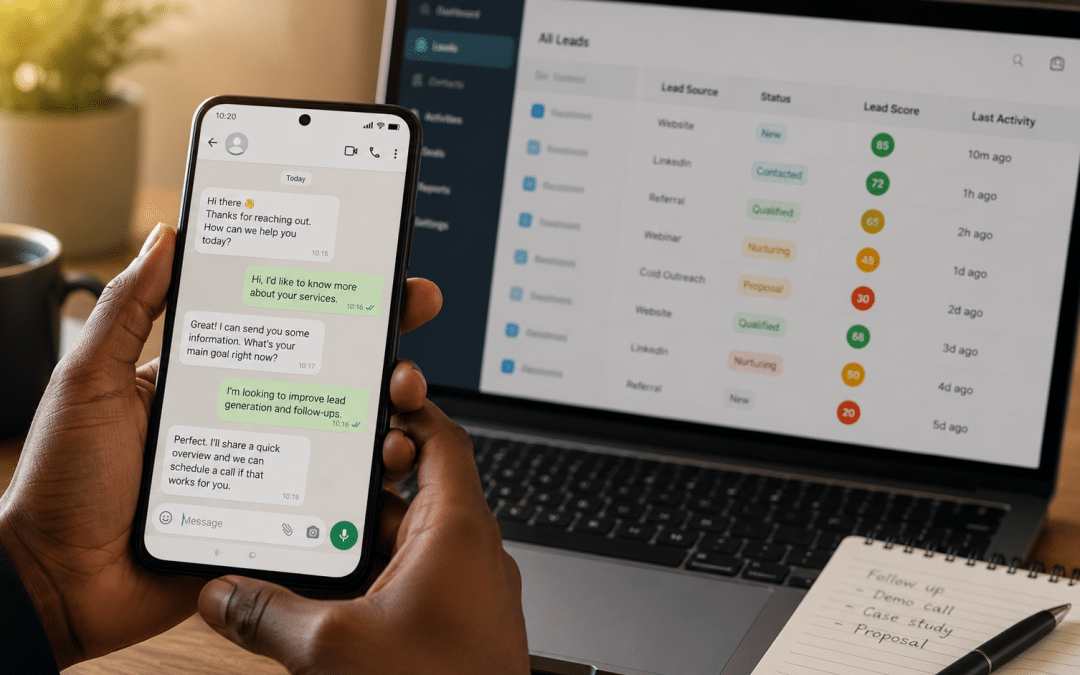
Using WhatsApp for B2B lead nurturing in South Africa works because SA decision-makers check WhatsApp 50-70 times per day but open business emails at 20-25% rates and read maybe one in four. A B2B nurture sequence delivered via WhatsApp instead of email reaches the decision-maker faster, gets responded to more often, and closes 2-4× more pipeline.
This guide breaks down how to run WhatsApp for B2B lead nurturing properly in the South African market — the sequence structure, compliance under POPIA + Meta's policy, and the operator-tested patterns that turn lukewarm leads into closed deals. For the broader context, start with our complete WhatsApp marketing guide and our complete B2B lead generation guide for South Africa.
Quick Answer
WhatsApp for B2B lead nurturing delivers 85-95% open rates inside 5 minutes versus 20-25% for email — and SA B2B leads nurtured via WhatsApp convert to discovery calls at 2-4× the rate of email-only nurture.
The compliant setup uses WhatsApp Business API integrated with a CRM, opt-in collected during the lead capture phase, and a hybrid sequence mixing utility messages (free) with marketing templates (paid). SA B2B businesses running this properly cut MQL-to-SQL conversion time from 30-45 days to 10-18 days.
Want a free audit of where your current B2B nurture is leaking — and whether WhatsApp would close the gap?
Get a Free B2B Nurture AuditWhy WhatsApp Outperforms Email for SA B2B Nurturing
Three structural advantages make WhatsApp for B2B lead nurturing dramatically more effective than email in the South African market. First, the channel itself — SA professionals treat WhatsApp as their primary work-adjacent channel, checking it constantly throughout the day, while email increasingly becomes the dump for newsletters and notifications.
Second, deliverability — WhatsApp messages do not land in spam folders or get filtered by promotion tabs. Third, response asymmetry — replying to a WhatsApp message takes 5-15 seconds while replying to a business email feels like a task that gets deferred to tomorrow.
The numbers behind this are stark. SA B2B email nurture campaigns typically see 20-25% open rates, 2-4% click-through, and 0.5-1.5% direct reply rates. The same content delivered via WhatsApp to the same opted-in audience sees 85-95% open rates inside 5 minutes, 30-45% click-through on embedded links, and 8-15% direct reply rates. The conversion impact compounds across the full nurture journey.
For SA B2B businesses where the average deal size is R 15,000-R 80,000/month in retainer value, the conversion lift from switching nurture to WhatsApp typically pays for the entire WhatsApp infrastructure cost within the first 30-45 days. After that the channel runs at margin.
The Asymmetry That Matters
The decisive advantage of WhatsApp for B2B lead nurturing is not message reach — it is reply rate. Email nurture produces visibility without engagement. WhatsApp produces conversations. A B2B lead who has had a two-message exchange with your business converts at 15-25× the rate of a lead who only opened a marketing email. The conversation IS the conversion mechanism.
The Compliant Setup: WhatsApp Business API + CRM + Opt-In
WhatsApp for B2B lead nurturing only works compliantly through the WhatsApp Business Platform (the API) — not through the WhatsApp Business app. The Business app is fine for solo operators or initial customer service, but it does not support automation, CRM integration, or the message template approval flow that B2B nurture requires. Trying to scale nurture through the Business app gets the account flagged within weeks.
The Three Mandatory Components
Component one: WhatsApp Business API access, typically via a Business Solution Provider (BSP) like 360dialog, Twilio, or MessageBird. SA businesses can budget R 600-R 3,000/month for the BSP layer depending on volume. Component two: a CRM that integrates with the WhatsApp API — HubSpot, Klaviyo, Salesforce, and Pipedrive all have native or near-native integration.
Component three: a documented opt-in flow that captures explicit consent at the lead-capture stage, naming WhatsApp specifically as a channel for marketing communication.
Opt-In Discipline for B2B
B2B leads are easier to opt in than B2C leads because the buying context is more receptive — someone downloading a B2B whitepaper expects follow-up. The compliant approach: add a clear, unchecked checkbox at the form-fill stage saying "Send me follow-up information on WhatsApp ([number captured above])".
Disclose the message categories (educational, demo offers, case studies), the frequency (typically 1-3 messages per week for B2B), and the opt-out mechanism. Document the opt-in with timestamp and consent text shown.
Want us to design the opt-in flow that fits your existing B2B lead capture forms?
Get a Free Opt-In Flow DesignThe Four-Stage WhatsApp for B2B Lead Nurturing Sequence
WhatsApp for B2B lead nurturing follows the same four-stage logic as email nurture but compresses the timeframe significantly. Email nurture for B2B typically runs over 60-90 days. WhatsApp nurture for the same lead profile runs over 21-35 days because the channel's higher response rates accelerate the buyer journey.
| Stage | Days from Capture | Message Count | Content Type |
|---|---|---|---|
| 1. Awareness | Days 0-3 | 2-3 messages | Educational content, framework intro |
| 2. Education | Days 4-12 | 3-4 messages | Case studies, comparisons, depth |
| 3. Consideration | Days 13-21 | 2-3 messages | Pricing transparency, social proof |
| 4. Decision | Days 22-35 | 1-2 messages | Discovery call offer + follow-up |
Stage 1 (Days 0-3): Awareness — Set the Frame
The first WhatsApp message goes out within 5 minutes of form submission while the lead's intent is hot. Message 1 (immediate) — short welcome, confirms what they downloaded, sets expectation for next contact. Message 2 (day 2) — delivers a useful framework or insight that genuinely helps regardless of whether they buy.
Message 3 (day 3) — invites a soft response ("does this match your current situation?"). The goal is establishing the conversation rhythm, not pitching.
Stage 2 (Days 4-12): Education — Build the Case
The middle stage carries the heaviest content load. Message 4 (day 5) — case study delivered as a short WhatsApp message with link to the full study. Message 5 (day 8) — comparison content addressing the most common alternative the lead is considering. If you want help building and running a sequence like this, our WhatsApp marketing in South Africa service is built on conversation, commerce and campaigns, and starts with a free audit.
Message 6 (day 10) — depth piece on the specific problem the lead's form-fill indicated. Message 7 (day 12) — invites a deeper response ("what is the biggest blocker for you right now?"). Replies from this stage typically convert at 40-60% to discovery call within 14 days.
Stage 3 (Days 13-21): Consideration — Reduce Friction
Stage 3 addresses the unspoken objections. Message 8 (day 15) — transparent pricing or scope ranges (most B2B sites hide pricing; revealing it here builds trust). Message 9 (day 18) — social proof from a comparable client. Message 10 (day 21) — handles the most common objection directly ("you might be thinking..."). This stage is where lukewarm leads either re-engage or self-disqualify, both of which are valuable outcomes.
Stage 4 (Days 22-35): Decision — The Soft Ask
Stage 4 is the only stage where the call-booking ask appears. Message 11 (day 25) — direct discovery call invitation with calendar link. Message 12 (day 32) — single follow-up if no booking, with low-pressure alternative ("if now is not the right time, here is what to revisit when it is"). Pushing harder than this within the 35-day window damages the brand for any future cycle.
The Economics: Why WhatsApp for B2B Lead Nurturing Pays for Itself Fast
The WhatsApp Business Platform charges per conversation, not per message — and the categories matter. According to Meta's WhatsApp Business Platform pricing, four message categories exist: marketing, utility, authentication, and service. Marketing conversations are paid. Utility (transactional updates) and service (responses to user-initiated chats within 24 hours) are free. For B2B nurture, a well-designed sequence routes most of the conversation volume through service and utility, keeping cost per nurtured lead under R 5-R 15.
| Cost Component | Monthly Range | Notes |
|---|---|---|
| BSP subscription | R 600 – R 3,000 | 360dialog, Twilio, MessageBird |
| Marketing conversations (SA region) | R 0.50 – R 1.20 per | ~R 600-R 1,500 for 1,000 nurture leads |
| Utility messages | Free (within 24h window) | Major cost saver for nurture |
| Service responses | Free | All user-initiated reply chains |
| CRM integration tier | Already paid | Assumes existing CRM |
| Total monthly cost for 1,000 leads | R 1,200 – R 4,500 | Vs R 15,000-R 30,000 in email tooling at scale |
The cost-per-converted-lead favours WhatsApp dramatically. Email nurture for SA B2B typically costs R 80-R 200 per MQL converted to SQL when fully loaded with platform, automation, content production, and management time. WhatsApp for B2B lead nurturing typically runs R 25-R 60 per MQL converted because the conversion rate is higher on the same lead volume.
Real-World Example: South African B2B Services Firm, 90-Day Programme
Here is what WhatsApp for B2B lead nurturing looks like in practice. We worked with a South African B2B professional services firm from January through March 2026 — 600 dormant leads in their database from past content downloads, all previously nurtured via email only with poor results. We deployed WhatsApp nurture in parallel with continued email and tracked the difference.
| Metric | Email-Only (Month 0) | Email + WhatsApp (Month 3) | Difference |
|---|---|---|---|
| Active leads engaged | 140 (23%) | 490 (82%) | +250% |
| Nurture message open rate | 22% | 91% | +69 pp |
| Direct replies per send | 1.8% | 14% | +12 pp |
| MQL-to-SQL conversion time | 38 days avg | 14 days avg | -63% |
| Discovery calls booked / month | 4 | 23 | +475% |
| Closed deals / month | 1.2 | 6.4 | +433% |
| Avg deal value | R 24,000 | R 27,500 | +15% |
| Monthly revenue from nurture | R 28,800 | R 176,000 | +R 147,200/mo |
The interesting comparison: the lead volume did not change. Same 600 leads. Same content cadence. The lift came entirely from delivering the same nurture sequence via WhatsApp instead of email. The R 147,200/month revenue lift came from leads the business had already paid to acquire — just engaged through the channel they actually read.
What Drove The Result
Two structural factors did most of the heavy lifting. First, the 5-minute open window meant leads engaged while their interest was still hot — email nurture often arrived after the interest had cooled. Second, the conversational nature of WhatsApp produced 23 inbound questions per week that sales could respond to directly.
Email rarely produces inbound questions; WhatsApp routinely does. That two-way mechanic compounds into the 14-day MQL-to-SQL timeline — leads progress through stages by replying, not by passively reading.
How Growth Pulse Media Sets Up WhatsApp for B2B Lead Nurturing
Most SA agencies treat WhatsApp as a separate channel from email, run them in silos, and end up with disconnected lead journeys. We approach WhatsApp for B2B lead nurturing as an integrated layer — Klaviyo or HubSpot orchestrates the email + WhatsApp sequence as a single nurture journey, with behavioural triggers routing the right message to the right channel at the right moment.
That orchestration requires real operator practice with both platforms, which we built running our own SA business pipelines before formalising the agency.
Every WhatsApp B2B nurture programme we build is configured for the specific South African context — POPIA-compliant opt-in flows, integration with PayFast and Peach Payments for transactional message anchoring, BSP selection (360dialog typically wins on SA latency and pricing for under-5,000-conversation accounts), and the four-stage sequence calibrated to the SA decision cadence (longer than US, faster than UK).
We work with a limited client load so every B2B nurture programme gets senior-level attention through the critical first 60 days when sequence performance gets tuned to the specific buyer profile. For SA B2B businesses wanting a fully integrated WhatsApp + email nurture programme, our B2B lead generation service covers the end-to-end build.
Common Mistakes With WhatsApp for B2B Lead Nurturing
Using the WhatsApp Business app instead of the API: The Business app does not scale, does not integrate with CRM, and triggers Meta account flags when used for marketing at any meaningful volume. B2B nurture requires the WhatsApp Business Platform (API). Skipping this is the most common reason SA businesses see their WhatsApp accounts suspended within 90 days.
Treating WhatsApp as a louder email channel: Sending the same long-form email content via WhatsApp fails. WhatsApp messages need to be conversational, short (under 200 characters typically), and end with a single question or clear next step. Pasting your email newsletter into WhatsApp produces unsubscribes within days.
Skipping CRM integration: Running WhatsApp nurture without CRM integration means sales does not see the conversation history, lead scoring does not include WhatsApp engagement, and the nurture journey ends up disconnected from the rest of the buyer journey. Integration is not optional for B2B at any meaningful scale.
No sales handoff plan: When a lead replies to a WhatsApp nurture message asking a sales question, the response time expectation is minutes, not hours. Without a defined sales handoff (and a sales rep with the WhatsApp inbox open during business hours), the hot lead cools off and the WhatsApp advantage evaporates. Plan the handoff before launching nurture. For a deeper framework, see our lead nurturing strategy guide.
Who This WhatsApp B2B Nurture Approach Is NOT For
Running WhatsApp for B2B lead nurturing is not the right next move for every South African business. Here is who should look elsewhere first.
B2B businesses with fewer than 50 leads in the pipeline: WhatsApp Business API setup, BSP onboarding, and CRM integration carry fixed costs and time investment that only pay back at meaningful nurture volume. Below 50 active leads, manual sales follow-up is more cost-effective than automated WhatsApp nurture infrastructure.
Businesses unwilling to assign a person to monitor inbound replies: WhatsApp generates 8-15% direct reply rates per message — meaning a 200-lead nurture send produces 16-30 inbound replies that need responses within hours. If nobody owns that response queue, the channel breaks and damages the brand more than email would.
B2B businesses with extremely long sales cycles (12+ months): Enterprise B2B with 12-18 month sales cycles fits better with email-led nurture supplemented by LinkedIn and event marketing. WhatsApp's speed advantage matters most when the buyer cycle is 30-180 days; for very long cycles the channel's immediacy gets exhausting for the decision-maker.
Businesses not currently doing email nurture well: WhatsApp amplifies what your nurture sequence already says. If the underlying content is weak, WhatsApp just gets the weak content read more often — which often produces faster unsubscribes than email did. Fix the content quality first via a proper nurture strategy, then layer WhatsApp on top.
Not sure if your B2B pipeline has the foundations for WhatsApp nurture to work? We will tell you honestly.
Get a Free Foundation CheckFrequently Asked Questions
How fast does WhatsApp for B2B lead nurturing produce results compared to email?
For SA B2B, WhatsApp nurture compresses the MQL-to-SQL timeline from typical email cycles of 30-45 days down to 10-18 days. First measurable results (open rates, reply rates) show within the first week. Discovery call booking rate impact shows by week 3-4. Closed-deal impact typically shows within 60-90 days as the accelerated pipeline converts at the bottom funnel.
Can I send marketing messages to all my existing B2B email subscribers via WhatsApp?
No. Past email opt-in does not constitute WhatsApp opt-in under either Meta's policy or POPIA. You must collect fresh, specific WhatsApp consent before sending marketing messages. The simplest re-opt-in approach is a transactional email offering the WhatsApp upgrade, with an explicit opt-in checkbox and disclosure of message categories and frequency.
What is the difference between WhatsApp Business app and WhatsApp Business API for B2B nurture?
The Business app supports one user, no automation, no CRM integration, and limits scale. The API (WhatsApp Business Platform) supports multi-user teams, full automation, native CRM integration, and unlimited scale within Meta's per-conversation pricing. B2B nurture at any meaningful volume requires the API. See our WhatsApp Business vs API guide for the full comparison.
How much does it cost to run WhatsApp for B2B lead nurturing for a 1,000-lead database?
Total monthly cost typically runs R 1,200-R 4,500: BSP subscription R 600-R 3,000, marketing conversation costs R 600-R 1,500 for active nurture sends, with utility and service messages free within the 24-hour windows. Compare to R 15,000-R 30,000/month for equivalent email tooling and automation at the same scale.
Does WhatsApp B2B nurture replace email nurture or run alongside it?
Best results come from running both in orchestrated sequence — email for longer-form content (case study delivery, whitepapers, in-depth comparisons) and WhatsApp for time-sensitive touches (welcome, response triggers, discovery call invitations). Klaviyo and HubSpot both support this cross-channel orchestration natively. Pure WhatsApp-only nurture works for shorter-cycle B2B; longer cycles benefit from the hybrid approach.
What CRM platforms work best with WhatsApp B2B nurture for SA businesses?
HubSpot has the most mature native WhatsApp integration for B2B workflows and the strongest SA reseller support. Klaviyo works well for B2B businesses with strong ecommerce or transactional component. Pipedrive integrates via 360dialog and suits smaller SA B2B sales teams. Salesforce supports WhatsApp via multiple BSPs but typically over-spec for SA B2B businesses under 50 staff.
Ready to Add WhatsApp Nurture to Your B2B Pipeline?
Growth Pulse Media builds integrated WhatsApp + email B2B nurture programmes for South African businesses — BSP selection, CRM integration, four-stage sequence design, and ongoing optimisation. Real operator experience, in-house execution, limited client load. No obligation — we will get back to you within 24 hours with a frank assessment of what would deliver in your specific pipeline.
Get Your Free WhatsApp B2B Nurture Audit