
 Add to Preferred Sources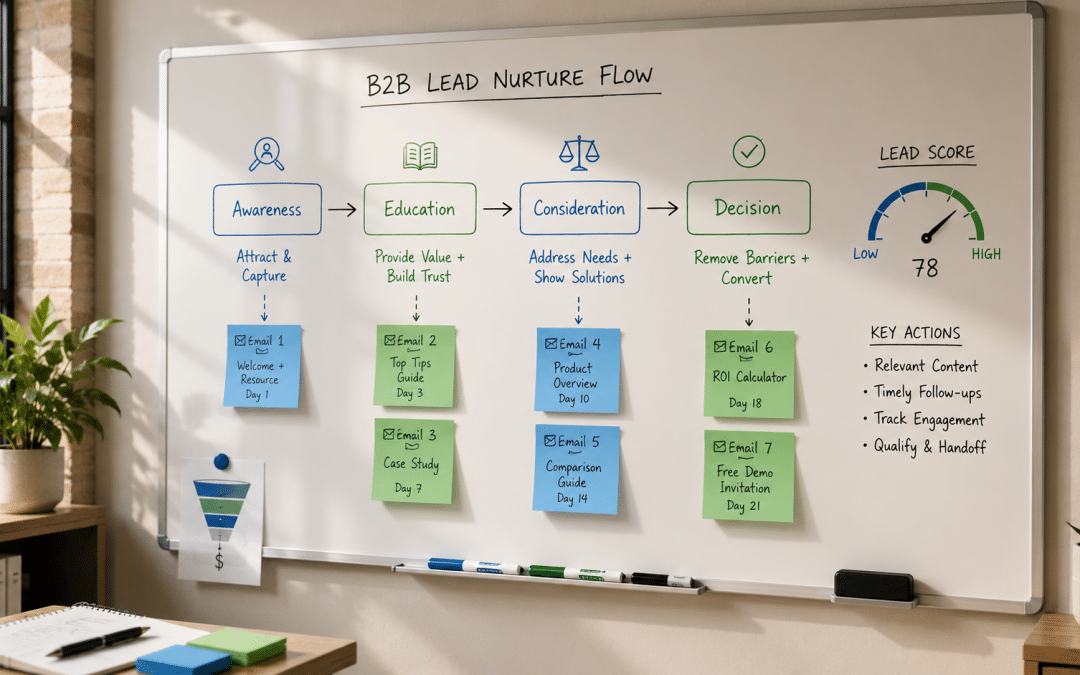
A lead nurturing strategy is the structured sequence of marketing touches that takes a lead from "vaguely interested" to "ready to buy" — and for most South African B2B businesses, the absence of one is the single biggest reason 80% of marketing-generated leads never convert.
This guide breaks down the lead nurturing strategy framework we run at Growth Pulse Media for South African B2B clients — built from real operator experience running Klaviyo and HubSpot flows that compound pipeline rather than leak it. For the full picture of how nurturing fits into the larger funnel, start with our complete B2B lead generation guide for South Africa.
Quick Answer
A lead nurturing strategy in 2026 works when three components run together: a multi-touch email sequence triggered by behaviour (not time), lead scoring that signals sales-readiness, and tight feedback between sales and marketing on what converts. SA businesses running this properly convert 30-50% more leads from the same lead volume — without spending more on acquisition. Most SA B2B firms have zero nurture in place. That gap is the cheapest pipeline win available.
Want a free review of your current lead nurturing setup and the highest-leverage gaps in your funnel?
Get a Free Lead Nurturing AuditWhat a Lead Nurturing Strategy Actually Is
A lead nurturing strategy is best understood as the system of automated and semi-automated marketing touches that move a lead from initial interest to a buying conversation. It is not "sending more emails" or "following up harder." It is a structured sequence engineered around how SA B2B buyers actually research, evaluate, and decide.
The strategy lives in your marketing automation platform — for SA businesses that typically means HubSpot, Klaviyo, ActiveCampaign, or Mailchimp. Each tool has different strengths, but the underlying framework is identical regardless of platform. The platform is plumbing; the strategy is what determines whether leads convert.
Most SA businesses confuse a lead nurturing strategy with email marketing. They are related but distinct. Email marketing reaches your existing audience with broadcast content. Nurturing builds a one-to-one journey for each lead based on what they have done, what they care about, and how close they are to buying. Done right, it makes every email feel like it was written for that specific lead.
Why SA B2B Businesses Need Structured Nurture in 2026
A lead nurturing strategy must reflect that South African B2B buyers in 2026 take longer to decide than they did three years ago — and they do significantly more independent research before talking to a salesperson.
According to HubSpot's 2026 State of Marketing research, 96% of prospects do their own research before speaking to a human sales rep, and nearly 70% of marketers report that leads now arrive later in the buying process because they have done extensive AI-assisted research first.
This shifts where the value of a lead nurturing strategy sits. Five years ago, nurturing helped fill the gap between MQL and SQL. In 2026, nurturing is the entire pre-sales relationship. By the time a lead books a discovery call, they have read 4-7 pieces of your content, compared you to 2-3 competitors, and formed a strong opinion about whether you understand their problem.
SA B2B businesses without a structured nurture sequence are absent from this research window. Leads engage with one piece of content, never hear from the business again, and forget the brand exists by the time they are ready to buy. A proper strategy keeps the business visible across the 30-90 day SA B2B decision cycle.
The 2026 Buying Reality
The average SA B2B buyer now spends 60-70% of the decision journey researching independently — without contacting the vendor. A lead nurturing strategy is what fills that 60-70% with your content rather than your competitor's content. Without it, you are entirely absent from the most important phase of the buying decision. With it, your business is the obvious choice by the time the buyer is ready to book a call.
Lead Nurturing Strategy: The Four-Stage Framework
An effective lead nurturing strategy moves leads through four distinct stages — each requiring different content, different cadence, and different success metrics. Skipping stages is the most common reason SA nurture programmes fail.
| Stage | Lead Mindset | Content Type | Goal |
|---|---|---|---|
| 1. Awareness | Aware of problem, not aware of solutions | Educational guides, frameworks, problem definition | Build trust without selling |
| 2. Education | Researching options, comparing approaches | Comparison content, case studies, frameworks | Position your approach as the right fit |
| 3. Consideration | Evaluating vendors, building shortlist | Pricing transparency, social proof, operator credibility | Make the shortlist with minimal friction |
| 4. Decision | Ready to buy, validating choice | Discovery offer, audit, free consultation | Convert to discovery call |
The mistake most SA B2B businesses make is sending Stage 4 messages to Stage 1 leads. A "book a discovery call" email to someone who downloaded an awareness-stage guide three days ago feels pushy and gets unsubscribed. The same email to a lead who has consumed 5 pieces of comparison content and visited the pricing page feels timely and gets booked.
Want to see which stage your current leads are stuck at — and what content unsticks them?
Get a Free Funnel Stage MappingLead Nurturing Strategy: The Real Mechanics
Once the four-stage framework is in place, the strategy needs three operational pieces working in concert: behavioural triggers, lead scoring, and the platform that runs both.
Behavioural Triggers Beat Time-Based Sequences
Old-school lead nurturing strategy sequences fired on time — "Day 1 email, Day 3 email, Day 7 email." A 2026 lead nurturing strategy fires on behaviour: when a lead opens a specific email, visits the pricing page twice, or downloads a comparison guide. Behavioural triggers convert at significantly higher rates because they reach the lead at the moment of intent, not at an arbitrary calendar interval.
Practical SA B2B examples: a lead who visits your pricing page twice in 48 hours triggers a "questions about our pricing structure?" email. A lead who clicks the comparison link in a nurture email triggers a deeper comparison send. A lead who has been silent for 21 days triggers a re-engagement sequence with a fresh angle.
Lead Scoring Tells Sales When to Engage
Within the lead nurturing strategy, lead scoring is the numerical layer that tracks how warm each lead is. Points accumulate from positive signals — opened the last 3 emails, visited the pricing page, downloaded a case study — and decay from negative signals like unopened emails or unsubscribes. When a lead crosses a defined threshold, sales gets the alert.
For most SA B2B businesses, a simple scoring model works: 1 point per email open, 3 points per email click, 5 points per page visit on commercial intent pages, 10 points per case study download, 15 points per pricing page visit. Threshold of 30-40 points moves the lead from marketing to sales. This stops sales chasing cold leads and stops marketing letting hot leads cool off.
The Platform Is Plumbing
Klaviyo, HubSpot, ActiveCampaign, Mailchimp — each has strengths and weaknesses, but all four execute the four-stage framework. Klaviyo wins for ecommerce-flavoured B2B. HubSpot wins when you need the full CRM-marketing-sales suite under one roof. ActiveCampaign wins for affordability with depth. Mailchimp is fine for businesses just starting nurture.
The platform choice is far less important than the underlying strategy. For platform-specific guidance, see our best email marketing platforms for South Africa comparison and the Klaviyo vs HubSpot South Africa head-to-head.
SA B2B Benchmarks: What Good Looks Like
Before measuring your own lead nurturing strategy, you need benchmarks. Here is what well-executed SA B2B nurture programmes typically produce — these are achievable, not aspirational.
| Metric | SA B2B Benchmark | What Strong Looks Like |
|---|---|---|
| Nurture email open rate | 25-35% | 40%+ on segmented sequences |
| Click-through rate | 3-6% | 8-12% on bottom-funnel touches |
| MQL to SQL conversion | 12-18% | 25%+ with proper scoring |
| SQL to discovery call | 30-40% | 55-65% with timely sales handoff |
| Time from MQL to closed deal | 60-90 days | 30-45 days for warm-source leads |
| Cost per qualified lead (vs paid) | 40-60% lower than cold paid | 70%+ lower when fully optimised |
SA-Specific Note on Timing
South African B2B buyers tolerate longer sales cycles than US buyers. A 90-day nurture window is normal; international "30-day fast-close" frameworks underperform in the SA market. Design your sequence for the actual SA decision cadence — patience compounds into higher close rates.
Real-World Example: SA B2B Software Firm, 90-Day Programme
Here is what a structured lead nurturing strategy looks like in practice. We worked with a Johannesburg B2B software firm in January 2026. They had 1,200 leads sitting in their database — most untouched since the initial download. We built a Klaviyo + HubSpot nurture flow over 90 days and tracked the before/after.
| Metric | Before Nurture System | After 90-Day Programme | Difference |
|---|---|---|---|
| Active leads in database | 1,200 (mostly dormant) | 1,580 (1,200 + new captures) | +32% |
| Email open rate (overall) | 14% | 38% | +24 pp |
| MQL identified per month | 11 | 87 | +691% |
| MQL to SQL conversion | 9% | 24% | +15 pp |
| Discovery calls booked / mo | 4 | 21 | +425% |
| Deals closed / month | 1.2 | 5.8 | +383% |
| Avg deal size | R 28,000 | R 31,500 | +13% |
| Monthly revenue from nurture | R 33,600 | R 182,700 | +R 149,100/mo |
The interesting part: they did not spend a single rand more on acquisition. Same lead volume, same marketing budget. The lift came entirely from properly nurturing the leads already in the database. The R149,100/month revenue lift came from leads they had already paid to acquire but had never properly engaged.
What Drove The Result
Two things did 80% of the heavy lifting. First, behavioural triggers replaced time-based sends — opens, clicks, and page visits drove the next email, not a calendar. Second, lead scoring let sales engage warm leads at the right moment instead of cold-calling everyone. The remaining 20% came from rewriting the email sequences to reflect actual SA B2B buyer questions, not generic global templates.
Why Growth Pulse Media Builds Lead Nurture Differently
Most SA agencies treat lead nurture as "set up some welcome emails in HubSpot and move on." That gets you a functional sequence but never a compounding revenue channel. We build differently because we have run nurture flows on our own SA businesses — managing Klaviyo flows for ecommerce and HubSpot sequences for B2B services across years of operator practice, not agency theory.
Every nurture programme we build is configured for the specific SA B2B context — 60-90 day decision cycles, SA buyer scepticism toward US-style pushy sequences, POPIA-compliant opt-in mechanics, and integration with the platforms most SA businesses actually use (PayFast for payment, The Courier Guy for fulfilment, Klaviyo or HubSpot for the marketing layer).
We work with a limited client load so every nurture programme gets senior-level attention through buildout and optimisation. For SA B2B businesses wanting a complete nurture strategy built end-to-end, our B2B lead generation South Africa service covers the full scope from list capture through nurture flow to sales handoff.
Common Lead Nurturing Strategy Mistakes to Avoid
Sending everyone the same sequence: A founder evaluating an enterprise solution and a marketing manager checking out a tactical tool are different buyers. Same nurture for both means neither converts well. Segment by role, company size, or stage and send sequences relevant to each.
Pushing the discovery call too early: A "book a call" CTA in email #2 of a Stage 1 awareness sequence kills the sequence. The CTA must match the stage. Educational content in Stage 1, comparison content in Stage 2, social proof in Stage 3, discovery offers in Stage 4 only.
Ignoring lead scoring entirely: Without scoring, sales chases cold leads while hot leads cool off in marketing's queue. A simple 30-point threshold tells sales when to call and stops marketing wasting time on leads that will never buy.
Writing US-style copy for SA buyers: Aggressive "buy now" language and high-pressure tactics underperform with SA B2B buyers. SA decision-makers respond to thoughtful, low-pressure content that respects their longer evaluation cycle. Tone matters more than tactics. For tactical missteps to avoid, see our guide on B2B lead generation mistakes in South Africa.
Who This Guide Is NOT For
Structured lead nurturing is not the right next move for every SA business. Here is who should look elsewhere first.
Businesses with fewer than 50 leads in the database: Nurture requires volume to be worth the build effort. Below 50 leads, the ROI on building a proper sequence is lower than the ROI on simply contacting each lead individually. Build the database first, then layer nurture.
Businesses without a defined ideal customer profile: Nurture sequences need an audience to write for. If "everyone who shows interest" is your target, your sequences will be generic and convert poorly. Define ICP first, then write nurture content for that ICP specifically.
Businesses with no marketing automation platform: Manual nurture sequences run from a Gmail account do not scale and quickly burn out the sender. You need at minimum a basic platform like Mailchimp before structured nurture is viable. For SA pricing on the major options, see our platform comparison.
Businesses needing pipeline within 30 days: Nurture compounds — the first 30-60 days produce limited revenue while sequences mature and leads progress through stages. If immediate pipeline is the requirement, run paid acquisition in parallel and let nurture build in the background.
Not sure if you have the foundations for nurture to work? We will tell you honestly — no pitch.
Get a Free Foundation CheckFrequently Asked Questions
How long should a lead nurturing strategy run before measuring results?
Allow 60-90 days minimum before judging results. The first 30 days build the sequence and capture initial behavioural data. Days 30-60 see early conversions from the most engaged leads. Days 60-90 reveal whether the sequence is compounding or stalling. Cutting evaluation at 30 days kills programmes that would have worked.
How many emails should a lead nurturing sequence include?
For SA B2B, plan 6-10 emails across a 60-90 day sequence as the baseline. Awareness stage: 2-3 educational emails. Education stage: 2-3 comparison emails. Consideration stage: 2-3 social proof emails. Decision stage: 1 discovery call invitation plus 1 follow-up. Behaviour-triggered branches add more touches without overwhelming the main sequence.
What is the difference between lead nurturing and email marketing?
Email marketing broadcasts the same content to your entire list. Lead nurturing sends personalised sequences to individual leads based on their behaviour and stage. Email marketing is one-to-many; nurturing is one-to-one at scale. Both have a place in a complete strategy — broadcast emails maintain audience awareness, nurture sequences move individual leads toward purchase.
Should sales or marketing own the lead nurturing strategy?
Marketing owns the sequence build and optimisation. Sales owns the handoff threshold and feedback on lead quality. Both must collaborate on what defines a sales-qualified lead — without alignment here, marketing sends "ready" leads that sales finds unready, and the system breaks. A monthly sync between sales and marketing fixes 90% of nurture handoff problems.
How much does a lead nurturing strategy cost to build for an SA B2B business?
Agency-built nurture programmes for SA B2B typically cost R15,000-R40,000 for initial buildout plus R8,000-R20,000 monthly for ongoing optimisation, depending on platform complexity and number of sequences. The platform subscription sits on top — HubSpot starts around R3,000/month for the marketing tier, Klaviyo similar, Mailchimp from R600/month. For full cost benchmarks, see our cost of B2B lead generation in South Africa guide.
Can a lead nurturing strategy work for SA service businesses with long sales cycles?
Yes — long sales cycles are exactly where nurture delivers the highest ROI. SA professional services, B2B software, and complex consulting often have 90-180 day decision cycles. Without nurture, the lead forgets the business by month 4. With structured nurture across the full cycle, the business stays present throughout the evaluation and is the obvious choice when the buyer is ready.
Ready to Build a Lead Nurturing Strategy That Actually Converts?
Growth Pulse Media builds complete lead nurturing programmes for South African B2B businesses — Klaviyo and HubSpot flows, behavioural triggers, lead scoring, and tight sales handoff. Real operator experience, in-house execution, limited client load. No obligation — we will get back to you within 24 hours with a frank assessment of what would deliver in your specific funnel.
Get Your Free Lead Nurturing Audit