
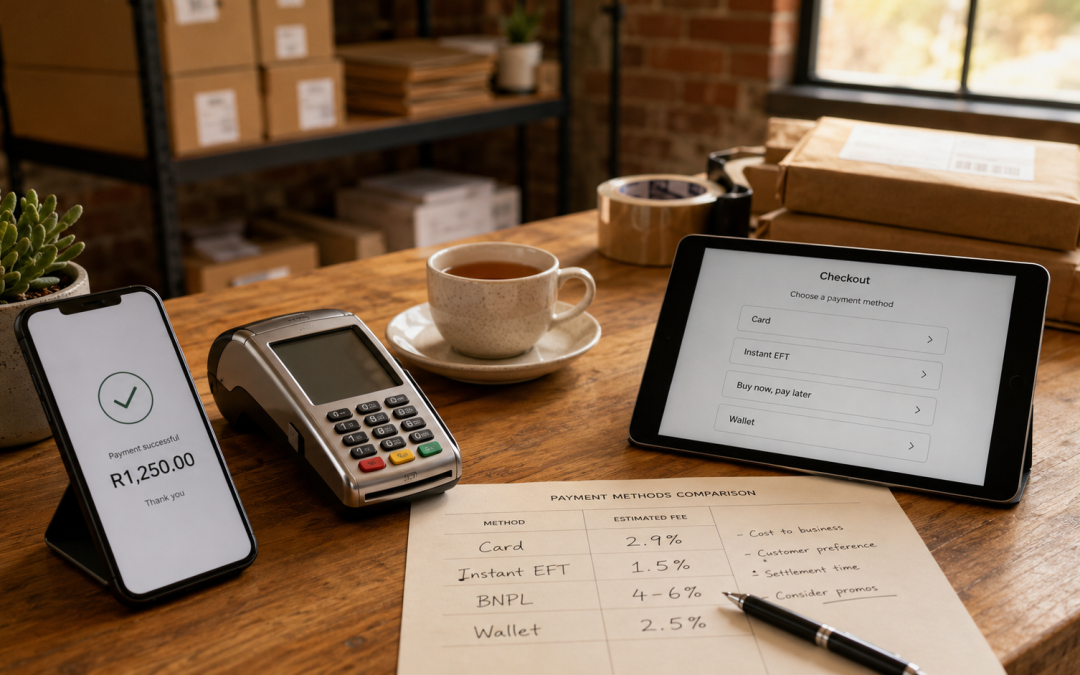
Ecommerce payment methods south africa fall into six practical categories every SA online store should understand — card payments (Visa and Mastercard, still the dominant method at roughly 54% of online transactions), instant EFT (Ozow, PayU, Capitec Pay), and digital wallets (SnapScan, Zapper, Apple Pay).
The remaining three categories are Buy Now Pay Later (PayJustNow, Payflex, Mobicred), prepaid vouchers (1Voucher, OTT) for unbanked consumers, and PayShap for instant bank-to-bank transfers. The strategic question is not which single method to offer but which combination matches your specific customer base.
This guide breaks down each payment method available to SA ecommerce stores — covering consumer adoption data, transaction costs, settlement speeds, the gateway options that aggregate them, and the decision framework for choosing the right mix for your store. For the broader context, see our complete ecommerce marketing guide for South African businesses.
Quick Answer
For most SA ecommerce stores in 2026, the optimal payment stack combines card payments (still preferred by roughly 54% of consumers), at least one instant EFT option (Ozow or Capitec Pay), and at least one Buy Now Pay Later provider (PayJustNow or Payflex). SA merchants offering at least three payment methods see up to 25% higher checkout conversion rates according to local benchmarks. The fastest-growing methods are BNPL (doubled from 3% to 6% of transaction volume between 2024 and 2025) and pay-by-bank options like Capitec Pay. The single biggest mistake SA stores make is offering card-only checkout, which excludes the significant share of SA consumers who either distrust entering card details online or prefer EFT, wallet, and BNPL alternatives. The right ecommerce payment methods south africa mix depends on your customer demographic — younger mobile-first buyers favour BNPL and wallets, while mature buyers favour cards and EFT.
Want a payment stack recommendation tailored to your specific SA store and customer base?
Get a Free Payment Stack ReviewEcommerce Payment Methods South Africa: The Six Categories
Understanding the ecommerce payment methods south africa landscape starts with grouping the options into six functional categories rather than memorising dozens of individual provider names. Each category serves a different consumer segment and carries different cost and settlement characteristics for the merchant.
| Payment Category | Typical Transaction Fee | Best For |
|---|---|---|
| Card payments (Visa, Mastercard) | 2.5-3.5% | Broadest acceptance; preferred by mature SA buyers and the default for most stores. |
| Instant EFT (Ozow, PayU, Capitec Pay) | 1-2% | Lower fees, lower chargeback risk; favoured by EFT-first SA shoppers. |
| Digital wallets (SnapScan, Zapper, Apple Pay) | 2-3% | Mobile-first shoppers wanting fast frictionless checkout. |
| Buy Now Pay Later (PayJustNow, Payflex) | 4-6% | Higher-value purchases; younger budget-conscious buyers; lifts average order value. |
| Prepaid vouchers (1Voucher, OTT) | 2.5-5% | Unbanked and budget-controlled consumers without cards. |
| PayShap (instant bank-to-bank) | Low flat fee | Instant settlement; growing fast for person-to-business payments. |
The consumer preference reality
SA consumer payment preference is shifting faster than most merchants realise. According to PayFast's State of Pay 2025 report, card payments remain the preferred online method but their dominance is eroding as consumers actively seek faster, more flexible alternatives like instant EFT, digital wallets, and BNPL. This is a buyer-driven shift, not a merchant-driven one — SA consumers increasingly request specific payment methods from merchants rather than accepting whatever is offered.
Ecommerce Payment Methods South Africa: Card Payments
Card payments remain the backbone of ecommerce payment methods south africa execution despite their slowly declining share — roughly 54% of SA online consumers still prefer card as their primary online payment method in 2026. Visa and Mastercard dominate, with credit and debit cards processed through 3D Secure authentication that shifts fraud liability and provides consumer protection.
What SA merchants need to know about cards
Card transaction fees for SA ecommerce typically run 2.5-3.5% per transaction, with settlement to the merchant account in 1-3 business days depending on the gateway. The main operational consideration is chargeback risk — disputed card transactions can be reversed up to 120 days later, creating cash flow uncertainty. SA stores selling higher-value items should implement 3D Secure 2.0 and address verification to reduce fraudulent chargebacks that erode margin.
Ecommerce Payment Methods South Africa: Instant EFT
Instant EFT is one of the most cost-effective ecommerce payment methods south africa stores can offer — providers like Ozow, PayU Instant Account Transfer, and Capitec Pay let customers pay directly from their bank account in real time without entering card details. Transaction fees typically run 1-2%, meaningfully lower than card processing, with significantly lower chargeback risk because bank-authenticated transfers cannot be disputed the way card payments can.
Why instant EFT matters for SA stores
A meaningful share of SA online consumers distrust entering card details online but are comfortable authenticating a payment through their banking app. Instant EFT captures this segment entirely. The trade-off is that some customers find the bank-redirect flow slightly more friction-heavy than a saved card, so the strongest SA checkout offers both — card for speed-preference buyers, instant EFT for security-preference buyers.
The Conversion Multiplier
The single highest-leverage payment decision for SA ecommerce stores is offering multiple methods rather than optimising any one of them. SA merchants offering at least three payment methods see up to 25% higher checkout conversion rates according to local benchmarks. A store offering only card checkout systematically loses the EFT-preference segment, the BNPL-preference segment, and the unbanked-voucher segment — often 30-40% of potential buyers combined. The cost of adding methods (slightly higher gateway complexity) is trivial compared to the revenue lost from a single-method checkout that silently turns away a third of ready-to-buy customers.
Need help calculating which payment methods your specific SA customer base actually wants?
Get a Free Checkout Conversion AuditEcommerce Payment Methods South Africa: Buy Now Pay Later
Buy Now Pay Later is the fastest-growing category in the ecommerce payment methods south africa landscape — BNPL doubled its share of total payment volume from 3% in 2024 to 6% in 2025, and it is the single most-requested new payment method, with 34% of SA consumers asking merchants to add it. Providers like PayJustNow, Payflex, Mobicred, and HappyPay let customers split purchases into interest-free instalments.
How BNPL works for SA merchants
BNPL providers pay the merchant the full purchase amount upfront (minus their fee, typically 4-6%) and assume the credit risk of collecting instalments from the customer. This means the merchant gets paid in full immediately while the customer pays over time — the merchant carries no credit risk. The average BNPL basket size in SA is around R1,568, meaningfully higher than card transactions, because BNPL specifically lifts average order value on considered purchases.
When BNPL makes sense for an SA store
BNPL produces the strongest returns for SA stores selling considered purchases in the R800-R8,000 range — electronics, furniture, fashion, beauty, and homeware. For these categories, BNPL typically lifts conversion rates and average order value enough to more than offset the higher transaction fee. For low-value impulse purchases under R300, BNPL adds little because the purchase decision does not require payment flexibility.
Ecommerce Payment Methods South Africa: Digital Wallets and PayShap
Digital wallets and PayShap represent the newest growth frontier in ecommerce payment methods south africa adoption — SnapScan, Zapper, Apple Pay, Google Pay, and the bank-backed PayShap instant payment rail are gaining share rapidly among mobile-first SA consumers who expect frictionless one-tap checkout. Digital wallet usage in SA has grown over 35% year-on-year according to industry data.
The mobile-first imperative
With the overwhelming majority of SA ecommerce traffic now arriving on mobile devices, wallet-based checkout that removes manual card entry directly improves mobile conversion rates. SnapScan and Zapper QR-based payments work particularly well for SA stores with both online and in-person sales channels because the same payment infrastructure serves both. PayShap, the SA Reserve Bank-backed instant payment system, settles bank-to-bank in seconds and is growing quickly as banking apps integrate it natively.
Ecommerce Payment Methods South Africa: Choosing a Payment Gateway
Most SA ecommerce stores do not integrate each payment method individually — they use a payment gateway that aggregates multiple methods through a single integration. The gateway choice determines which payment options are available, what the blended transaction cost is, and how smoothly checkout integrates with the store platform.
| Gateway | Typical Fee Structure | Best For SA Stores |
|---|---|---|
| PayFast (by Network) | From 2.75% per transaction | Most widely adopted; broad method support; strong Shopify and WooCommerce integration. |
| Peach Payments | From 2.95% plus R1.50 | Medium to large brands; recurring billing; international currency support. |
| Ozow | Around 1.5% (EFT-focused) | EFT-first stores and high-volume merchants prioritising low fees. |
| Yoco | From 2.6-2.95% | Small businesses and stores with combined online and in-person sales. |
| Netcash | Tiered by volume | Stores wanting cards, EFT, vouchers, and BNPL through one integration. |
| iKhokha | From 2.75% | Start-ups and SMEs wanting fast integration and simple admin. |
The gateway selection principle
The right SA gateway is the one that supports the specific payment methods your customer base prefers at the lowest blended cost for your transaction profile, while integrating cleanly with your store platform. For Shopify-specific gateway guidance, see our dedicated guide on Shopify payment gateways for South African stores, which covers the platform-specific integration details in depth.
The Blended Cost Trap
SA merchants frequently choose a gateway on headline rate alone — but the headline rate of a single method is not the blended cost across the full method mix. A gateway advertising "from 2.75%" may deliver a real blended cost of 2.4% if a meaningful share of customers use lower-cost instant EFT, or 3.1% if BNPL volume is high. The correct comparison models each gateway against your actual method distribution and transaction profile, not the marketed headline figure. For a store doing R400,000 monthly revenue, a 0.4 percentage point difference in blended cost is roughly R1,600 monthly — meaningful enough to justify modelling rather than guessing.
The Before-After Reality for SA Ecommerce Stores
The operational difference between an SA store running a strategic payment stack versus a default single-method checkout crystallises into specific business outcomes. Below is a realistic comparison for an SA ecommerce store doing R400,000 monthly revenue before and after payment optimisation.
| Metric | Card-Only Checkout (Before) | Optimised Payment Stack (After) |
|---|---|---|
| Payment methods offered | Card only | Card, instant EFT, BNPL, wallet |
| Checkout conversion rate | 1.2-1.8% | 1.8-2.6% |
| Cart abandonment at payment step | 25-40% abandon at payment | 12-22% abandon at payment |
| Average order value | R650 baseline | R780-R950 with BNPL available |
| Blended transaction cost | 2.9% card-only | 2.4-2.7% blended across methods |
| Chargeback rate | 0.8-1.5% of card transactions | 0.3-0.7% blended |
| Unbanked customer reach | Zero (cards exclude them) | Voucher option captures segment |
| Estimated monthly revenue impact | Baseline | R60,000-R140,000 uplift |
The table makes the strategic point clear — payment method optimisation is one of the highest-ROI changes available to an SA ecommerce store because it requires no additional traffic. The same visitors convert at a meaningfully higher rate simply because the checkout no longer turns away buyers whose preferred payment method was missing. For most SA stores, this is a faster path to revenue growth than equivalent investment in additional advertising.
Why GPM Approaches Payment Strategy Differently
Most SA marketing agencies treat checkout and ecommerce payment methods south africa as a developer's problem outside the marketing scope. That approach optimises traffic and ad spend while ignoring the single point in the funnel where ready-to-buy customers are silently lost — the payment step. A 25% conversion improvement from payment optimisation is often cheaper to achieve than a 25% traffic increase from additional ad spend.
Growth Pulse Media builds ecommerce marketing programmes for South African businesses from operator experience — we have configured PayFast, Peach Payments, Ozow, and BNPL providers on live SA stores, measured the conversion impact of adding each payment method, and tracked the blended transaction cost against margin. The payment stack is treated as a core conversion lever, not an afterthought handed to a developer.
Our typical payment optimisation engagement starts with a 7-day audit — analysing the current checkout abandonment rate at the payment step, mapping the customer demographic against payment preference data, modelling the blended transaction cost of alternative gateway and method combinations, and providing the prioritised payment stack recommendation before any implementation work begins.
Who Payment Optimisation Is NOT For
Being upfront about who should not prioritise payment method optimisation saves wasted effort. For some SA stores, payment is genuinely not the highest-leverage area to focus on right now.
SA stores with very low traffic volume. Payment optimisation improves the conversion rate of existing traffic — it does nothing for a store that simply does not have enough visitors yet. SA stores doing under roughly 1,000 monthly sessions should prioritise customer acquisition through SEO, content, and paid traffic before optimising the payment step, because the absolute revenue impact of payment changes is small at low traffic volumes.
Stores already offering a well-balanced payment stack. If your SA store already offers card, instant EFT, BNPL, and at least one wallet option with clean checkout integration, payment is not your bottleneck. Further payment tinkering produces diminishing returns — the leverage has moved elsewhere, typically to product page conversion, traffic quality, or post-purchase retention.
Pure B2B businesses with invoice-based payment terms. SA B2B businesses transacting through purchase orders, invoices, and 30-day payment terms operate on fundamentally different payment infrastructure than consumer ecommerce. The consumer payment method comparison in this guide does not apply — B2B payment optimisation centres on invoicing systems, credit terms, and accounts receivable rather than checkout method mix.
Stores with deeper checkout UX problems. If an SA store has a slow, confusing, or mobile-broken checkout, adding more payment methods will not fix the underlying problem — it may worsen it by adding choice complexity to an already-broken flow. Fix the fundamental checkout experience first, then optimise the payment method mix on a checkout that actually works.
Want help deciding whether payment optimisation is your highest-leverage priority right now?
Book a 20-Minute Payment Strategy CallFrequently Asked Questions
Questions on ecommerce payment methods south africa that come up most often when SA ecommerce operators start evaluating their payment method mix and looking for checkout conversion improvements.
What payment methods should a South African online store offer?
Most SA online stores should offer at minimum card payments (Visa and Mastercard), one instant EFT option (Ozow or Capitec Pay), and one Buy Now Pay Later provider (PayJustNow or Payflex). This combination covers the dominant card-preference segment, the security-conscious EFT-preference segment, and the budget-flexible BNPL segment.
Stores targeting younger mobile-first audiences should add a digital wallet option, and stores serving budget-conscious or unbanked customers benefit from adding a prepaid voucher option like 1Voucher. SA merchants offering at least three payment methods typically see up to 25% higher checkout conversion than single-method stores.
How much do payment gateways charge in South Africa?
SA payment gateway fees typically range from 1.5% to 3.5% per transaction depending on the method and provider. Instant EFT through Ozow is among the cheapest at around 1.5%, card payments through gateways like PayFast or Peach Payments typically run 2.75-2.95% plus a small per-transaction fee, and BNPL providers charge the highest fees at 4-6% but lift average order value to compensate.
Most SA stores experience a blended effective rate of 2.4-2.9% across all methods once the mix is balanced. Volume-based pricing negotiation becomes available for stores processing significant monthly transaction value.
Is instant EFT better than card payments for SA stores?
Instant EFT is not universally better than cards — it is better for specific situations. Instant EFT has lower transaction fees (around 1.5% versus 2.9% for cards) and significantly lower chargeback risk because bank-authenticated transfers cannot be disputed like card payments. This makes it attractive for merchant economics.
However, some customers prefer the speed and familiarity of saved card checkout over the bank-redirect EFT flow. The strongest SA stores offer both rather than choosing one, letting each customer use their preferred method while the merchant benefits from the lower-cost EFT transactions when customers choose them.
Does offering Buy Now Pay Later increase sales for SA stores?
Buy Now Pay Later typically increases both conversion rate and average order value for SA stores selling considered purchases in the R800-R8,000 range — electronics, furniture, fashion, beauty, and homeware. The average BNPL basket size in SA is around R1,568, meaningfully higher than typical card transactions, because payment flexibility encourages larger purchases.
BNPL produces little benefit for low-value impulse purchases under R300 where payment flexibility is not a purchase barrier. The merchant receives the full amount upfront minus the BNPL fee and carries no credit risk, making it low-risk to offer for appropriate product categories.
What is PayShap and should SA ecommerce stores use it?
PayShap is South Africa's instant bank-to-bank payment system, backed by the South African Reserve Bank, that lets customers transfer money between bank accounts in seconds using a phone number or PayShap ID. It is growing rapidly as SA banking apps integrate it natively and consumers become familiar with it.
SA ecommerce stores should consider adding PayShap as banking app integration matures because it offers instant settlement and low transaction costs. It is currently strongest for person-to-business payments and is best treated as a complementary method alongside cards and EFT rather than a primary standalone option in 2026.
How do I reduce cart abandonment at the payment step in South Africa?
The most effective ways to reduce SA payment-step abandonment are offering multiple payment methods (single-method checkout is the largest avoidable cause), displaying trust signals like secure payment badges and clear refund policies at checkout, ensuring the checkout is fully mobile-optimised since the majority of SA traffic is mobile, and minimising the number of form fields and steps between cart and payment confirmation.
Adding instant EFT and BNPL options specifically captures the segments most likely to abandon a card-only checkout. Combined with a fast mobile checkout flow, these changes typically reduce payment-step abandonment from the 25-40% range down to the 12-22% range for SA stores.
Get Your Custom Payment Stack Recommendation for Your SA Ecommerce Store
Receive a custom ecommerce payment methods south africa recommendation covering your optimal payment method mix, gateway selection analysis, blended transaction cost modelling, checkout abandonment audit, and prioritised implementation roadmap. Built by operators who configure and measure SA payment stacks on live stores, not by consultants reading provider marketing pages. No obligation — we will get back to you within 24 hours.
Request Your Custom Payment Plan