
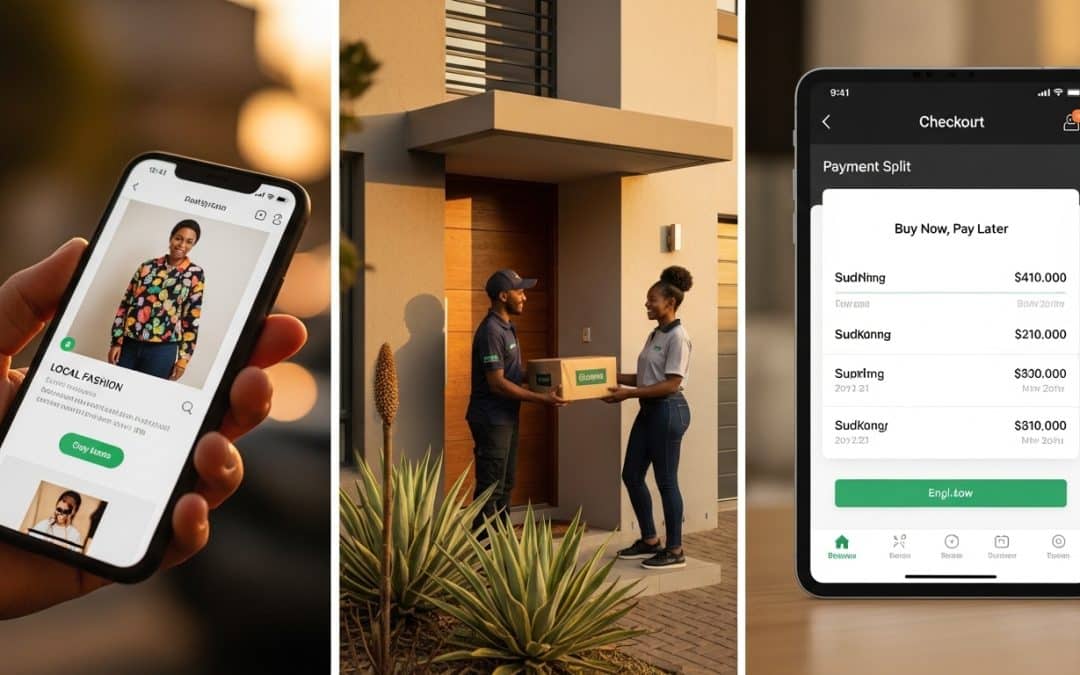
SA online retail grew 38% in 2025 while physical retail managed under 3% — and the ecommerce trends driving that gap are accelerating in 2026, not slowing down. Mobile purchases now account for over 71% of all online transactions, buy-now-pay-later has doubled adoption, and global players like Amazon, Shein, and Temu are forcing local retailers to compete on speed, price, and customer experience simultaneously. For South African businesses selling online — or planning to — understanding which ecommerce trends are shaping buyer behaviour and which ones are hype determines whether you capture the growth or watch competitors take it. This guide covers the 8 ecommerce trends that are actually reshaping how SA consumers buy online in 2026, what each one means for your store, and which ones require immediate action versus which ones you can monitor. If you are still deciding which platform to build on, start with our Shopify South Africa guide.
SA Ecommerce 2026 — Key Numbers
R130+ billion online retail turnover (2025)
38% annual ecommerce growth rate
~10% of total retail now happens online
71.4% of purchases made on mobile
USD $41.86 billion total SA ecommerce market value
8.54% projected CAGR through 2031
Want to know which of these trends matter most for your specific store — and which ones you can safely ignore? We will assess your business and give you a prioritised action list.
Get a Free Ecommerce Trend AssessmentEcommerce Trends SA 2026: Mobile Commerce Dominance
The most important ecommerce trend in South Africa is not new — but its scale in 2026 is. Mobile devices now account for 71.42% of all B2C ecommerce transactions, 98.4% of SA internet users access the web via mobile, and median mobile download speeds improved 27.3% year-on-year to 66.15 Mbps. Mobile commerce in SA is no longer a trend — it is the default.
For SA online stores, the implication is binary: either your entire customer experience — from product discovery through checkout — works flawlessly on a 5-inch screen, or you are losing the majority of your potential sales at every stage of the funnel.
What mobile-first means in practice: Product images load in under 2 seconds. Add-to-cart buttons are thumb-reachable. Checkout requires fewer than 3 taps after cart review. Payment options include one-tap solutions like PayFast and Ozow. Delivery estimates appear before checkout, not after. Every one of these elements affects your mobile conversion rate — and mobile is where 71% of your sales happen.
What mobile-last looks like: Desktop-designed product pages that require pinch-to-zoom. Checkout forms with 15 fields. Payment redirects that break on mobile browsers. Pop-ups that cover the entire mobile screen with no visible close button. If any of these describe your store, you are losing sales every hour of every day from the 71% of shoppers who visit on mobile.
Ecommerce Trends SA 2026: Buy Now Pay Later Explosion
Buy-now-pay-later is one of the fastest-growing ecommerce trends in South Africa — BNPL transaction volume is projected to double by 2026 according to the Payments Association of South Africa, and SA stores offering BNPL options see average order values 60–70% higher than single-payment purchases.
The leading BNPL platforms for SA ecommerce stores are Payflex (now part of Zip), PayJustNow, and Float. All three integrate with Shopify and WooCommerce, and all split purchases into interest-free instalments that the platform finances — meaning the store receives full payment upfront while the customer pays over time.
| BNPL Platform | How It Works | SA Ecommerce Impact |
|---|---|---|
| Payflex | 4 interest-free payments over 6 weeks | Widely recognised SA brand — strong consumer trust |
| PayJustNow | 3 interest-free payments over 3 months | Growing adoption — integrates with major SA platforms |
| Float | Flexible repayment up to 4 months | Newer entrant — competitive terms for merchants |
Key Takeaway
BNPL is not just a payment option — it is a conversion and average order value strategy. SA stores offering BNPL see 60–70% higher average order values because customers who would hesitate to spend R2,000 in one payment will readily spend R2,500 when split into four payments of R625. If your store does not offer BNPL, you are losing high-value orders to competitors who do — especially in fashion, electronics, and home goods where cart values regularly exceed R1,000.
Ecommerce Trends SA 2026: Global Marketplace Competition
The arrival of Amazon South Africa, combined with the rapid growth of Shein and Temu, is one of the most disruptive ecommerce trends reshaping the SA market — Shein and Temu together captured 3.6% of SA retail clothing, footwear, and leather market share going into 2025, and that share is growing.
For local SA retailers, this competitive pressure creates both a threat and an opportunity:
The threat: Global marketplaces compete on price, variety, and marketing budget that local stores cannot match. A SA fashion store selling a dress at R899 competes directly with Shein selling a visually similar item at R199. On price alone, local retailers lose — and Google Shopping makes that price comparison visible before the shopper even clicks.
The opportunity: Local SA retailers hold three advantages global marketplaces cannot replicate: faster delivery (same-day and next-day through Checkers Sixty60, Pargo, and The Courier Guy versus 2–4 week international shipping), easier returns (local returns versus international shipping hassles), and stronger consumer trust (SA shoppers trust local brands they can contact by phone). SA stores that lean into speed, service, and trust — rather than competing on price — will retain and grow market share despite global competition.
Worried about global competition eating into your ecommerce sales? We will analyse your competitive position and show you where your advantages actually are — free, no obligation.
Get a Free Competitive AnalysisEcommerce Trends SA 2026: Email Marketing as the Highest-ROI Retention Channel
As customer acquisition costs rise across Google Ads and Meta, one of the most important ecommerce trends in SA is the shift from acquisition-focused marketing to retention-focused marketing — and email marketing is the channel driving that shift.
SA ecommerce stores with properly configured email automation generate 20–30% of total store revenue through email — abandoned cart recovery, welcome sequences, post-purchase flows, and broadcast campaigns working together as a system. Stores without automation typically generate under 5% from email, meaning they re-acquire every customer from scratch through paid ads at increasing cost.
| Retention Metric | Without Email Automation | With Email Automation |
|---|---|---|
| Email revenue as % of total | Under 5% | 20–30% |
| Abandoned cart recovery | 0% (no recovery mechanism) | 10–20% of abandoned carts recovered |
| Repeat purchase rate (60 days) | 8–12% | 15–25% |
| Customer acquisition dependency | 95%+ from paid ads | 70–80% from paid ads, 20–30% from email |
For SA stores on Klaviyo or Omnisend, the automation setup takes days, not months. The ROI is measurable within the first 30 days from abandoned cart recovery alone. This is not a future trend — it is a current competitive requirement that separates growing SA stores from stagnating ones.
Ecommerce Trends SA 2026: AI-Powered Personalisation
AI-driven personalisation is one of the ecommerce trends gaining real traction in SA — 78% of South African marketers now report using AI for personalised customer experiences, and the ecommerce platforms that enable it (Klaviyo, Shopify, and Omnisend) are making it accessible to stores of every size, not just enterprise retailers.
For SA ecommerce stores, practical AI personalisation in 2026 means product recommendations based on browsing history, email subject lines optimised by AI for higher open rates, dynamic product blocks in emails that show items the customer has viewed, and predictive send-time optimisation that delivers emails when each subscriber is most likely to open them.
Key Takeaway
AI personalisation in ecommerce is not about futuristic technology — it is about the features already built into the platforms SA stores are using. Klaviyo's predictive analytics, Omnisend's smart segmentation, and Shopify's product recommendation engine are all AI-powered features available on current plans. The stores that activate these features see measurably higher conversion rates and average order values. The stores that ignore them serve the same generic experience to every visitor regardless of behaviour or purchase history.
Ecommerce Trends SA 2026: Same-Day and Next-Day Delivery
Delivery speed has become one of the defining ecommerce trends in South Africa — driven by Checkers Sixty60 surpassing 100 million cumulative orders and setting an expectation for speed that every SA retailer now competes against.
For non-grocery SA ecommerce stores, the practical implication is that 2–5 day delivery is no longer competitive for metro areas. SA shoppers in Johannesburg, Cape Town, Durban, and Pretoria now expect next-day or same-day options — and stores that offer them see higher conversion rates, lower cart abandonment, and stronger repeat purchase behaviour compared to stores offering standard 3–5 day shipping only.
How SA stores are competing on speed: Pargo's 3,000+ pick-up point network lets customers collect orders within hours of dispatch. The Courier Guy and Aramex offer next-day metro delivery for orders dispatched before 2pm. uAfrica and Bob Go integrate directly with Shopify to show live delivery estimates at checkout based on customer location. Displaying "Delivered tomorrow" at checkout converts more shoppers than displaying "Delivered in 3–5 business days."
Ecommerce Trends SA 2026: Social Commerce and Discovery
Social commerce — buying products directly through social media platforms — is an ecommerce trend growing faster in SA than in most markets because South Africans spend an average of 9 hours and 23 minutes online daily, with 98.25% of users engaging regularly on social platforms.
The practical application for SA stores is not selling directly through social media (platform checkout adoption is still low in SA) but using social platforms as discovery engines. Instagram product tags, Facebook Shops, TikTok product showcases, and WhatsApp Business catalogues all drive traffic to your store — and for visually driven categories like fashion, beauty, home decor, and food, social discovery is becoming as important as Google search for initial product awareness.
Ecommerce Trends SA 2026: Data Privacy and POPIA Compliance
Data privacy is an ecommerce trend that SA businesses cannot afford to treat as a checkbox exercise — POPIA violations carry fines of up to R10 million, and consumer awareness of data rights is growing alongside enforcement activity from the Information Regulator.
For SA ecommerce stores, POPIA compliance in 2026 means explicit opt-in for all marketing communications (no pre-ticked boxes), clear privacy policies explaining what data you collect and why, easy unsubscribe mechanisms in every email, and proper cookie consent notices on your website. Every reputable email platform — Klaviyo, Omnisend, and Mailchimp — handles the technical compliance mechanisms automatically, but the responsibility for obtaining and managing consent sits with the business.
Ecommerce Trends SA 2026: What These Trends Mean for Your Store
Not every ecommerce trend requires immediate action from every SA store. Here is how to prioritise based on your business stage:
If you are launching a new store: Build mobile-first from day one (non-negotiable). Set up email automation before launch — abandoned cart recovery and welcome sequence. Offer at least one BNPL option. Use a SA courier with next-day metro capability. These four elements are the baseline for a competitive SA store in 2026.
If you are an established store doing R100K–R500K/month: Audit your mobile conversion rate — if it is below 2%, your mobile experience needs work. Activate AI personalisation features in your email platform. Add BNPL if you have not already. Invest in ecommerce SEO to reduce paid acquisition dependency. These optimisations compound — each one adds 5–15% to revenue without increasing ad spend.
If you are scaling past R500K/month: Implement advanced email segmentation with predictive analytics. Build a same-day delivery option for metro areas. Develop a social commerce strategy for discovery. Invest in Google Shopping and Performance Max campaigns. At this stage, the margin gains from AI personalisation and retention marketing become your biggest growth lever.
Want a prioritised action plan based on your store's current revenue and growth stage? We will map out which trends to act on now and which ones to monitor — free, no obligation.
Get a Free Ecommerce Growth PlanWhy Growth Pulse Media for Ecommerce in South Africa
Growth Pulse Media is an ecommerce agency that builds and grows South African online stores — not just the store itself, but the marketing engine that drives traffic, converts visitors, and retains customers. We have configured these exact systems — PayFast and Peach Payments integration, SA courier setup through The Courier Guy and Aramex, Klaviyo and Omnisend email automation, and Google Ads campaigns — for SA stores firsthand.
We work with a limited number of ecommerce clients at a time so that every store gets direct access to the person doing the work. Our results are measured in revenue growth and conversion rate improvement — not in reports about impressions and followers. If your store is not at a stage where these trends are relevant, we will tell you what to focus on instead.
Ecommerce Trends: Who This Is NOT For
These ecommerce trends apply to SA businesses selling products online — they are not universal recommendations for every business type.
Not for businesses not yet selling online: If you do not have an ecommerce store, these trends are future planning — not current action items. Build your store first on Shopify or WooCommerce, then apply these trends. The foundation comes before the optimisation.
Not for stores with fewer than 50 orders per month: At very low order volumes, your priority is traffic generation through Google Ads and SEO, not trend optimisation. Get consistent traffic and sales first. AI personalisation and BNPL are powerful at scale but irrelevant if you are not generating enough visitors to justify the setup.
Not for stores chasing every trend simultaneously: Implementing all 8 trends at once with a small team is a recipe for doing everything poorly. Pick the 2–3 that match your current stage, implement them properly, then move to the next. Concentrated execution beats scattered activity every time.
Ecommerce Trends South Africa 2026: Frequently Asked Questions
What are the biggest ecommerce trends in South Africa for 2026?
The biggest ecommerce trends in SA for 2026 are mobile commerce dominance (71% of transactions), buy-now-pay-later adoption doubling, increased competition from global marketplaces like Amazon, Shein, and Temu, email marketing becoming the primary retention channel, AI-powered personalisation going mainstream, same-day and next-day delivery expectations, social commerce as a discovery channel, and POPIA compliance becoming stricter. The most impactful for immediate revenue are mobile optimisation, email automation, and BNPL integration.
How big is the South African ecommerce market in 2026?
The SA ecommerce market is valued at approximately USD $41.86 billion in 2026, with online retail turnover exceeding R130 billion in 2025 at a 38% annual growth rate. Online retail now accounts for nearly 10% of total SA retail sales. The market is projected to reach USD $63.06 billion by 2031 at an 8.54% CAGR. Fashion and apparel lead with 24.67% revenue share, followed by food and beverages as the fastest-growing category.
Is mobile commerce important for SA ecommerce stores?
Mobile commerce is not just important — it is the dominant channel. 71.42% of all B2C ecommerce transactions in SA happen on mobile devices, and 98.4% of SA internet users access the web via mobile. Any SA ecommerce store that is not fully mobile-optimised — fast loading, touch-friendly navigation, simplified checkout — is losing the majority of potential sales. Mobile-first is the baseline, not an option.
Should SA ecommerce stores offer buy now pay later?
Yes — SA stores offering BNPL see average order values 60–70% higher than single-payment purchases. Payflex, PayJustNow, and Float all integrate with Shopify and WooCommerce. The store receives full payment upfront while the BNPL provider finances the customer instalments. For any store where average order values exceed R500, BNPL is a proven conversion and AOV booster that requires minimal setup effort.
How can SA ecommerce stores compete with Amazon, Shein, and Temu?
Local SA retailers compete on three advantages global marketplaces cannot replicate: faster delivery (same-day and next-day through local couriers versus 2–4 week international shipping), easier returns (local returns process versus international shipping hassles), and stronger trust (SA consumers trust local brands they can contact directly). SA stores that lean into speed, service, and personalised customer experience — rather than competing on price — retain and grow market share despite global competition.
The SA ecommerce stores growing fastest right now are the ones that picked 2–3 of these trends and implemented them properly rather than chasing all 8 at once.
Ready to Position Your SA Store for Ecommerce Growth in 2026?
Growth Pulse Media builds and grows South African ecommerce stores — Shopify and WooCommerce setup, PayFast and Peach Payments integration, SA courier configuration, Klaviyo and Omnisend email automation, and Google Ads campaigns. We help SA stores capture the growth that these trends are creating. No obligation — we will get back to you within 24 hours.
Get Your Free Ecommerce Growth Assessment